

Pick up your last electricity bill and look at the name printed at the top. It is not a power plant. It is not NTPC or a dam either. It is your DISCOM, short for distribution company, and it is the last of several organisations that handled the power before it reached your switchboard.
Most explanations of how electricity reaches homes in India stop at “plant, transformer, pole, house”. This one follows the same path, but it also covers who owns each stage, why the house next door can have light when yours does not, and where to go when something is actually wrong.
The journey has three stages, and three different owners
Electricity goes through generation, transmission and distribution. The point worth remembering is that different organisations run each one. The company that makes the power is usually not the one that carries it, and neither of them sends you the bill.

Stage 1: Generation
Whatever the fuel, a power plant does one basic thing: it turns a shaft attached to a generator. Burning coal or gas makes steam or hot gas that spins a turbine. A dam sends falling water through one. A nuclear reactor boils water for the same purpose. Wind pushes the blades directly. Ordinary solar panels are the odd one out, because they produce electricity straight from sunlight and have nothing that spins.
India uses all of these. Coal has carried most of the load for decades, hydro plants are handy because they can start and stop quickly, nuclear plants run steadily in the background, and wind and solar keep growing. I have left exact shares out on purpose, since they change every year. The Central Electricity Authority publishes the current numbers.
The plants belong to three groups: central government companies such as NTPC, state generation companies, and private companies. Their power does not go to their own customers. It goes into the grid, a shared network that everyone draws from.
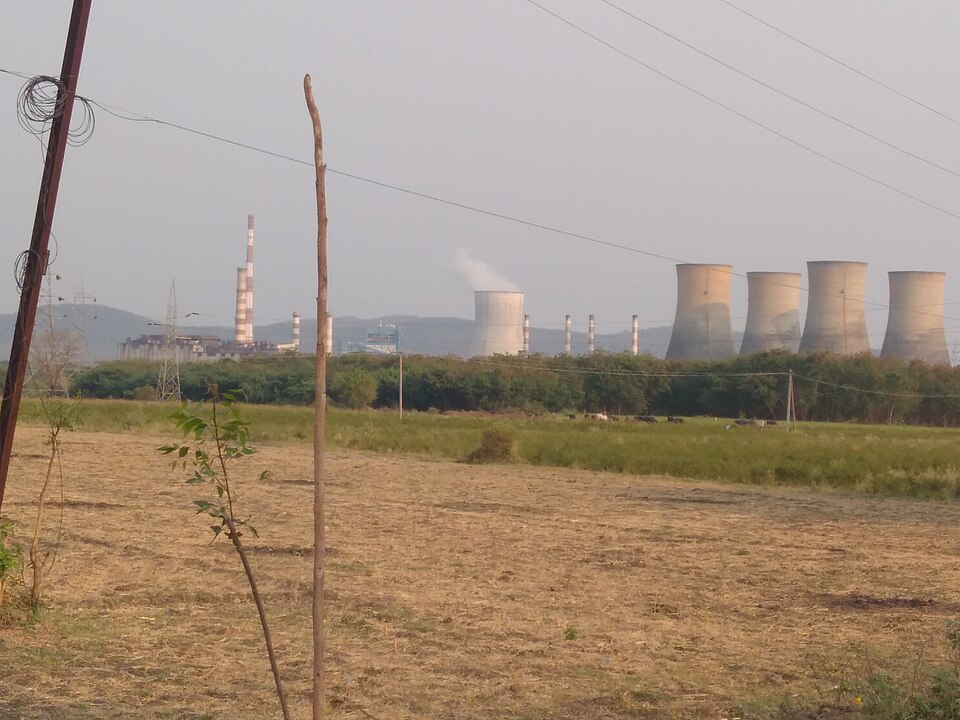
A generator puts out power at a fairly low voltage, somewhere around 11 to 25 kV depending on the plant. That is far too low to send across a state, which is where the next stage begins.
Stage 2: Transmission
Why the voltage goes up before the power travels
Wires warm up when current flows through them, and that heat is wasted energy. The loss grows with the square of the current. Double the current and you lose four times as much.
A transformer lets you swap current for voltage. For the same amount of power, a higher voltage means a lower current. So the power is stepped up, travels hundreds of kilometres with little loss, and is stepped down again near the place that needs it.
The voltage ladder
On the way from the plant to your wall socket, the voltage steps down several times. The levels below are the ones commonly used in India, though not every state uses every one.
| Level | Typical voltage | Where you will notice it |
|---|---|---|
| Extra-high-voltage transmission | 765 kV, 400 kV, 220 kV | Tall lattice towers crossing fields and highways |
| High-voltage transmission | 132 kV | Large substations on the edge of cities |
| Sub-transmission | 66 kV or 33 kV | Substations that feed a town or a group of villages |
| Primary distribution | 11 kV | Lines along roads, ending at the transformer in your lane |
| Low-tension (LT) supply | 415 V three-phase, 230 V single-phase | The wires that reach your meter and your sockets |

One grid, many control rooms
All this equipment is tied into one national grid. For a long time India’s regional grids worked mostly on their own, with limited links between them. The five regions, North, East, West, North-East and South, were joined step by step. When the South was connected in 2013, the whole country began running on a single frequency.
Why should you care? The grid has very little storage, so supply has to match demand at every moment. If one state’s demand jumps on a hot evening, power can flow in from another region. A chain of control rooms watches over this, called load despatch centres: one for each state (SLDC), one for each region (RLDC), and a National Load Despatch Centre (NLDC) on top. The regional and national ones are run by Grid-India, earlier known as POSOCO. Long inter-state lines are mostly built and run by Power Grid Corporation of India, while each state has its own transmission company for the lines inside its borders.
Stage 3: The last few kilometres to your home
This is where the DISCOM takes over, and it is also the answer to the question of how power is distributed to a house.
At a substation near your town, the voltage is brought down to 11 kV. From there, feeders carry it along roads and through neighbourhoods. A feeder is simply an 11 kV line that serves one section of a town or a group of villages.
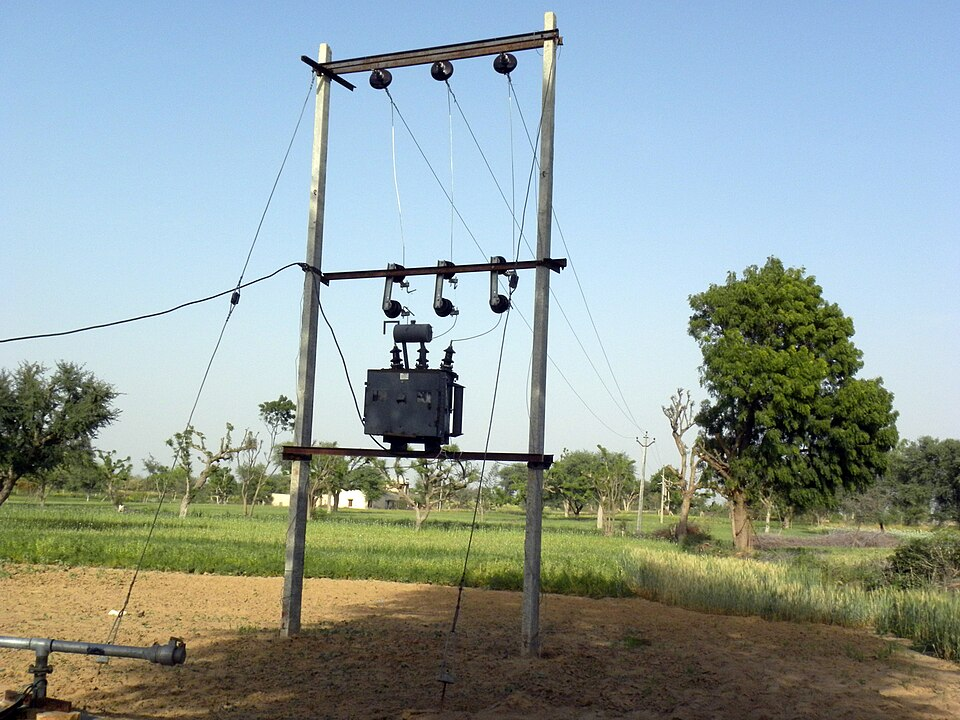
Near your lane you will see a distribution transformer, either on a pole or on a platform on the ground. It brings 11 kV down to 415 V. From the transformer, thin LT wires run through the lane. Most homes take a single phase at 230 V. Larger homes and shops with heavy machinery may take all three phases at 415 V. A service wire goes from the pole to your meter, then to your main switch, your MCB, and finally your house wiring.
Who actually runs what
| Job | Who does it |
|---|---|
| Making power | Central government companies, state generation companies, private companies |
| Carrying it between states | Power Grid Corporation of India and other licensed transmission companies |
| Carrying it inside a state | The state transmission company |
| Balancing supply and demand | Load despatch centres (state, regional and national) |
| Delivering it, reading your meter, sending the bill | Your DISCOM. Most are owned by state governments, though a few cities, such as parts of Delhi and Mumbai, are served by private companies |
| Deciding the tariff | The State Electricity Regulatory Commission |
The Electricity Act, 2003 is the main law behind this arrangement. In practice it means money flows backwards along the chain. You pay the DISCOM, and the DISCOM pays the transmission and generation companies upstream. When a DISCOM is short of cash, it can end up buying less power or paying late, and in some states that shows up as longer outages.
Why your neighbour has power and you don’t
Start with the dull explanation: the fault may be inside your own house. Check your main switch and MCB before anything else. If one has tripped, the problem is yours.
If everything inside looks fine and the house next door is lit, the cause is usually on the network side:
- A different phase. Houses in the same lane can be connected to different phases of the LT line. A fault on one phase darkens only the homes on that phase.
- A blown fuse or loose joint on your service wire or at the meter.
- A different transformer or feeder. Parts of the same colony are sometimes fed from different points.
- An overloaded transformer that tripped or whose fuse blew.
If the whole lane is dark, the transformer or feeder is the likely cause, and only the DISCOM can fix it. If only you or a few houses are dark, say so when you call, and mention that it looks like a phase or service-line problem. It helps them send the right crew the first time.
Why power cuts happen
An outage and load shedding are not the same thing. An outage is something going wrong or being repaired. Load shedding is a deliberate cut made because there is not enough power to go around.
The usual causes of outages are repair and maintenance shutdowns, faults from storms, tree branches, birds or a cable cut by road digging, and heavy evening demand in summer that overloads a transformer.
Shortages are a separate problem. They can come from fuel supply trouble at power plants, from a DISCOM that cannot afford to buy more power, or from a mismatch between what the state demands and what it has contracted.
There is also a structural reason that explains many rural cuts. In many areas, farm pumps and household connections once hung on the same feeder, so cutting power to farms meant cutting homes as well. Feeder separation under the Deen Dayal Upadhyaya Gram Jyoti Yojana was meant to give farms and homes their own lines, so that one could be managed without the other.
Are all villages in India electrified?
On paper, yes. As reported by the states, all inhabited census villages stood electrified by 28 April 2018, and the Ministry of Power has said so in Parliament. But “electrified village” has a narrow technical meaning, and it is easy to read more into it than it says.
Under the Ministry of Power’s definition, in use since 2004-05, a village counts as electrified if three things are true:
- basic infrastructure, such as a distribution transformer and lines, is in place in the inhabited area and in the dalit basti or hamlet where there is one;
- public places such as schools, the panchayat office and health centres have electricity; and
- at least 10% of the households in the village are connected.
The gram panchayat certifies this each year, as on 31 March. The definition says nothing about how many hours of supply a village gets, and the government itself has confirmed that minimum supply is not part of it. So a village can be “electrified” while many of its houses are not connected, and while the ones that are connected get only a few hours of power.
The 2011 Census shows the gap. A Lok Sabha answer put rural households at 16.78 crore, of which 9.28 crore had electricity, a little over half. The household connection drive came later through the Saubhagya scheme, launched in October 2017, which aimed to connect all willing households that still had none. Hours of supply is a different matter again, and it still varies from state to state.
How your bill is put together
An electricity bill looks complicated, but it is built from a few parts:
- Fixed charge. You pay this every month, even if you use nothing. It is usually linked to your sanctioned load.
- Energy charge. This is the rate per unit of electricity you use. One unit is one kilowatt-hour: a 1,000-watt appliance running for an hour. In many states the rate rises in slabs, so the more you use, the more each additional unit costs.
- Other charges. Many bills also include a fuel or power-purchase cost adjustment, electricity duty and taxes.
- Subsidy. Some states give subsidies to certain groups of consumers, which show up as a deduction.
The rates are not set by your DISCOM alone. The DISCOM files a proposal, the State Electricity Regulatory Commission examines it, often with public hearings, and then approves the tariff. That is a large part of why the same one unit costs a different amount in different states. Local power purchase costs and each state’s subsidy policy also play a role. Even how often you get a bill, monthly or every two months, depends on the state.
What is sanctioned load?
Your bill shows a number called sanctioned load, or sometimes contract demand, in kilowatts. It is the maximum load the DISCOM has agreed to supply at your connection.
It is not the same as connected load, which is the total rating of everything you have plugged in. You might own several heavy appliances and never run them together. A home sanctioned for a small load can still cross the limit if a geyser, an air conditioner and an induction cooktop are all running at once.
It matters for two reasons. Your fixed charge depends on it, and the service wire, meter and local transformer are sized with it in mind. If your real usage regularly goes past the sanctioned figure, for example after you add an AC or an EV charger, the DISCOM may ask you to apply for a load increase, and some states charge penalties. Check your own state’s rules.
Trace your own supply in five steps
You can do this with nothing more than your latest bill and a short walk down your lane.
- Find your DISCOM’s name and your consumer number on the bill.
- Look for the section or sub-division office printed on the bill. That is the local office responsible for your area.
- Walk to the nearest distribution transformer and note any ID number or pole number on it. Keep your distance and do not touch anything.
- Check whether your DISCOM’s app or website lists planned outages by area or feeder, and save the page.
- Save the complaint number. Many DISCOMs use 1912, but not all, so confirm the one printed on your bill.
Doing this once, on a normal day, saves a lot of time when the power actually goes.
Where to complain, in order
The Electricity Act, 2003 sets up three levels, and the order matters.
- Your DISCOM. Use the customer care number, the app, or the local office. Write down the complaint number.
- Consumer Grievance Redressal Forum (CGRF). Every distribution licensee must set one up under Section 42(5). If the DISCOM does not fix your problem in the time your state’s rules allow, or you are not satisfied, file a complaint here.
- Electricity Ombudsman. Under Section 42(6), if the forum rejects your complaint, gives inadequate relief or does not decide in time, you can appeal to the Ombudsman, who is appointed by your State Electricity Regulatory Commission.
Time limits, forms and fees differ by state, so check the rules on your state regulator’s website. Keep every bill, complaint number and reply.
Frequently asked questions
How is power distributed to a house?
A DISCOM brings it down from a substation on 11 kV feeders, steps it to 415 V at a distribution transformer, and sends it through LT wires and a service wire to your meter.
Does my electricity come from the nearest power plant?
Not necessarily. All plants feed a shared grid, and the power is pooled. Your DISCOM buys from many sources, and the electricity in your wires cannot be traced back to one plant.
Can I choose my electricity company?
For most households, no. You are served by the DISCOM for your area. Some large industrial users can buy power from other suppliers through open access. Rules in this area have been changing, so check the latest position for your state.
What does kV mean?
It stands for kilovolt, which is 1,000 volts. Your home runs on 230 V, while the long-distance lines run on hundreds of kilovolts.
Are all villages in India electrified?
Officially yes, since 2018. But the label covers the village as a unit, and it does not guarantee that every house has a connection or round-the-clock supply. The section above explains the definition.
One last thing
Next time the lights go out, you can ask a better question than “why is there no current?” Is it my house, my lane or the whole area? Is it a transformer, a feeder or a shortage? Each answer points to a different part of the chain, and a different office to call.
Sources and further reading
- Lok Sabha, Unstarred Question 1671, answered 7 March 2013: village electrification criteria
- Lok Sabha, Unstarred Question 4312, answered 11 August 2016: electrified villages and rural households (Census 2011)
- Rajya Sabha, Question 254, answered 20 July 2021: electrified village definition and Saubhagya
- Lok Sabha, Starred Question 231, answered 27 December 2018: all inhabited census villages electrified as on 28 April 2018
- Electricity Act, 2003 (Sections 26 to 28 and 42), Ministry of Power

Hi, I’m Aryan, the writer behind IndiaClarity. I write plain-language explainers on how India’s systems, places and history work. Before I publish, I check facts against primary sources such as official records, Parliament answers, Census data and Acts of law, and I list the sources at the end of each article. If you spot a mistake, write to me at 7brewusaofficial@gmail.com and I will fix it.
1 thought on “How Electricity Reaches Your Home in India: From Power Plant to Meter”