

Most of us read “NH 44” on a signboard the way we read a house number: it is just there. But a national highway number in India works more like a coordinate than a label. Once you know the rule, a number such as 27 or 66 tells you which way the road runs and roughly which part of the country it sits in, before you open any map.
This guide explains where the rule comes from, how to decode any NH number yourself, what happened to old numbers like NH 7 and NH 8, and why people still use them. A few details, such as three-digit numbers and letters after the number, trip people up, so those get their own sections.
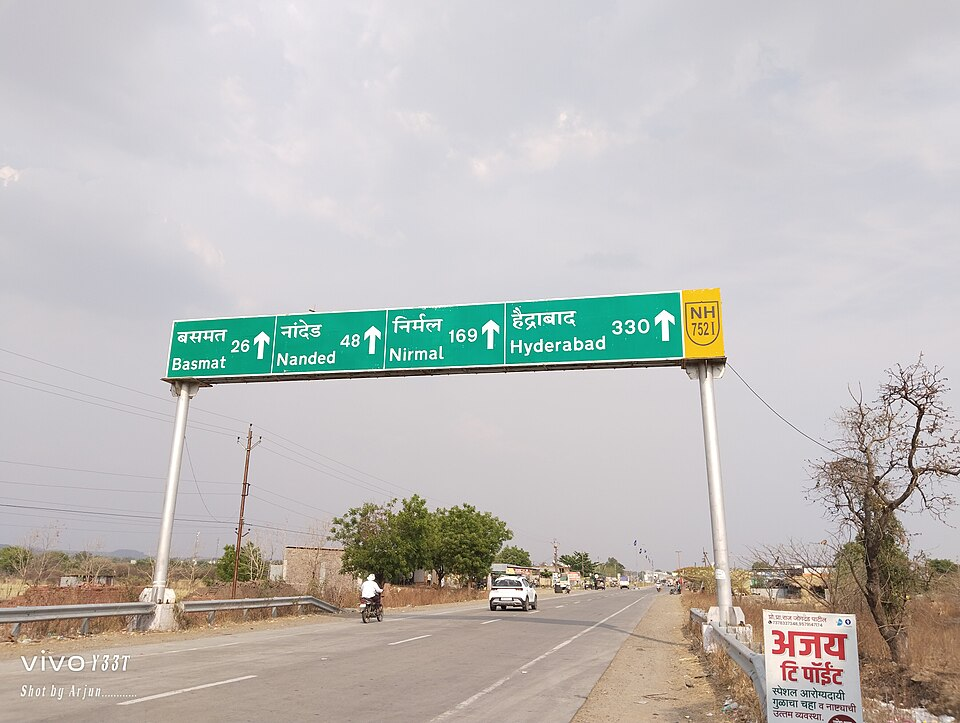
Arjunbansode0143 / Wikimedia Commons,
licensed under
CC BY-SA 4.0.
Why India Changed Its Highway Numbers in 2010
Until 2010, an NH number told you almost nothing. The numbers followed the National Highways Act of 1956 and the order in which roads were added to its list. Seeing a number on a milestone gave no clue about where the road went or which way it pointed.
The bigger problem was that one long route kept changing its name. Take a drive from Srinagar to Kanyakumari. Under the old list you would have started on NH 1A, then moved to NH 1, NH 2, NH 3, NH 75, NH 26 and finally NH 7. That is seven numbers for what is really one north-south line down the country, and nothing in the numbers showed that these stretches belonged together.

In 2010 the Ministry of Road Transport and Highways (MoRTH) published a new numbering scheme in the Gazette of India. The stated aim was to make numbering consistent, and flexible enough to take in new highways without breaking the pattern. That whole Srinagar-to-Kanyakumari line is now a single highway: NH 44.
The Two Rules Behind Every NH Number
The scheme rests on two rules, one about direction and one about position.
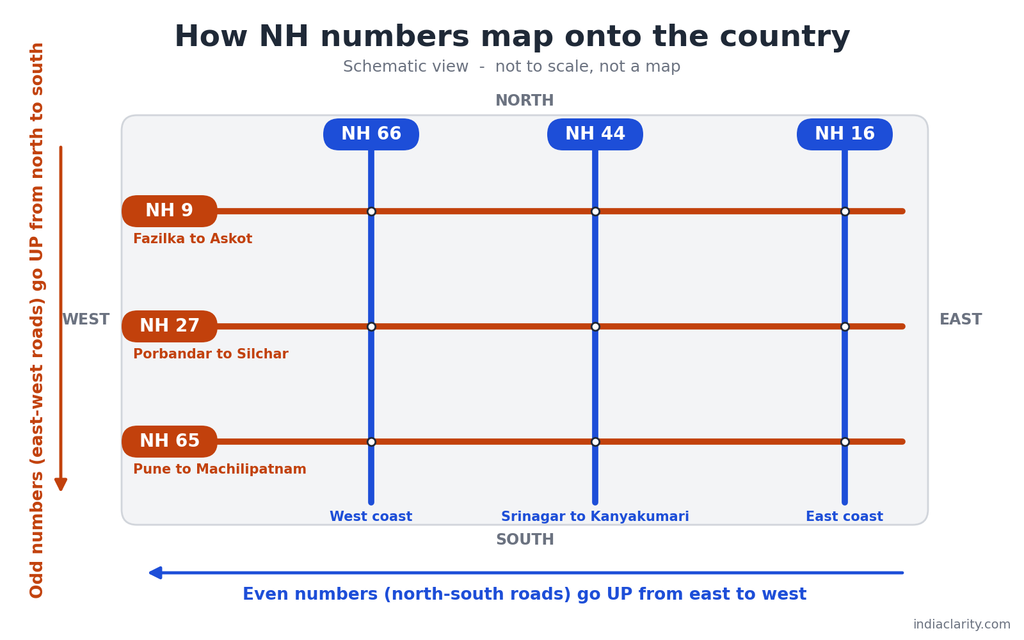
Direction: highways that run north-south get even numbers. Highways that run east-west get odd numbers.
Position: even numbers go up as you move from east to west. Odd numbers go up as you move from north to south.
The second rule is the one most people skip, and it is the useful one. It means the number also acts like a rough map reference. Compare NH 16 and NH 66, both even. NH 16 is the road along the east coast, from West Bengal down to Chennai. NH 66 hugs the west coast. You can tell which is which without a map: 16 is the one near the Bay of Bengal, 66 is the one near the Arabian Sea.
| Number | Direction | Route (in short) | Where it sits |
|---|---|---|---|
| NH 16 | North-south (even) | West Bengal to Chennai, along the east coast | Far east of the even group |
| NH 44 | North-south (even) | Srinagar to Kanyakumari | Through the middle of the country |
| NH 66 | North-south (even) | Along the west coast down to Kanyakumari | Arabian Sea side |
| NH 9 | East-west (odd) | Fazilka in Punjab to Askot in Uttarakhand, via Delhi | Far north |
| NH 27 | East-west (odd) | Porbandar in Gujarat to Silchar in Assam | Across northern India into the north-east |
| NH 65 | East-west (odd) | Pune to Machilipatnam, via Hyderabad | Peninsular India, south of NH 27 |
The United States does it the other way round, with odd numbers for north-south roads. Drivers who know American highways sometimes get India’s pattern backwards at first.
One, Two and Three Digits: Main Roads and Their Branches
Main highways carry one or two digits. When a road branches off a main highway, it gets a three-digit number. The branch number is a serial digit placed in front of the main highway’s number. So NH 144, NH 244 and NH 344 are all branches of NH 44, and NH 766 is a branch of NH 66.
A branch is not always a short side road. The official description of NH 244 in Jammu and Kashmir says it begins at NH 44 near Nashri, runs through Batote, Kishtwar and Sinthan Pass, and ends back at NH 44 near Khanabal. It leaves the main highway and rejoins it later, so it works as an alternative route rather than a dead-end spur.
Letters after the number, such as A, B, C and D, mark smaller spurs or stretches of a sub-highway. The rule describes them as “very small”, but in practice size varies a lot. NH 766EE in Karnataka is only about 4 km long, running from Hattikeri to Belekeri Port. NH 766E, from the same family, runs from Kumta on NH 66 to Haveri, a stretch of roughly 130 km. Under the old system, NH 1A ran for 663 km, longer than many main highways. So a letter tells you a road is attached to a parent, not that it is small.
How to Decode Any NH Number in 10 Seconds
You do not need to memorise any list. Three quick checks are enough.
Step 1: Count the digits. One or two digits means a main highway. Three digits means a branch. Drop the first digit to find the parent, so 244 comes from 44.
Step 2: Check even or odd on the main number. Even means the parent runs north-south. Odd means east-west.
Step 3: Compare with an anchor. For even numbers, think of 16 on the east coast, 44 in the middle and 66 on the west coast. For odd numbers, think of 1 at the very top, 27 across the north and 65 in the peninsula.

| Number | How to read it | What it actually is |
|---|---|---|
| NH 1 | One digit and odd, so east-west. The lowest odd number means the northernmost. | Uri to Leh through Srinagar and Kargil, in Jammu and Kashmir and Ladakh. Published lengths vary from about 524 km to 534 km. |
| NH 48 | Even, so north-south. Higher than 44, so it should lie west of NH 44. | Delhi to Chennai, taking the Jaipur, Ahmedabad, Mumbai, Pune and Bengaluru side of the country. |
| NH 244 | Three digits. Parent is NH 44, which is even, so a north-south parent. | A branch in Jammu and Kashmir from NH 44 near Nashri to NH 44 near Khanabal. |
| NH 766E | Parent is NH 66. The letter E marks a spur. | A spur from Kumta on NH 66 to Haveri in Karnataka. |
Old Number to New Number: What Actually Happened
Matching old numbers to new ones is where most confusion starts, because the change was not one-to-one. Some old highways were merged, and some were split. According to the 2010 renumbering list, the old NH 8 ended up as parts of NH 48, NH 58, NH 64 and NH 448. The old NH 4 became parts of NH 40, NH 48, NH 69 and NH 75. So one old number can scatter into several new ones.
| Old number | Old route | Now |
|---|---|---|
| NH 1 | Delhi – Ambala – Jalandhar – Amritsar – Attari | NH 44 and NH 3 |
| NH 1A | Jalandhar – Jammu – Srinagar – Uri | NH 44 and NH 1 |
| NH 7 | Lakhnadon section down to Kanyakumari | NH 44 |
| NH 8 | Delhi – Jaipur – Ahmedabad – Mumbai | Mostly NH 48, with parts as NH 58, NH 64, NH 448 |
| NH 9 | Pune – Solapur – Hyderabad – Vijayawada – Machilipatnam | NH 65 |
| NH 10 | Delhi – Rohtak – Sirsa – Fazilka section | NH 9 |
| NH 24 | Delhi – Rampur section | NH 9 |
There is a trap in this table. Some old numbers were reused for different roads. The old NH 9 was the Pune-Machilipatnam road, which is now NH 65. The new NH 9 is a completely different road from Fazilka through Delhi to Askot, built from pieces of the old NH 10, NH 24, NH 87, NH 74 and NH 125. The same happened with NH 1: the old NH 1 ran from Delhi to Attari, while the new NH 1 is the Uri-Leh highway in the far north. If you read an old article or an old travel blog, check which system it uses before trusting a number.
Why People Still Say NH 8
The new numbers were announced around 2010, but the changeover on the ground was slow. Writers in 2013 described journeys where some stretches had new signboards and others of the same highway still showed the old number. A mapping forum post from 2014 mentioned seeing both NH 7 and NH 44 signs near Bengaluru, which confused first-time drivers. Highways declared after 2010 were numbered directly in the new system, so the network ended up with two layers of numbers living side by side.
Habit did the rest. A driver posting on a car forum in 2019 wrote that NH 8 was now NH 48 but that he, and many others, still preferred to say NH 8. If you search for road conditions, tenders or old news, search both numbers. A report from 2012 will use the old one, and a report from 2022 will probably use the new one.
When the Number Does Not Match the Road in Front of You
The direction rule applies to a highway as a whole, not to every kilometre of it. Long highways bend. NH 48 is classed as north-south because it runs from Delhi down to Chennai, but its last stretch, from Krishnagiri to Chennai, heads mostly east. A driver on that stretch is travelling east on a road with an even number, which can look wrong until you remember the rule is about the whole route.
Roads can also share a number plate. On the stretch between Bengaluru and Krishnagiri, NH 44 and NH 48 run along the same road. So the sign you see there can carry two numbers for one carriageway, which is another reason to read a number as a route name and not as a property of the tarmac under your wheels.
Frequently Asked Questions
Why was NH 7 renamed NH 44?
It was not renamed on its own. The 2010 scheme joined the southern part of the old NH 7 with highways further north to make one Srinagar-Kanyakumari highway. A north-south road needs an even number, and 44 places it in the middle of the east-to-west order.
Are NH 9 and NH 24 the same?
No. The Delhi-Rampur section of the old NH 24 now forms part of the new NH 9, which also took in sections of four other old highways.
Are NH 8 and NH 48 the same?
Mostly on the Delhi-Mumbai side, yes. But NH 48 continues down to Chennai, and some old NH 8 sections now carry other numbers.
Which highway is NH 1 in India?
Today NH 1 is the Uri-Srinagar-Kargil-Leh highway in the north. It was built from parts of the old NH 1A and NH 1D. The old NH 1 from Delhi to Attari now sits mainly under NH 44.
Which is the longest national highway in India?
NH 44 from Srinagar to Kanyakumari. Its length is quoted differently across sources, from about 3,745 km in older lists to over 4,000 km in newer ones, because routes and bypasses change over time.
Reading the Number Next Time You Travel
The scheme is not perfect, and the old numbers will not disappear soon, but it does give every NH number a reason to exist. India’s national highway network was about 1.46 lakh km long in March 2024, and new highways are added to it every year, each fitted into this same pattern. A pattern of this kind is also what makes a six-digit PIN code useful, which is worth a look if you like systems that hide meaning in plain numbers.
Sources and Further Reading
This article draws on the 2010 numbering notification and later gazette notifications published by the Ministry of Road Transport and Highways (morth.nic.in), the 2010 renumbering table and the national highway list on Wikipedia, and highway-by-highway pages for NH 1, NH 9, NH 65 and the NH 766 spurs. Highway lengths and routes get revised over time, so figures here may differ slightly from the latest official list.
Last reviewed: October 2026.
Check also: How Electricity Reaches Your Home in India: From Power Plant to Meter

Hi, I’m Aryan, the writer behind IndiaClarity. I write plain-language explainers on how India’s systems work, from district administration to the power grid. Before I publish, I check facts against primary sources such as Parliament answers, regulator documents and Acts of law, and I list them at the end of each article. If you spot a mistake, write to me at [contact@indiaclarity.com] and I will fix it.
1 thought on “How NH Numbers Work in India: Even, Odd & 3-Digit Rules”