
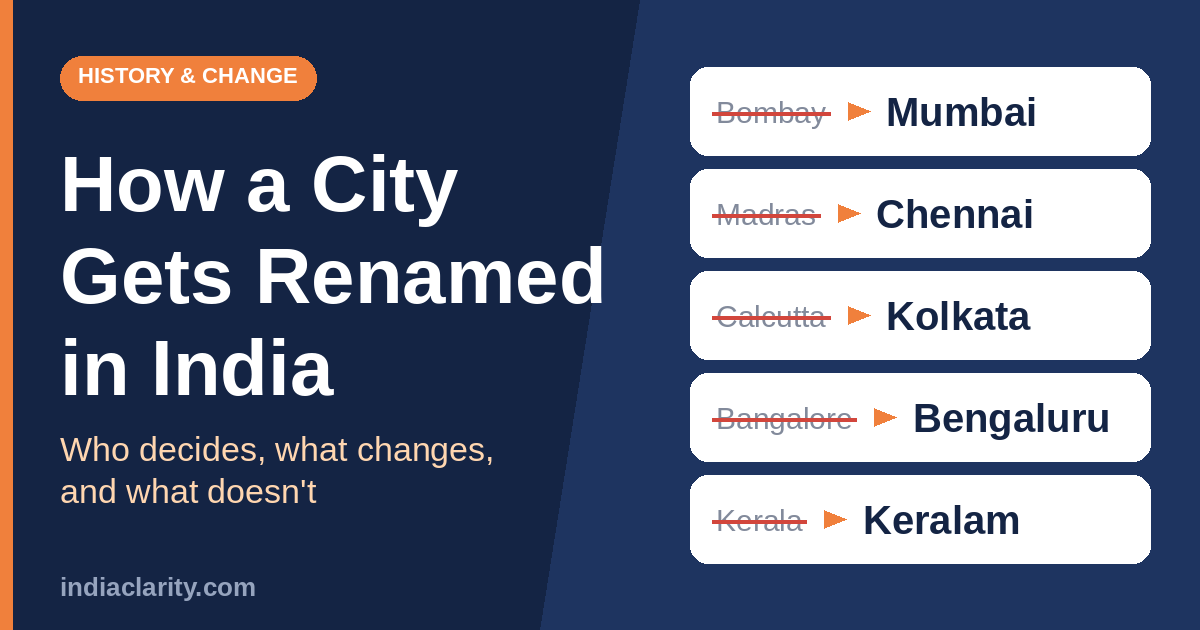
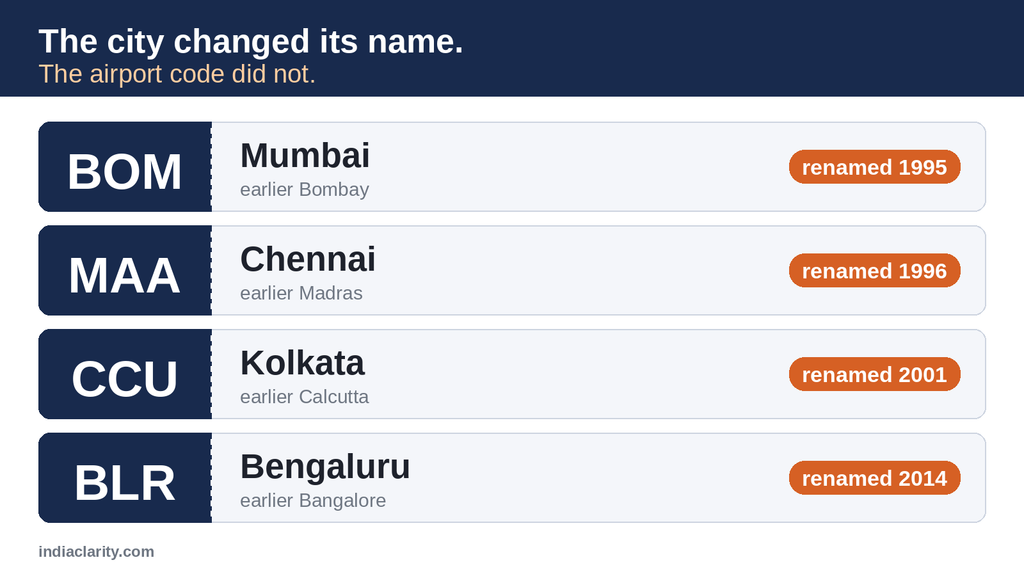
Book a flight to Mumbai and your ticket says BOM. Fly to Chennai and the baggage tag says MAA. Kolkata is CCU and Bengaluru is BLR. None of these letters match the city names we use today, and none of them are mistakes.
They are leftovers from the days of Bombay, Madras, Calcutta and Bangalore. The cities changed their names between 1995 and 2014, but the airport codes stayed exactly where they were. That small gap explains most of how renaming works in India. A name is not one thing kept in one place. It sits inside laws, railway records, court titles, maps and airline systems, and each of these belongs to a different authority.
This article follows the process from the start: who can rename a city or a state, what Bengaluru’s eight-year file looked like, how Kerala became Keralam in August 2026, and which names get left behind every time.
Who owns a name
People say “the government changed the name” as if it were one decision. In practice, the power depends on what is being renamed.
| What is being renamed | Who decides |
|---|---|
| A state | Parliament, by passing a law under Article 3 of the Constitution |
| A city or town | The state government, after the Home Ministry gives a no-objection |
| A railway station | The state proposes and the Home Ministry clears it. The Railways then issue the station code |
| A High Court | Parliament, not the state |
| An airport code | IATA, the airline industry body. No government is involved |
For a state, the route is fixed by Article 3. A Bill to change the name can be introduced only on the President’s recommendation, and the President sends it to that state’s legislature to give its views. Parliament is not bound by those views. The Bill needs only a simple majority, and once it becomes law the First Schedule of the Constitution is amended.
For a city, the Constitution says nothing directly, because land and local areas are state subjects. State laws, such as the revenue codes of Maharashtra and Uttar Pradesh, let the government alter the name of a revenue area through a gazette notification. On top of that sits a Home Ministry practice that goes back to a 1953 letter: the state sends a proposal for the town, city or railway station, and the Home Ministry gives or refuses a no-objection before the notification is issued.
The Home Ministry’s 2005 guidelines tell states to keep a name people are used to unless there is a very special reason, to leave names with a historical connection alone as far as possible, to avoid new names that repeat another town’s name in the state or nearby, and not to rename places only to honour a leader or out of local sentiment. The state is expected to give detailed reasons for the change and for the new name. A district is renamed by the state government as well. Faizabad district became Ayodhya district in 2018 by a state cabinet decision.
Bengaluru: eight years from proposal to signboard
The Bengaluru case is the cleanest example of the city route, because every step left a paper trail.
- December 2005: the writer U R Ananthamurthy suggests, during Karnataka’s golden jubilee year, that Bangalore should officially be Bengaluru.
- 27 October 2006: Karnataka’s proposal for 12 cities reaches the Home Ministry.
- The years in between: the Home Ministry collects no-objections from the Survey of India, the Railways, the Department of Posts, the Ministry of Science and Technology and the Intelligence Bureau. Maharashtra objects to the new name for Belgaum (Belagavi) because of the border dispute between the two states.
- 17 October 2014: the Home Ministry clears the proposal and overrules Maharashtra’s objection. It asks Karnataka to publish each name in Devanagari, Roman and the regional script, and to send the notification to the Surveyor General of India and the Railways, among others.
- 31 October 2014: Karnataka notifies the new names.
- 1 November 2014: the names take effect, on Karnataka Formation Day. Mysuru, Mangaluru, Belagavi, Kalaburagi and Shivamogga change on the same day.
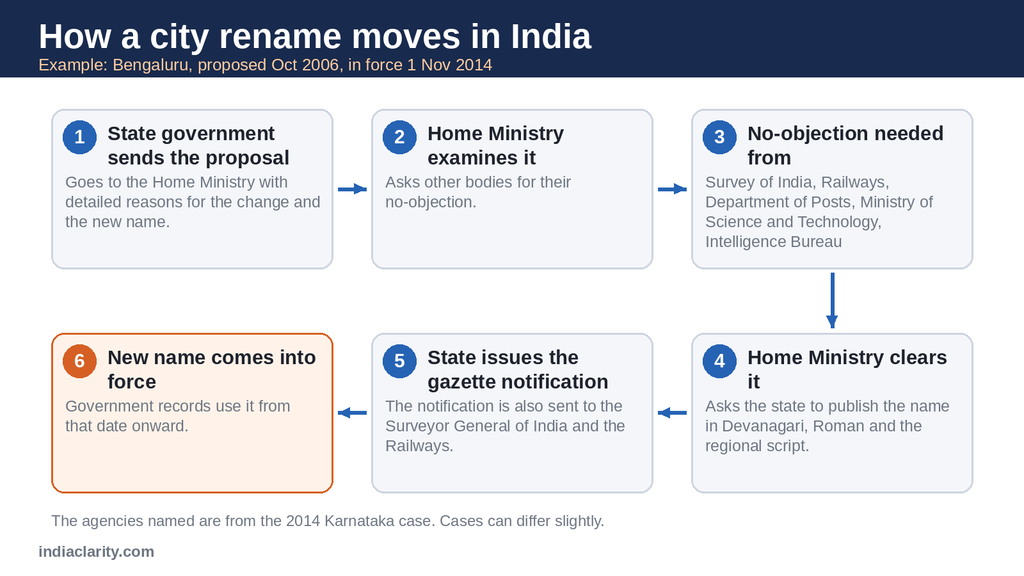
Government records began using the new names from 1 November onward. The change was still not finished that day, because the old spellings were sitting inside various Karnataka laws. The state legislature passed a separate Act to correct them, and it was published in the gazette in January 2017.
Look at what kind of change this was. Bengaluru is the Kannada name. What moved was the English spelling, which the Survey of India writes according to local phonetics. So Bangalore to Bengaluru is a spelling and pronunciation correction more than a new name.
Keralam: how a state gets a new name
Kerala’s change in August 2026 shows the other route, the one that runs through Parliament.
- 24 June 2024: the Kerala Assembly unanimously asks the Centre to change the name to Keralam, the form used in Malayalam.
- 24 February 2026: the Union Cabinet approves the proposal. The President refers the Bill to the Kerala Assembly for its views.
- July 2026: the Assembly unanimously approves it.
- 11 and 12 August 2026: the Lok Sabha and then the Rajya Sabha pass the Kerala (Alteration of Name) Bill, 2026.
- Mid-August 2026: the President gives assent.
- 25 August 2026: the Home Ministry notifies the “appointed day” and the Act comes into force.
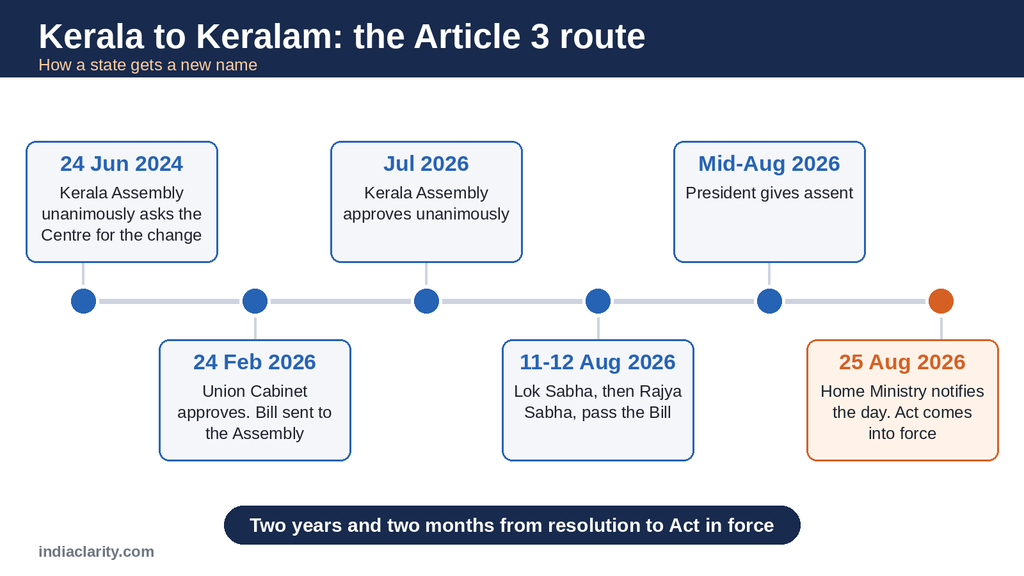
The Act also amends Article 31A, Article 290A and the First Schedule, and it gives governments up to one year after the appointed day to adapt existing laws to the new name. The same pattern we saw in Karnataka shows up again: the name changes on one date, and the paperwork follows over the months after it.
The names that stay behind
This is the part most explainers skip. When a renaming is notified, some things change on that date, some change later, and some never change.
Airport codes. IATA assigns airport codes, and it does not like changing a code once it is printed on tickets, baggage tags and flight charts. Mumbai’s airport was itself renamed after Chhatrapati Shivaji Maharaj, and the code is still BOM.
Railway stations. The Railways run on their own timeline. Allahabad became Prayagraj in October 2018, but Allahabad Junction kept its name for another sixteen months. In February 2020 it became Prayagraj Junction and the code changed from ALD to PRYJ. Three other stations in the city were renamed at the same time: Allahabad City became Prayagraj Rambag, Allahabad Chheoki became Prayagraj Chheoki, and Prayag Ghat became Prayagraj Sangam.
High Courts. Courts are the strangest case. Bombay became Mumbai in 1995, Madras became Chennai in 1996 and Calcutta became Kolkata in 2001, yet the three High Courts still carry the old names. A High Court’s name belongs to Parliament, so a state’s decision about its capital cannot reach it. A Bill to rename them was introduced in the Lok Sabha in July 2016. In 2023 the Law Ministry told Parliament that the Bombay High Court and the Maharashtra and Goa governments had agreed to “Mumbai High Court”. Calcutta High Court and West Bengal had not agreed to a change, and the Madras High Court had not agreed to the “High Court of Tamil Nadu” name that Tamil Nadu suggested. The Orissa High Court has kept its name for about fifteen years after the state became Odisha.
In each of these cases, the owner of the name was someone other than the government that renamed the city.
A new name, or just a new spelling?
Renamings in India are not all the same kind of change. Some correct the English spelling of a local name. Some make the local-language name official. In others, the new name is built on an older name of the place, as with Prayagraj. The table lists six that people ask about most.
| Old name | Current name | Year | What to know |
|---|---|---|---|
| Bombay | Mumbai | 1995 | Marathi and Gujarati speakers always said Mumbai. The name is linked to the local goddess Mumbadevi |
| Madras | Chennai | 1996 | Done through the Madras (Alteration of Name) Act, 1996 |
| Calcutta | Kolkata | 2001 | Closer to the Bengali pronunciation |
| Bangalore | Bengaluru | 2014 | Cleared by the Home Ministry on 17 October 2014, in force on 1 November |
| Allahabad | Prayagraj | 2018 | City renamed in 2018. Railway station renamed in 2020 |
| Kerala (state) | Keralam | 2026 | Act of Parliament, in force from 25 August 2026 |
Questions people ask
Why is Bombay now called Mumbai?
The official change came in 1995. Mumbai is the form that Marathi and Gujarati speakers have always used, and it is linked to the city’s local goddess, Mumbadevi. Bombay was the anglicised form that became common during British rule.
Did Ahmedabad change its name?
No. In November 2018 the Gujarat government said it was considering the name Karnavati and had started consulting on the legal side. A petition against the idea was filed in the Gujarat High Court. I could not find any notification changing the name, and the city is still officially Ahmedabad.
Do private companies have to change their registered names after a renaming?
When Karnataka renamed its 12 cities in 2014, the chief secretary said private firms and organisations would not be compelled to change registered names that referred to those cities. That was one state’s statement for one renaming, so a company should check the position for its own case.
Next time you see BOM on a boarding pass or “Bombay High Court” on a judgment, you will know what you are looking at. It is not a name that was missed. It is a name held by a different authority.
Sources used
- PIB: Cabinet approves alteration of the name of Kerala to Keralam (24 Feb 2026)
- The News Minute: Keralam notified, Act in force on 25 August 2026
- SCC Online: Kerala (Alteration of Name) Bill, 2026 provisions
- Drishti IAS: Article 3 procedure for renaming a state
- PRS India: Karnataka Alteration of Names of Certain Places Act (Act 4 of 2017)
- Deccan Herald: Centre clears renaming of 12 Karnataka cities
- LiveLaw: Procedure for renaming states and cities, including the 1953 and 2005 Home Ministry guidelines
- Rajya Sabha reply (7 Dec 2023): renaming of High Courts
- LiveLaw (Aug 2026): why High Courts keep old names

Hi, I’m Aryan, the writer behind IndiaClarity. I write plain-language explainers on how India’s systems, places and history work. Before I publish, I check facts against primary sources such as official records, Parliament answers, Census data and Acts of law, and I list the sources at the end of each article. If you spot a mistake, write to me at 7brewusaofficial@gmail.com and I will fix it.
2 thoughts on “How a City Gets Renamed in India: Who Decides & What Changes”