
India’s government telegram service ended on 15 July 2013. Sunday, 14 July, was the last day people could book a telegram at a BSNL office. The service had run for more than 160 years, and it closed because very few people still used it while it cost far more to run than it earned.
This article is about the telegram sent through telegraph lines, not the Telegram messaging app. It covers what most news reports of 2013 skipped: how the telegraph reached India, what sending a telegram involved, and what the government’s own figures say about the closure. Where sources disagree, the article says so instead of quietly picking one number.
How the telegraph reached India
The first experiments happened in Calcutta in 1839. William O’Shaughnessy, a doctor who also taught chemistry at the city’s Medical College, set up a short experimental line near the city. It then took more than ten years before anyone with money agreed to back the idea.
In March 1850 the directors of the East India Company approved a trial line between Calcutta and Diamond Harbour, and it was working in 1851. Sources give October, November or December 1851 for the first message and the formal opening, so “1851” is the safe date. O’Shaughnessy was helped by Seebchunder Nandy, a young Indian assistant with strong technical skills.
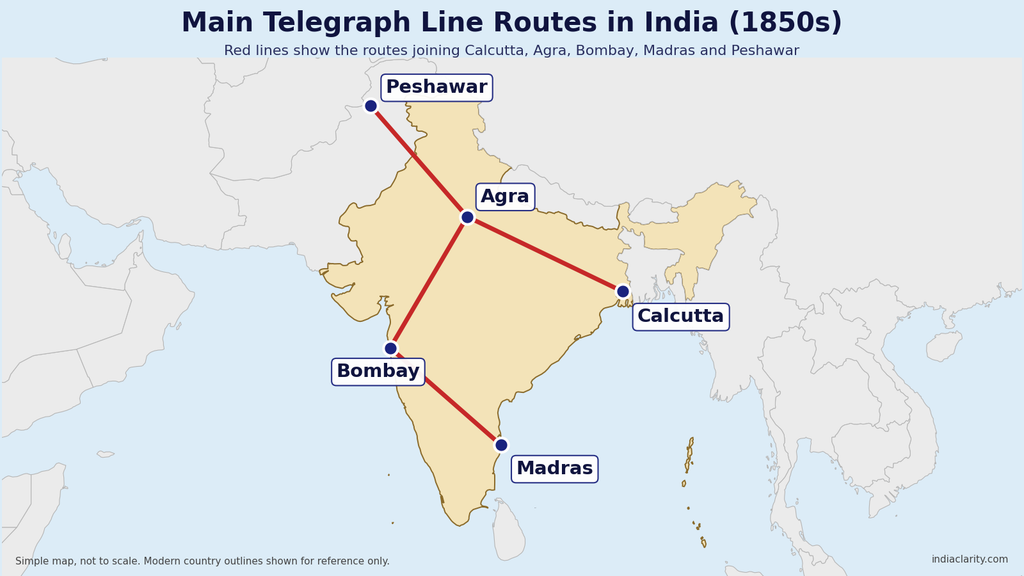
The trial convinced the Governor-General, Lord Dalhousie, to plan a network for the whole country, mostly for military reasons. Work on the main lines began in November 1853. The long line from Calcutta to Agra was working in 1854, and the same year the telegraph was opened to the public.
By the end of 1856, India had about 4,250 miles of telegraph line and 46 receiving offices, linking Calcutta with Agra, Bombay, Madras and Peshawar. O’Shaughnessy became the first Director General of the Indian Telegraph Department. During the 1857 uprising the lines carried military news, and in places such as Meerut and Lucknow the wires were cut.
What sending a telegram involved
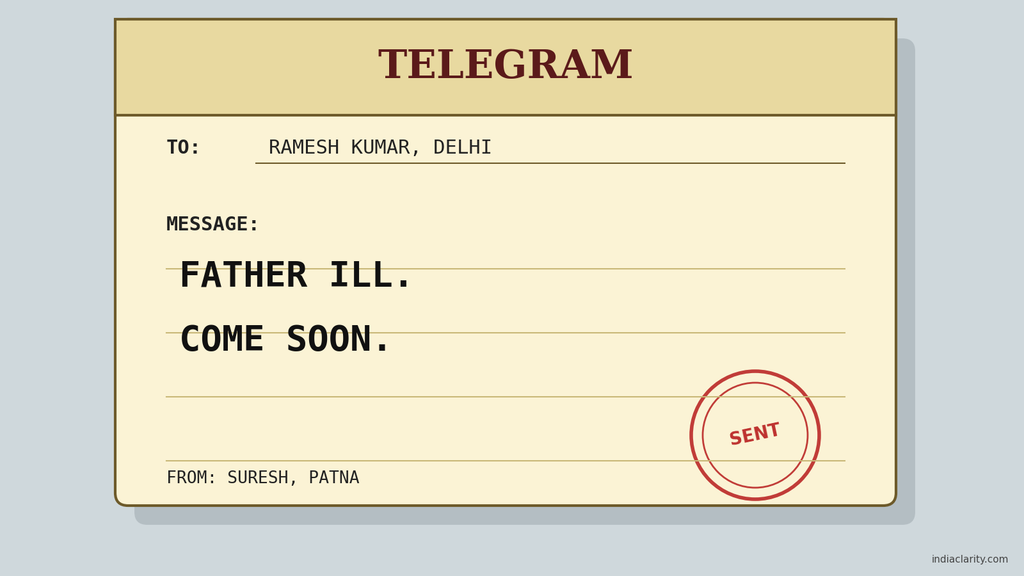
You wrote your message on a printed form. The Department of Telecommunications form was in Hindi and English, with spaces for the sender’s and receiver’s address, a phone number, the message and the sender’s signature. A printed note on it said the department was not responsible for delays, mistakes or non-delivery.
The office counted your words and you paid for each one, so people cut everything they could. A typical message looked like this: FATHER ILL. COME SOON. (This one is made up, but it shows the style.) That clipped way of writing is known as telegraphese.
Greetings had a shortcut of their own. Blogger Ajith Prasad Edassery remembers choosing a numbered greeting code from a printed list for birthdays and weddings, and the office turned the number into a full sentence. Diaries of that time often printed the list at the back. He also recalls that a telegram arriving at the door made families anxious, and that words like “serious” or “unwell” sometimes softened news of a death. That is one person’s memory, not an official record.
At the other end, a postal worker carried the message to the address. A 2013 Deccan Herald report describes people waiting for the knock of the khaki-clad worker delivering it. Over the 160 years the equipment changed from hand-operated keys to printing machines and, finally, computers.
From the post office to BSNL
For most of its history the telegraph was handled together with the post office. The telegraph work moved to the telecom side in 1985, when the postal and telecom departments were separated, and BSNL took over telegram services after it was set up in 2000.
When the numbers started to fall
In 1982-83 India had about 45,000 telegraph offices, and they handled around 75.2 million telegrams in the year, according to figures reported by IANS. Other reports give different peak numbers (one says 60 million in 1985), so treat the exact peak as approximate.
Mobile phones and the internet changed that. CBS News reported that India had 867 million mobile subscriptions by April 2013, more than double the number four years earlier. In the telegram’s last year it handled only about 5,000 telegrams a day, according to reports, which is roughly 1.8 million a year. If both figures are right, that is about one-fortieth of the early-1980s volume.
In May 2011 the government raised telegram charges for the first time in 60 years. An inland telegram went to about ₹27 from a few rupees before. Reports differ on the word limit that this price covered (50 words in most, 30 in one). The hike did not save the service.
Some users stayed to the end. A BSNL official in Jammu said only around 100 telegrams were being booked across the region, mostly by government employees asking for leave extensions or sending and receiving money. Many banks and state governments were also still using the service.
What the official figures show
News reports at the time said the service earned about ₹75 lakh a year against a running cost of over ₹100 crore. A few weeks after the shutdown, on 7 August 2013, the Minister of State for Communications gave Parliament a year-wise table in reply to a Lok Sabha question:
| Year | Revenue (₹ crore) | Expenditure (₹ crore) | Loss (₹ crore) |
|---|---|---|---|
| 2010-11 | 14.87 | 162.08 | 147.21 |
| 2011-12 | 13.07 | 149.37 | 136.03 |
| 2012-13 | 9.89 | 142.68 | 132.79 |
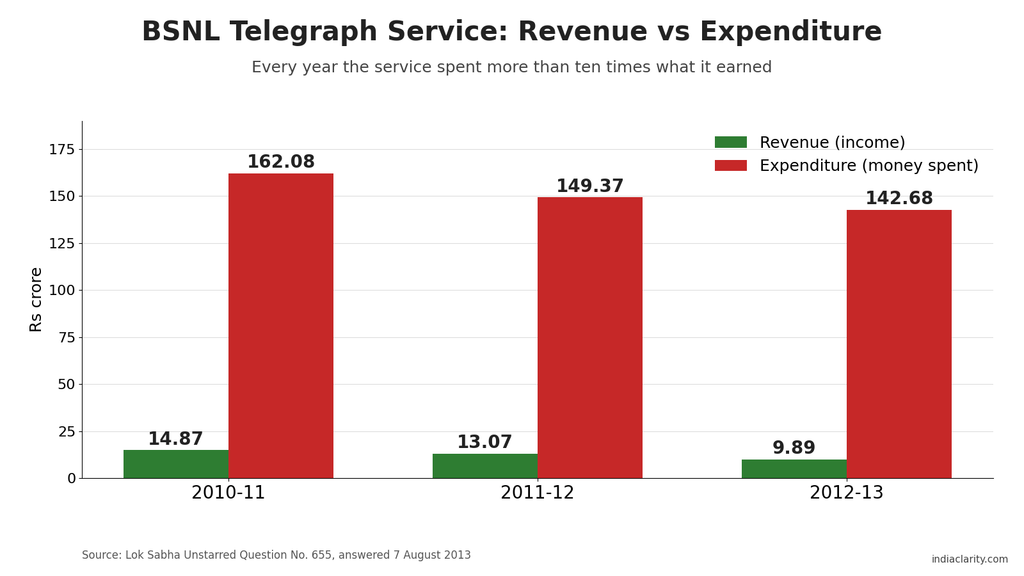
Revenue fell from ₹14.87 crore to ₹9.89 crore in two years, a drop of about a third. Spending fell by only about 12 percent over the same period. In 2012-13, BSNL spent roughly ₹14 for every ₹1 it earned from telegrams.
These numbers do not match the ₹75 lakh and ₹100 crore figures quoted in the news, and neither source explains the gap. If you need an official source, use the Lok Sabha table.
The last day
BSNL’s telegraph services head, Shameem Akhtar, issued a circular dated 11 June 2013 telling all offices to stop booking telegrams from 15 July. On the last day, BSNL’s chairman and managing director, R K Upadhyay, told PTI that booking would run from 8 am to 9 pm and would not be available from Monday.
Reports differ on the final minutes. One says the service stopped at 10 pm. IANS reported that the last telegram went out at around 11:30 pm, sent by Ashwani Mishra of DD News to Congress leader Rahul Gandhi.
About 20,000 telegrams were booked across the country that Sunday, including around 2,200 from Delhi and 1,867 from Kerala, IANS reported. That is about four times the daily number reported for the year before. In Bengaluru’s General Post Office, young and old people, many of whom had never sent a telegram, queued to send a message as a keepsake. BSNL cancelled staff holidays to handle the rush. At closing the service had about 75 offices and around 1,000 employees.
After the shutdown
In its Lok Sabha reply, the government said the telegraph offices were being used by BSNL to serve customers. The staff were moved to Customer Service Centres and other BSNL services, and the government said no employee lost a job because of the closure.
The law written for the telegraph outlived the service by about a decade. The Indian Telegraph Act of 1885 stayed on the books until the Telecommunications Act, 2023, which received the President’s assent on 24 December 2023 and repeals the 1885 Act and the Indian Wireless Telegraphy Act of 1933. Parts of the new Act came into force in stages from 26 June 2024. One part of the 1885 Act, covering transmission lines under section 164 of the Electricity Act, 2003, continues to apply.
Frequently asked questions
Is the telegram service stopped in India?
Yes. The government told Parliament that BSNL’s telegraph services were discontinued with effect from 15 July 2013.
When did the telegram service start in India?
An experimental line between Calcutta and Diamond Harbour was working in 1851, and the telegraph was opened to the public in 1854.
Who introduced the telegraph in India?
William O’Shaughnessy built the first lines, with the backing of the Governor-General, Lord Dalhousie. He later became the first Director General of the Indian Telegraph Department.
Which organisation ran the telegram service at the end?
BSNL, the state-owned telecom company.
Read Also: How a City Gets Renamed in India: Who Decides & What Changes
Sources
- Lok Sabha Unstarred Question No. 655, answered 7 August 2013: eparlib.nic.in
- Journal of the United Service Institution of India, “Did the Telegraph Save the British in 1857?” (2007): usiofindia.org
- The Daily Star, “India says goodbye to telegram” (13 June 2013): thedailystar.net
- Daily Excelsior (PTI), reports on the closure: report 1, report 2 (Jammu)
- Deccan Herald (IANS), “Delhi books highest telegrams”: deccanherald.com
- Deccan Herald, “Telegram comes full stop”: deccanherald.com
- CBS News, “India’s last telegram”: cbsnews.com
- Christian Science Monitor, “India bids farewell to state-run telegram service”: csmonitor.com
- Global News (AP), “Stop… India sends its last telegram”: globalnews.ca
- Indian Philatelists’ Forum, Indian Telegraph Service: indianphilately.net
- Ajith Prasad Edassery, “Telegram Service to Stop in India: Some Childhood Memories” (2013): ajithprasad.com
- Indian Liberals archive, Department of Telecommunications telegram form: indianliberals.in
- Telecommunications Act, 2023: Vikaspedia, AZB & Partners, PRS Legislative Research

Hi, I’m Aryan, the writer behind IndiaClarity. I write plain-language explainers on how India’s systems, places and history work. Before I publish, I check facts against primary sources such as official records, Parliament answers, Census data and Acts of law, and I list the sources at the end of each article. If you spot a mistake, write to me at 7brewusaofficial@gmail.com and I will fix it.