

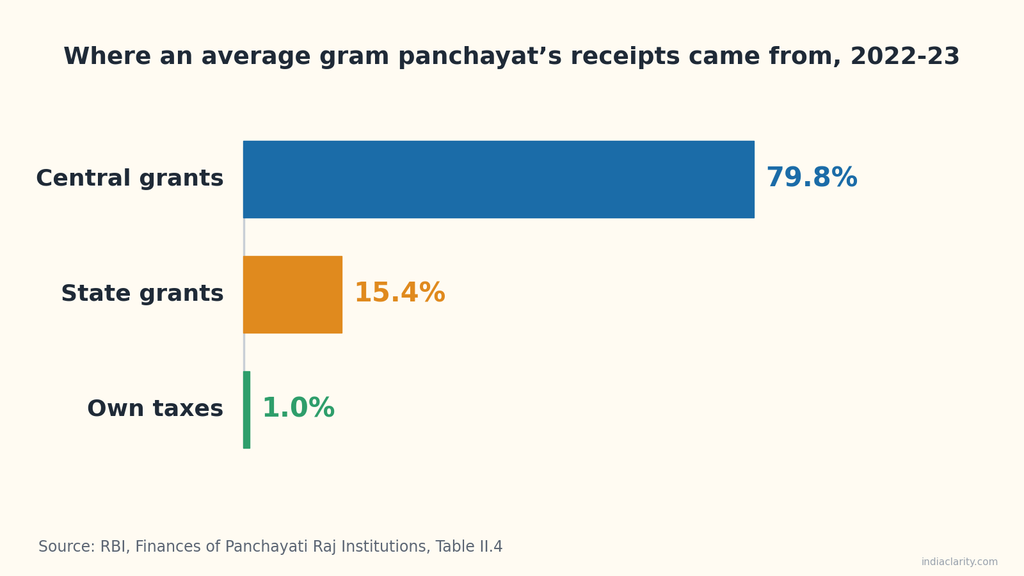
A gram panchayat is expected to handle 29 subjects listed in the Eleventh Schedule of the Constitution, from drinking water and village roads to sanitation and local markets. Now look at how it pays for all of that. When the Reserve Bank of India studied panchayat accounts for 2020-21 to 2022-23, more than 95 per cent of what a typical panchayat received came as grants from higher levels of government. Its own taxes brought in roughly one rupee in every hundred.
So the useful question is not what a panchayat does, but whose money it spends and on whose terms. This article follows that money from its source to the village account: who sends it, what conditions come with it, how it travels, and how you can look up your own panchayat’s accounts. The figures are current as of October 2026, which matters because a new Finance Commission award started this April.
Who gives money to a Gram Panchayat?
Three kinds of senders show up in a panchayat’s books: the Centre through the Finance Commission, the state government, and the schemes run by either. One rule sits above all three. Panchayats are a State subject, and each state’s own Panchayati Raj law decides what its panchayats can do and how much they get, as the Ministry of Panchayati Raj told Parliament in March 2026. That is why the same question gets different answers in different states.
Union Finance Commission grants
Every five years the Union Finance Commission recommends grants that the Centre sends to the states to add to their panchayats’ resources. The constitutional basis is Article 280(3)(bb). Under the 15th Finance Commission, panchayats were allocated ₹2,97,555 crore in total: ₹60,750 crore for the interim year 2020-21 and ₹2,36,805 crore for 2021-26, according to the same PIB release.
The 16th Finance Commission, whose award runs from 2026-27 to 2030-31, recommended ₹4,35,236 crore for rural local bodies. Its report was tabled on 1 February 2026 along with a Finance Ministry memorandum that accepted the local body recommendations. Compared with the 15th Commission’s ₹2,36,805 crore for 2021-26, the new amount is about 84 per cent higher. The grant is meant for all three tiers of the panchayat system, and the gram panchayat is the village-level tier. States get their shares from a formula that gives 90 per cent weight to projected rural population (2026) and 10 per cent to area.
State government money
The second stream is the state’s own. Article 243-I requires every state to set up a State Finance Commission (SFC) every five years to recommend how the state’s revenue should be shared with its local bodies, as the RBI’s study of panchayat finances explains. States also hand over some taxes they collect themselves. Tamil Nadu’s panchayat department, for example, lists a surcharge on stamp duty paid on property transfers and a local cess on land revenue among the assigned revenues that go to village panchayats. That page carries older figures, and every state keeps its own list.
This is the weaker stream. A PRS summary of a July 2025 parliamentary committee report says only 25 of 28 states had constituted State Finance Commissions. The 16th Finance Commission now makes timely SFCs one of the conditions a state must meet to claim local body grants.
The RBI’s numbers show how lopsided the mix is. In 2022-23 an average panchayat got about ₹16.9 lakh from the Centre and about ₹3.3 lakh from its state government. In share terms, central grants were nearly 80 per cent of its receipts and state grants about 15 per cent.
Scheme money
The third stream is money for specific programmes, and it is not free money. Take rural wage work. The MGNREGA was replaced by the VB-G RAM G Act from 1 July 2026, with a Budget allocation of ₹95,692.31 crore for 2026-27 and a 125-day guarantee instead of 100 days. Workers can still register at the gram panchayat, but wages are paid straight into their bank or post office accounts, as Business Standard reported. So this money passes through the village without becoming the panchayat’s own to spend. Many older web pages still describe MGNREGA, which is worth knowing when you compare sources.
How does a Gram Panchayat earn its own money?
What a panchayat may charge is decided by state law, so the list differs from state to state. The account heads the RBI used to sort panchayat income give a good picture of what is possible. On the tax side they include taxes on professions and trades, land revenue, stamps and registration fees, tax on property other than farmland, and vehicle tax. Non-tax income includes fees from markets and fairs, charges for water supply and sanitation, receipts from community assets and interest.
The reality is far smaller than that list suggests. For 2022-23 the RBI shows the average panchayat collecting about ₹21,000 in its own taxes and about ₹73,000 in non-tax income, roughly ₹94,000 in all. A few states do better. Panchayats in Andhra Pradesh, Haryana, Himachal Pradesh, Maharashtra, Tamil Nadu and Telangana generate comparatively more of their own revenue.
The new ₹1,200 yardstick
The 16th Finance Commission wants that to change, and it has tied part of the money to it. The performance grant is 20 per cent of the package and is split into two equal halves, one for panchayat-level performance and one for state performance. The panchayat half is linked to targets for own source revenue. According to an analysis in Down To Earth by V N Alok, a professor of public finance at the Indian Institute of Public Administration, a gram panchayat has to collect at least ₹1,200 per household per year, or meet a growth criterion, to qualify. The exact eligibility rules for each tier sit in the Commission’s report itself; the Finance Ministry’s memorandum points to paragraphs 10.97 to 10.99 of Volume I.
Here is what that means for a village. Take an imagined panchayat with 500 households. At ₹1,200 per household it would need ₹6 lakh a year in its own revenue. That is more than six times the ₹94,000 the average panchayat collected in 2022-23. The comparison is rough, because real panchayats differ a lot in size, but it shows the distance many of them have to cover. Alok himself says the target may work where panchayats already collect taxes and may not work where own revenue is negligible, and he adds that some states have not even framed the rules for it.
The Ministry of Panchayati Raj has been building support for this. According to the PIB release, it developed a training module on own source revenue with IIM Ahmedabad, started an award in 2025 for panchayats that raise their own revenue, and built the SAMARTH Panchayat portal for issuing tax and fee demands and tracking collections online.
How much money does a Gram Panchayat get?
There is no single figure, and the spread is wide. The RBI found that average revenue per panchayat ran from ₹2.7 lakh in Andhra Pradesh to ₹64 lakh in West Bengal across the states it studied. The national average for 2022-23 was ₹21.23 lakh. Two things drive the gap.
The first is the size of the state’s share. Under the 16th Commission, the basic grant for rural bodies is ₹66,608 crore for Uttar Pradesh and ₹41,539 crore for Bihar, against ₹140 crore for Goa, as per the PRS summary of the report. Those are totals for all tiers in the state, and the number of panchayats differs too: the RBI counts about 57,700 village panchayats in Uttar Pradesh and 191 in Goa. So what one panchayat receives depends on how its state divides the pot.
The second is the state’s own formula. Tamil Nadu’s panchayat department describes how its Fourth State Finance Commission (2012-17) worked. Ten per cent of the state’s own tax revenue was set aside for local bodies, 58 per cent of that went to rural bodies, and the rural share was divided 60:32:8 among village panchayats, panchayat unions and district panchayats. Every village panchayat was promised at least ₹5 lakh a year before the rest was shared out by population. The state had raised the village panchayat share to 60 per cent in the first place because the earlier shares did not even cover the electricity and water bills many panchayats owed, a reminder that how electricity reaches homes in India is also a panchayat finance story. This is one state’s older formula, not a national rule, but it shows how a minimum guarantee can be built in.
Tied and untied funds: what a sarpanch can and cannot decide
Finance Commission money comes in two kinds. Tied money must go to purposes the Commission names. Untied money can go to local needs the panchayat picks for itself, as long as they fall under the 29 Eleventh Schedule subjects.
Under the 16th Commission the rural grant has a basic part (80 per cent) and a performance part (20 per cent). Half of the basic grant is tied to sanitation and solid waste management and/or water management, including the cost of running and maintaining them. The other half, and the whole performance part, is untied. The Ministry’s figures put the tied and untied basic grants at ₹1,74,094 crore each. Worked out against the full ₹4,35,236 crore, that makes 40 per cent of the package tied and 60 per cent untied.
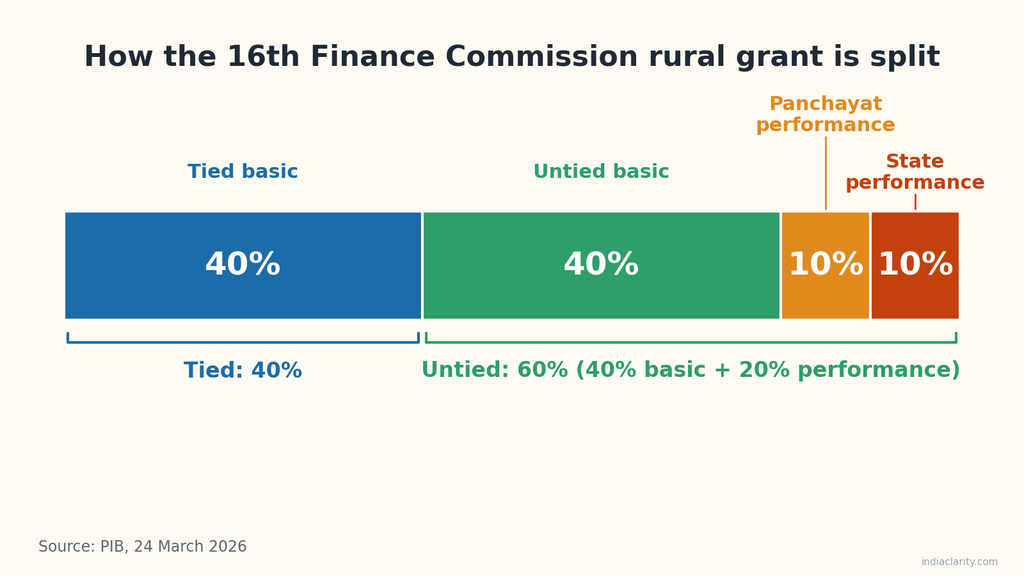
| Part of the grant | Share of the total | Where it can be spent |
|---|---|---|
| Basic grant, tied | 40% | Sanitation and solid waste management and/or water management, including operation and maintenance |
| Basic grant, untied | 40% | Local needs under the 29 Eleventh Schedule subjects, with the limits below |
| Performance grant, panchayat half | 10% | Untied, but earned by meeting the Commission’s conditions, including own revenue targets |
| Performance grant, state half | 10% | Untied, linked to conditions set for the state |
Even the untied half has limits. According to the Finance Ministry’s memorandum, untied grants cannot pay salaries or other establishment costs, and no local body may spend more than 20 per cent of its untied allocation on building and maintaining roads. A panchayat that wants to spend heavily on roads therefore has to find the rest from some other source.
The older arrangement was tighter. Under the 15th Commission, 60 per cent of the grant was tied to drinking water and sanitation. As for where panchayat money actually goes, the RBI’s accounts show the share of revenue spending on water supply and sanitation more than doubling, from 13 per cent in 2020-21 to 27 per cent in 2022-23, while panchayat programmes, the largest single head, took 63 per cent.
From the treasury to the village account: how the money moves
This path applies to Finance Commission grants. Scheme money travels by its own channels. For the Finance Commission grants, the steps run like this.
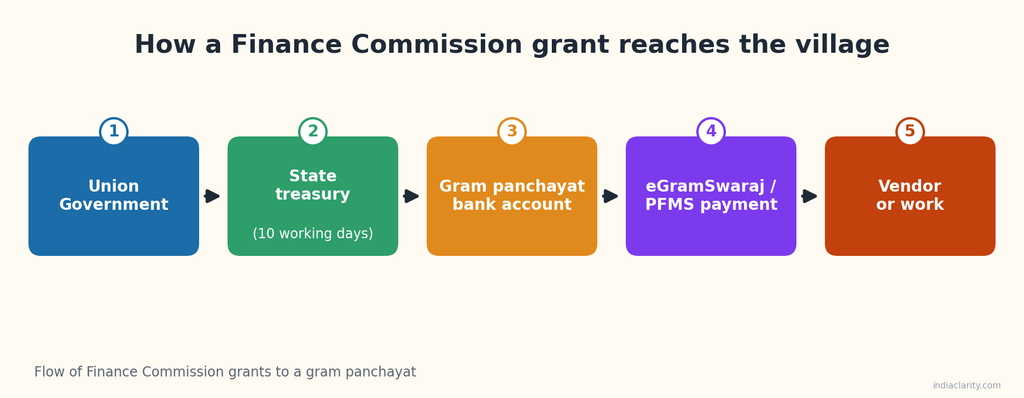
- The Centre releases the grant to the state in at least two equal instalments a year. If some local bodies in a state meet the conditions and others do not, the Commission says those that qualify should not have to wait for the rest.
- The state passes it on within ten working days. A late transfer must carry interest, at the rate the state pays on its market borrowings, and the Commission added that neither the Centre nor the state should attach conditions beyond those in its report. The ten-day rule is not new; the 15th Commission had it too.
- Before it can claim any of this, the state has to clear three entry conditions: elected panchayats in place as Part IX of the Constitution requires, provisional accounts for last year and audited accounts for the year before posted online, and a State Finance Commission formed on time with its action-taken report laid in the legislature within six months.
- Inside the panchayat, spending is recorded on eGramSwaraj, the Ministry’s work-based accounting portal. The Ministry says it is linked to the Public Financial Management System for payments, the Government e-Marketplace for purchases and AuditOnline for audits.
Delays can start well before the village. Under the 15th Commission’s arrangement, the next instalment waited for the state’s certificate that the last one had been passed on, so slow paperwork in a state capital could hold up money meant for a village.
How the spending plan gets made
Money is meant to follow a plan, and the plan is the Gram Panchayat Development Plan, or GPDP, which a panchayat prepares for each financial year. It is meant to begin with what villagers raise in Gram Sabha meetings. Under the 15th Commission’s arrangement, uploading the GPDP to eGramSwaraj was mandatory before grants were released. The parliamentary committee whose report PRS summarised found that some states had not uploaded GPDPs, or had uploaded fewer than required, and suggested lining them up with block and district plans.
You may also come across searches about a “five-year budget” for a panchayat. The five years in the news belong to the Finance Commission cycle, 2026-27 to 2030-31. The panchayat’s own plan is drawn up year by year.
How to check your own panchayat’s funds online
Panchayat receipts and payments are meant to be public. The RBI notes that this information is accessible through the eGramSwaraj portal. Here is how to look.
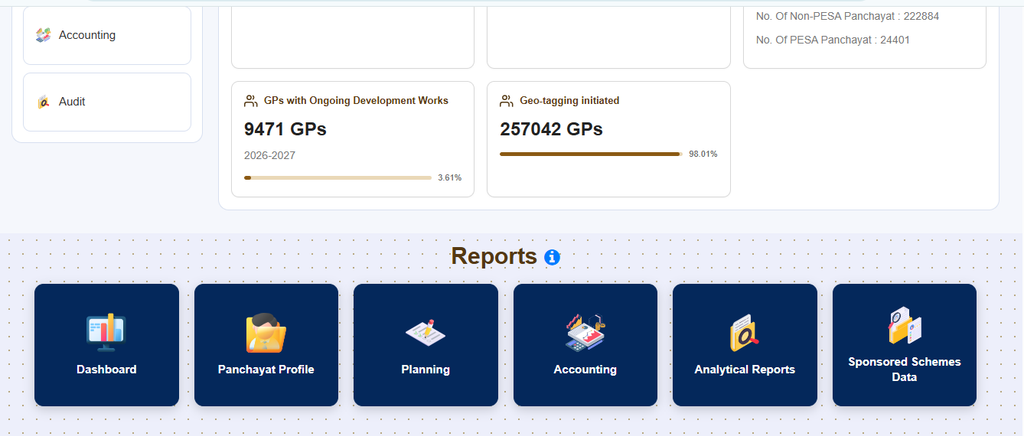
- Open egramswaraj.gov.in in your phone or computer browser.
- On the home page, find the Reports section.
- Look for the financial reports on receipts and expenditure and choose the financial year you want.
- Select your state, district, block and then your gram panchayat, in that order.
- Compare three things: money received, money spent, and what is left. Note which scheme or grant each item sits under.
Menu and report names change when the portal is updated, so if your screen looks different, go for the closest match. If your panchayat shows blanks, that proves nothing by itself. The RBI says reporting on the portal covers more than 90 per cent of village panchayats, which leaves some gaps. It is still a fair question to ask at the next Gram Sabha. The 16th Commission’s entry conditions also require provisional and audited accounts to be public online, so these records are meant to become easier to find.
How is a municipality’s money different?
A municipal corporation’s finances look very unlike a panchayat’s. In the RBI’s 2022 study of municipal corporations, covering 2017-18 to 2019-20, own revenue was roughly 60 to 65 per cent of total receipts. Own taxes alone were 31 to 34 per cent, and property tax made up about half of that tax income. Transfers from state governments were around a third of receipts and transfers from the Centre were under 5 per cent.
Two cautions apply. Those figures are for corporations only. The same RBI report’s historical table shows smaller municipalities relying far more on transfers, with own sources at about 25 per cent of revenue in 2012-13 against about 65 per cent for corporations. And the 16th Finance Commission treats the two sides under similar basic rules: the same 80:20 split between basic and performance grants and the same entry conditions. Urban bodies get ₹3,56,257 crore in all, which includes ₹56,100 crore for wastewater projects in selected larger cities and ₹10,000 crore to help areas moving from rural to urban status.
Where the system still pinches
Bigger numbers on paper do not always mean bigger transfers in the village. Looking at the six Finance Commissions since the 1990s, the RBI found that what was actually released ran 5 to 18 per cent below what was recommended, mostly because local bodies did not meet the conditions on performance grants. For the 15th Commission, the Ministry reported that ₹2,70,624.83 crore of the ₹2,97,555 crore, about 91 per cent, had been released as of 19 March 2026.
The July 2025 committee report listed more snags under that earlier award. Tied grants cannot be moved to other uses, so where a panchayat had already reached full water and sanitation coverage through other schemes, the tied money was not released at all; the committee asked for a way to convert such grants into untied ones. Some panchayats could not claim performance grants because they missed the conditions, while others sent misleading information to qualify. Delayed panchayat elections, only partial transfer of functions, funds and staff to panchayats, and district planning committees that rarely meet were flagged as well.
There is also a plain money question. Alok points out that the 16th Commission’s annual grant amounts were fixed without adjusting for inflation, so the rise looks smaller in real terms, and panchayats will not share in any growth in central tax revenue. The new award has things going for it too: a much bigger pot, a rule that accounts be public, and a push for panchayats to raise more of their own money. How these balance out will only be clear after a few years of actual releases.
The rules in this article follow the Finance Commission’s report, the Finance Ministry’s memorandum and the sources linked above, as of October 2026. States add their own rules on top, so your state’s panchayati raj department and the eGramSwaraj reports are the places to confirm what applies to your own panchayat.
Check also: What Is a Tehsil in India? Meaning, Tehsildar, Work & Services
Sources and further reading
- Finance Ministry memorandum on the 16th Finance Commission’s recommendations: local body grant rules, entry conditions, tied and untied limits, ten-day transfer rule
- PRS summary of the 16th Finance Commission report: grant totals and state-wise rural and urban figures
- PIB release, Ministry of Panchayati Raj, 24 March 2026: 15th and 16th Commission figures, tied and untied split, eGramSwaraj, SAMARTH portal
- RBI, Finances of Panchayati Raj Institutions (January 2024): panchayat revenue and spending data for 2020-21 to 2022-23
- RBI, Report on Municipal Finances (November 2022): municipal corporation revenue data
- PRS summary of the Standing Committee report on devolution of funds to panchayats (July 2025)
- Down To Earth: analysis of the 16th Commission’s panchayat grants by V N Alok
- Tamil Nadu Rural Development and Panchayat Raj Department: fund release details
- Business Standard: VB-G RAM G replacing MGNREGA from 1 July 2026
- eGramSwaraj portal, Ministry of Panchayati Raj

Hi, I’m Aryan, the writer behind IndiaClarity. I write plain-language explainers on how India’s systems, places and history work. Before I publish, I check facts against primary sources such as official records, Parliament answers, Census data and Acts of law, and I list the sources at the end of each article. If you spot a mistake, write to me at 7brewusaofficial@gmail.com and I will fix it.
2 thoughts on “How a Gram Panchayat Gets Its Money: Where Village Funds Actually Come From”