
By Aryan | Last updated 13 November 2026
Look at any ballot paper or voting machine in India and you will find three things beside each candidate: a name, a photo and a small picture. For many voters, the picture does the real work. The Supreme Court said as much back in 1967, observing that symbols are central to how our elections function, because a large part of the population could not have voted without them.
Most explainers stop at one line: recognised parties get reserved symbols, everyone else gets free ones. That is true, but it skips the part where the decisions are actually made. A table in a Returning Officer’s office. A 3 p.m. deadline. A draw of lots. This guide walks through that part first. After that it looks at two situations that cause the most confusion: a small party that wants one symbol across a whole state, and a big party that breaks into two.
A note on accuracy. The rules below follow the text of the Election Symbols Order, the Election Commission’s own training material for Returning Officers (2024 version) and news reports up to March 2026. The Commission amends the Order from time to time, so check the latest notification on eci.gov.in before relying on any number in a legal or political context.
The rulebook behind every symbol
Until August 1968 there was no certified set of guidelines for handing out symbols. The Election Commission filled that gap with the Election Symbols (Reservation and Allotment) Order, 1968, issued on 31 August that year. The Commission acts under Article 324 of the Constitution, Section 29A of the Representation of the People Act, 1951, and Rules 5 and 10 of the Conduct of Elections Rules, 1961.
A fair question is whether a commission can make an order like this at all. The Supreme Court looked at exactly that in Kanhiya Lal Omar v. R.K. Trivedi (1986). The argument was that Article 324 does not give the Commission law-making power. The Court rejected it and upheld the Order.
One limit to keep in mind: the Order covers Lok Sabha and Assembly elections only. Rajya Sabha and legislative council elections are outside it.
Everything in the Order rests on one split.
| Reserved symbol | Free symbol |
|---|---|
| Belongs to one recognised party. Nobody else can be given it, in any constituency. | Any symbol that is not reserved. The Commission publishes a list of free symbols for each state and union territory. |
Four kinds of candidates, four different roads
| Candidate | What they get |
|---|---|
| Set up by a national party | The party’s reserved symbol, and nothing else, anywhere in India (Para 8). |
| Set up by a state party, in a state where it is recognised | The party’s reserved symbol in that state, and nothing else. |
| Set up by a registered but unrecognised party | A free symbol. Sometimes one common symbol across many seats, if the Commission has approved it (see the section on smaller parties below). |
| Independent | A free symbol, decided by the Returning Officer. |
One rule surprises people. A reserved symbol stays locked even where its owner is not contesting. If a recognised party does not field anyone in a particular seat, no other candidate there can be given that symbol. Para 8(3) says so in plain words.
Allotment, step by step
Each constituency has a Returning Officer, a government officer who runs the election there. In most places this officer works inside the same district machinery described in our guide to how a district works in India. Here is the sequence the Returning Officer follows.
- Nomination. The candidate files a nomination paper that includes a request for a symbol. A candidate backed by a party also declares in that paper which party has set them up. At this stage the Returning Officer gives every candidate written notice of the date, time and place where symbols will be allotted.
- 3 p.m. on the last day for nominations. This is the deadline that trips up parties. By then the party must give the Returning Officer and the state’s Chief Electoral Officer Form A, which names the office-bearers allowed to send candidate names, with their specimen signatures. It must also give the Returning Officer Form B, which names the approved candidate and a substitute who steps in if the first nomination is rejected or the candidate withdraws. Both forms must be signed in ink by an authorised office-bearer. Fax, email, photocopies and rubber stamps are not accepted.
- Scrutiny and withdrawal. Nominations are checked and candidates get time to withdraw. Symbols are given out only after the withdrawal deadline of 3 p.m. has passed.
- Allotment. The Returning Officer works from the Commission’s latest notified list of parties and symbols. Recognised-party candidates receive their reserved symbol. Everyone else gets a free symbol. No two candidates in the same constituency can have the same symbol.
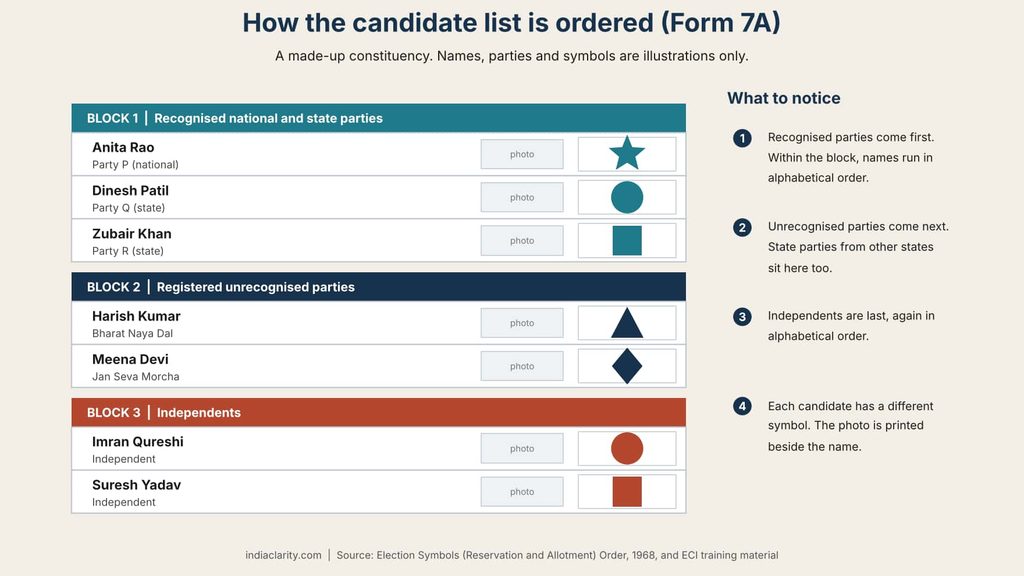
- Form 7A. Right after allotment the Returning Officer prepares the list of contesting candidates. It has three blocks: candidates of recognised national and state parties first, then candidates of registered unrecognised parties (this block also includes state parties from other states), then independents. Each block is in alphabetical order, and each candidate’s photo is printed against the name. This is also why recognised-party candidates appear at the top of the voting machine.
- Gazette and ballot. Form 7A is published in the Gazette and becomes the single source for the ballot paper and the candidate details on the machine.

When two candidates want the same symbol
This is the part almost nobody explains, even though Para 12 of the Order deals with it directly. It matters because free symbols are popular. Candidates give their preference in the nomination paper, and the Commission’s own training material says that only the choice made in the first nomination paper counts, even if that paper is later rejected.
When several candidates ask for the same free symbol, the Returning Officer follows a fixed order.
| Who is in the contest for the symbol | Who gets it |
|---|---|
| One candidate of a registered unrecognised party, the rest independents | The party candidate. |
| Candidates of two or more different unrecognised parties (independents may also be asking) | A draw of lots among the party candidates. The one exception: if exactly one of them was a sitting MP or MLA just before the election, that person gets it. |
| No party candidates, all independents, and one of them was a sitting member who held this same symbol at the previous election | That independent. |
| All independents, and no such sitting member | A draw of lots. |
An imagined example
Take a made-up Assembly seat, Rampur. Four candidates all put “pressure cooker” as their first choice.
- Meena Devi, of a registered unrecognised party, Jan Seva Morcha.
- Harish Kumar, of another unrecognised party, Bharat Naya Dal.
- Imran Qureshi, an independent who is the sitting MLA and who contested with a pressure cooker last time.
- Suresh Yadav, an independent with no past record.
Two unrecognised parties are in the race, so the independents are out of this round, including the sitting MLA. Neither party candidate is a sitting member, so the Returning Officer holds a draw of lots between Meena and Harish. Whoever wins gets the pressure cooker. The others receive their next choice from the free list, as long as it is still available.
The sitting-member advantage is real but narrow. It helps an independent only when no party candidate wants the same symbol. It helps a party candidate only when the other party candidates are not sitting members.

Where the paperwork can go wrong
Most disputes at the Returning Officer’s table are not about politics. They are about forms.
The declaration. Under Para 13, a candidate counts as “set up” by a party only if several things line up: the candidate declared it in the nomination paper, the candidate is on the party’s membership rolls, Form B reached the Returning Officer by 3 p.m. on the last day, and the forms carry the ink signature of an authorised office-bearer whose name and specimen signature were already sent in. If the candidate never made that declaration in the nomination paper, the party cannot hand over its reserved symbol just by sending Form B.
Two Form Bs. A party can change its mind. It may send a revised Form B for the same seat, but the new form must say clearly that the earlier one is cancelled, and it must also arrive before the 3 p.m. deadline. If two Form Bs for two people arrive and the second does not say it replaces the first, the Returning Officer gives the party’s symbol to the person whose nomination paper was delivered first. The other person is not treated as the party’s candidate.
A wrong allotment. A Returning Officer’s allotment is final, with one exception: if it goes against the Order or against the Commission’s directions, only the Election Commission can correct it (Rule 10(5) of the Conduct of Elections Rules). The candidate list then has to be revised and published again. The Commission’s training material lists the mistakes it sees most often: giving a symbol that is not on the notified list, giving a reserved symbol to someone who is not entitled to it, and giving the same free symbol to two candidates.
Smaller parties and the common symbol
A registered party that is not recognised does not own any symbol. Its candidates pick from the free list, and under the old system that created an odd result: the same party’s candidates could end up with different symbols in different seats. The Election Commission accepted in 2011 that this hurt small parties, after some of them went to the Supreme Court. In September 2011 it added a one-time concession for a party contesting at least 10% of the constituencies in a state, with minimums for small states.
That arrangement has since been reworked into Para 10B of the Order. As the Election Commission’s training material put it in 2024, a registered unrecognised party can ask the Commission for one common symbol if it fields candidates in at least 5% of a state’s Assembly seats (at least 3 seats in states with 40 or fewer seats), or in at least two Lok Sabha seats of the state. The party sends a list of preferred symbols, and the Commission allots them largely on a first-come, first-served basis. The application window opens six months before the term of the House ends.
The rule has sharp edges, and 2024 in Tamil Nadu showed them. The Naam Tamilar Katchi had polled more than 1% of the votes in its last two elections, but it applied for its old symbol only in February 2024. By then another party that had applied earlier had been allotted it, and the Naam Tamilar Katchi got a new symbol instead. The Viduthalai Chiruthaigal Katchi, which had an MP and MLAs, was refused a common symbol because it had not reached 1% of the vote in the 2021 Assembly election. Its candidates then got the “pot” as an ordinary free symbol from their Returning Officers.
In March 2026 the Commission changed the Order again. Under the earlier rule, a party had to reach 1% in both of the last two elections to keep a common symbol. The amendment, reported by The Tribune on 30 March 2026, says 1% in one of the two is enough.
Two smaller provisions are worth knowing:
- Para 10: a state party recognised in one state can ask to use its home-state symbol in another state where it is not recognised. It must apply no later than the third day after the election notification is published, and the Commission must see no reason to refuse.
- Para 10A: a party that lost recognition can ask for its old reserved symbol, as long as it was recognised within six years before the election notification.
How a party earns a reserved symbol, and how it can lose it
Recognition is what unlocks a reserved symbol. The Order lists the routes. A party needs only one of them.
| Status | Any one of these conditions |
|---|---|
| State party (Para 6A) | 6% of valid votes in the last Assembly election, plus at least 2 Assembly seats; or 6% of valid votes in the state at the last Lok Sabha election, plus at least 1 Lok Sabha seat; or 3% of Assembly seats, or 3 seats, whichever is more; or 1 Lok Sabha seat for every 25 seats (or part of it) the state has; or 8% of valid votes in the state at the last Lok Sabha or Assembly election, even with no seat. |
| National party (Para 6B) | 6% of valid votes in four or more states at the last general election, plus at least 4 Lok Sabha seats; or at least 2% of all Lok Sabha seats (11 seats out of 543, since a fraction above half counts as one) won from at least three states; or recognition as a state party in at least four states. |
Recognition can also go. On 10 April 2023 the Commission recognised the Aam Aadmi Party as a national party, because it had state-party status in four states: Delhi, Goa, Punjab and Gujarat. On the same day it withdrew the national party status of the Trinamool Congress, the Nationalist Congress Party and the Communist Party of India. The NCP, for example, stayed a state party in Maharashtra and Nagaland.
That difference matters for symbols. A national party’s symbol is reserved across the country. A state party’s symbol is reserved only in the state or states where it is recognised (Para 8). Para 9 adds that a symbol reserved for a state party in one state cannot be placed on the free list of any other state.
Where the symbols come from
The pictures themselves have a small human story. When the first elections were planned, the Commission needed images that voters could recognise at a glance. It used a draughtsman, M. S. Sethi, who is reported to have joined the Commission around 1950 and who retired in 1992. He sat with officials, they decided which everyday objects ordinary people would know, and he drew them with pencil. A set of around a hundred sketches was kept ready as the free list. Several well-known symbols, such as the bicycle and the elephant, came out of those sessions.
The free list keeps changing. Outlook reported 197 free symbols on the notification of 23 September 2021, and newer items such as a noodle bowl and a mobile charger have been added over the years. A party that wants a new symbol can suggest up to three, with drawings and clear names. The Commission will not accept one that looks like an existing reserved or free symbol, that carries a religious or communal meaning, or that shows a bird or an animal. A 2019 report noted that animal symbols were withdrawn from the list after live animals appeared in rallies. A few older ones, such as the elephant, stayed with the parties that already held them.
When a party splits
A symbol is easy to share out when parties are separate. It is much harder when two groups both claim to be the same recognised party. Para 15 of the Order covers this. If the Commission is satisfied that rival sections of a recognised party each claim to be that party, it can hear them and decide that one section is the party, or that none is. The decision binds all the groups.
The Supreme Court upheld this power in Sadiq Ali v. Election Commission of India (decided in 1971, reported in 1972), a case that came out of a split in the Congress. In that case, the test of support within the party’s organisation and among its elected members in the legislature was considered a valid one. The Court’s 2023 Constitution Bench judgment in the Shiv Sena case is read as saying that Para 15 sets no single mandatory test. The Commission can look at the party constitution, organisational strength and legislative strength, depending on the facts.
Because such cases take months, and elections do not wait, the Commission has often passed an interim order that freezes the symbol and gives each group a temporary name and a free symbol. It happened in these decided cases:
- AIADMK, 2017. The Commission froze the “two leaves” symbol on 22 March 2017, ahead of a by-election. The next day it gave the two groups new names and symbols (an electric pole and a hat). On 23 November 2017 it decided that the two leaves belonged to the merged camp, relying on the support it enjoyed in both the organisation and the legislature.
- Lok Janshakti Party, 2021. The “bungalow” symbol was frozen in October 2021 after the party split in June.
- Shiv Sena, 2022–23. The “bow and arrow” was frozen in October 2022 with interim names and symbols for both groups. On 17 February 2023 the Commission ruled that the party name and the symbol would stay with the group led by Eknath Shinde. The other group kept the name Shiv Sena (Uddhav Balasaheb Thackeray) and the flaming torch. The order also noted that the party had amended its constitution in 2018 without placing the change on the Commission’s record, as Section 29A requires.
- NCP, 2024. In February 2024 the Commission recognised the Ajit Pawar group as the NCP and gave it the “clock”. The other group received a new symbol, a man blowing a turha.
A group that does not get the parent party’s name and symbol is treated as new in the Commission’s eyes. It has to register as a party and earn recognition on its own future performance. A frozen symbol is also not the same thing as a party being cancelled. A freeze only decides who may use the name and symbol while the case is pending. At the time of writing (November 2026), another such dispute is waiting for a decision from the Commission, so this list will keep growing.
Frequently asked questions
Can a candidate choose any symbol?
No. Candidates who are not backed by a national or state party choose from the notified list of free symbols, and getting your first choice is not guaranteed. Reserved symbols are closed to everyone except the party they belong to.
Can an independent keep the same symbol as last time?
Only in one situation: the independent was a sitting MP or MLA just before the election, held that same symbol last time, and no party candidate is asking for it. Otherwise it is a draw of lots.
Does the Symbols Order apply to Rajya Sabha or local body elections?
The Order covers Lok Sabha and Assembly elections only. It does not apply to Rajya Sabha or legislative council elections. Municipal and panchayat elections are run by State Election Commissions, which keep their own lists.
Can a symbol be changed after it is allotted?
The Returning Officer’s allotment is final. The only exception is a mistake that goes against the Order or the Commission’s instructions, and only the Election Commission can correct it.
What does it mean when the Election Commission “freezes” a symbol?
It means nobody can use the symbol for the time being. The Commission usually does this when rival groups of one party both claim it. Each group gets a temporary name and a free symbol until the dispute is decided. The party is not cancelled.
Sources
- Election Symbols (Reservation and Allotment) Order, 1968 (text): legislative.gov.in
- Election Commission training material for Returning Officers, “Allotment of Symbols” (2024 version): ceodelhi.gov.in
- Press Information Bureau, Election Commission release on common symbols, 17 October 2011: pib.gov.in
- Deccan Herald, how the Commission recognises state and national parties (April 2023): deccanherald.com
- The Tribune, AAP gets national party status; TMC, NCP, CPI lose it (10 April 2023): tribuneindia.com
- The Tribune, EC relaxes symbol allotment rule for smaller parties (30 March 2026): tribuneindia.com
- Vajiram & Ravi, “How are Symbols Allotted to Political Parties?” (based on The Hindu, 2024): vajiramandravi.com
- PMF IAS, Election Symbols Disputes: pmfias.com
- SCC Online, the Commission’s Shiv Sena order (February 2023): scconline.com
- The News Minute, timeline of the AIADMK “two leaves” dispute: thenewsminute.com
- Gulf News, “India election: The designer of symbols”: gulfnews.com
- Outlook India, “The curious case of the party symbol”: outlookindia.com
- Quartz, “How political parties in India get their symbols” (2019): qz.com
- Drishti IAS, role of the Election Commission in party disputes (21 September 2026): drishtiias.com
- Legal Services India, summary of Para 15 case law (September 2026): legalservicesindia.com
This article is general information about election procedure, not legal advice.
Hi, I’m Aryan, the writer behind IndiaClarity. I write plain-language explainers on how India’s systems, places and history work. Before I publish, I check facts against primary sources such as official records, Parliament answers, Census data and Acts of law, and I list the sources at the end of each article. If you spot a mistake, write to me at 7brewusaofficial@gmail.com and I will fix it.