
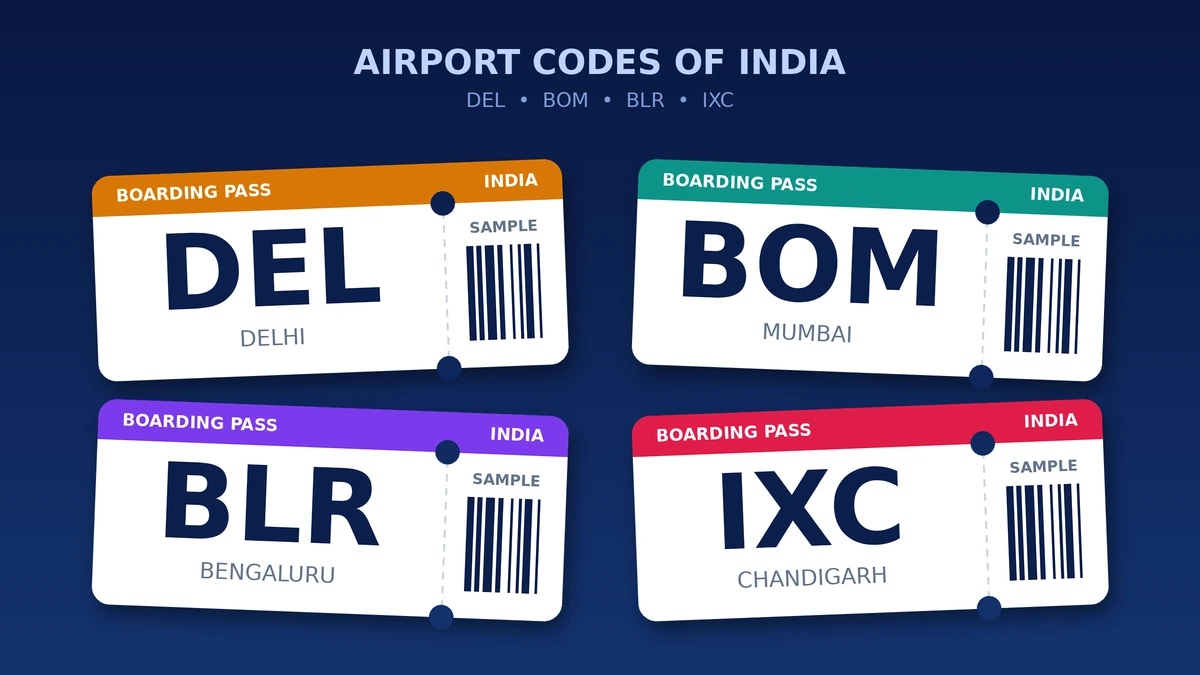
Book a flight to Mumbai and your boarding pass says BOM. The city stopped being Bombay in 1995, but the code never followed. Book one to Chandigarh and it says IXC. Mangaluru is IXE, Port Blair is IXZ, and Hyderabad’s HYD once belonged to a completely different airport.
None of this is random, though some of it is hard to explain. This guide covers how airport codes are decided in India: who hands out the three letters, why so many Indian airports start with IX, and what happens to a code when an airport moves or a city changes its name. The details come from IATA’s own fact sheet, the Airports Authority of India, a 2008 Government of India notification and the airports’ own announcements, all listed at the end.
Every airport has two codes, and they are unrelated
The three letters on your ticket are the IATA code. IATA is the airlines’ trade body, and its codes are made for commercial flying: tickets, bag tags, booking apps. The other one is the ICAO code, four letters long, issued by the International Civil Aviation Organization and used by pilots, air traffic control and flight planners. ICAO gives codes to commercial and non-commercial airfields alike, so a small military airstrip can have an ICAO code and never get an IATA one.
| Airport | City | IATA | ICAO |
|---|---|---|---|
| Indira Gandhi International | Delhi | DEL | VIDP |
| Chhatrapati Shivaji Maharaj International | Mumbai | BOM | VABB |
| Netaji Subhas Chandra Bose International | Kolkata | CCU | VECC |
| Chennai International | Chennai | MAA | VOMM |
| Kempegowda International | Bengaluru | BLR | VOBL |
| Rajiv Gandhi International | Hyderabad | HYD | VOHS |
| Navi Mumbai International | Navi Mumbai | NMI | VANM |
| Noida International | Jewar, near Noida | DXN | VIND |

The two codes follow separate systems, so you cannot work one out from the other.
Why every Indian ICAO code starts with V
Look at the last column. Every code starts with V, and the second letter is always A, E, I or O. Those four letters match India’s four flight information regions, the blocks of airspace looked after by the Mumbai, Kolkata, Delhi and Chennai control centres: VA for Mumbai, VE for Kolkata, VI for Delhi and VO for Chennai. The regions’ own identifiers (VABF, VECF, VIDF and VOMF) carry the same prefixes.
The split follows airspace, not state borders. Belagavi (VABM) and Bengaluru (VOBL) are both in Karnataka, yet one sits under the Mumbai prefix and the other under Chennai’s. Passengers almost never see these codes. They turn up in flight plans and weather reports.

Who decides the three letters
IATA does, under a rule called Resolution 763. It is not the government, and an airport cannot simply pick its own letters. IATA’s fact sheet says a code is issued when a commercial airline needs one, and the first airline planning to fly to a place is usually the one that asks. The applicant can suggest codes from the list of free ones.
When IATA chooses, it follows a fixed order. First choice is a free code made from the first three letters of the place name. If that is gone, it takes another free combination, preferably one starting with the place’s first letter. That is how Delhi became DEL and Hyderabad became HYD, and it is also why plenty of other cities ended up with something less obvious.
The pool is smaller than most people think. Three letters give 26 × 26 × 26, which is 17,576 combinations. IATA says around 11,300 are already assigned and that it hands out 40 to 50 new ones a year. About two of every three possible codes are used up.
Codes are also issued well before the first flight. Noida’s operator announced DXN on 27 September 2023, and the airport got its first commercial flight on 15 June 2026, more than two and a half years later. Navi Mumbai’s NMI was already visible on IATA’s website in May 2024, about a year and a half before the airport opened on 25 December 2025.
Once a code exists, it stays. IATA calls three-letter codes permanent and says they are almost never changed, and only for strong reasons, mainly air safety. Its own example is Washington Dulles, which was switched from DIA to IAD so nobody would confuse it with nearby Reagan National, DCA.
Old city names that never left the ticket
A lot of Indian codes need no decoding. DEL is Delhi, HYD is Hyderabad, AMD is Ahmedabad, JAI is Jaipur. BLR fits both the old spelling Bangalore and the new one, Bengaluru. The interesting ones are the codes that kept an old name after the city dropped it.
| Code | City today | Older name the letters point to |
|---|---|---|
| BOM | Mumbai | Bombay |
| CCU | Kolkata | Calcutta |
| MAA | Chennai | Madras |
| COK | Kochi | Cochin |
| BDQ | Vadodara | Baroda |
| CCJ | Kozhikode | Calicut |
BOM, CCU and MAA can be read straight out of the old names. COK, BDQ and CCJ are looser. Their first two letters can be found in Cochin, Baroda and Calicut, while the third letter has no obvious source. None of them can be traced to Kochi, Vadodara or Kozhikode.
Even the Airports Authority of India’s own airport list still files airports under Cochin, Calicut, Trivandrum, Belgaum and Mangalore. If the official list has not caught up with the new names, a code was never going to. Aurangabad is the example playing out right now: the city is now Chhatrapati Sambhajinagar, and the airport still flies as IXU. For the full story of how a city’s name actually changes, see How a City Gets Renamed in India.
The IX family: how to decode IXA, IXC, IXR and the rest
On a map of regional India, one family of codes stands out: IXA, IXB, IXC and so on, all starting with IX. Wikipedia’s page on IATA codes notes the convention: IX, followed by the first letter of the city. We tested it on 24 IX codes taken from Wikipedia’s list of airports in India and two airport-code directories.
| Code | Airport serves | Letter after IX is the city’s first letter? |
|---|---|---|
| IXA | Agartala | Yes |
| IXB | Bagdogra | Yes |
| IXC | Chandigarh | Yes |
| IXD | Prayagraj (Allahabad) | No. A is held by IXA, P by IXP |
| IXE | Mangaluru (Mangalore) | No. M is held by IXM |
| IXG | Belagavi (Belgaum) | No. B is held by IXB |
| IXH | Kailashahar | No. K is held by IXK |
| IXI | Lilabari (North Lakhimpur) | No. L is held by IXL |
| IXJ | Jammu | Yes |
| IXK | Keshod | Yes |
| IXL | Leh | Yes |
| IXM | Madurai | Yes |
| IXN | Khowai | No. K is held by IXK |
| IXP | Pathankot | Yes |
| IXQ | Kamalpur | No. K is held by IXK |
| IXR | Ranchi | Yes |
| IXS | Silchar | Yes |
| IXT | Pasighat | No. P is held by IXP |
| IXU | Aurangabad | No. A is held by IXA |
| IXV | Along | No. A is held by IXA |
| IXW | Jamshedpur | No. J is held by IXJ |
| IXX | Bidar | No. B is held by IXB |
| IXY | Kandla | No. K is held by IXK |
| IXZ | Port Blair | No. P is held by IXP |
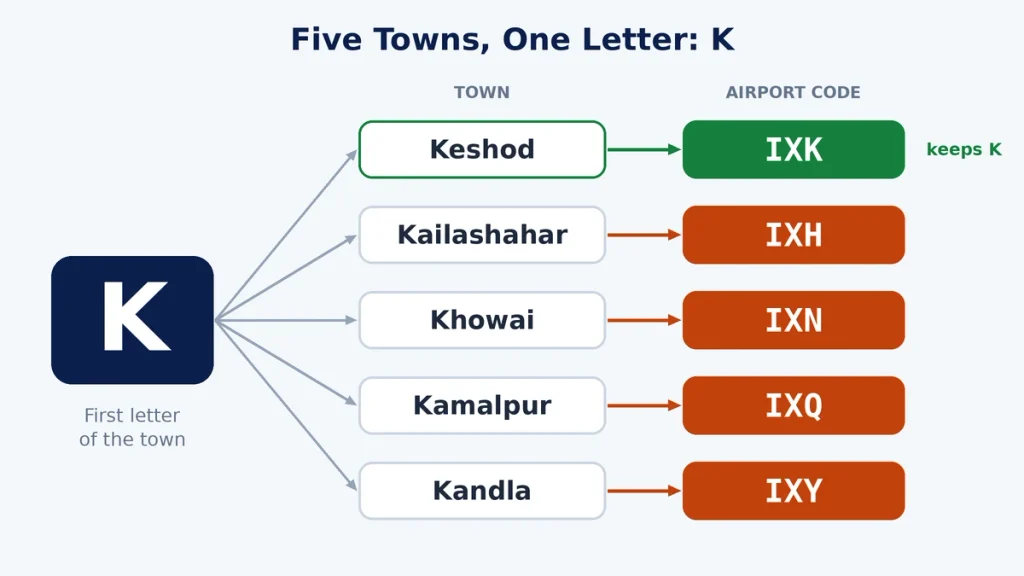
Ten of the 24 follow the rule directly. The other fourteen break it for the same reason: the city’s first letter had already gone to another IX airport. Five towns start with K (Kailashahar, Khowai, Kamalpur, Kandla and Keshod), and only Keshod got IXK. The other four took H, N, Q and Y. Bagdogra holds IXB, so Belagavi became IXG and Bidar became IXX. Mangaluru lost M to Madurai, which is why it has IXE instead of IXM.
That is a pattern in the data, not a published IATA rule, and we cannot say which airport got its letter first. But it makes the list guessable. When an IX code does not match its city, the city’s first letter was taken in every one of the 14 cases above.
Why IX in the first place? IATA’s fact sheet does not mention it. Some travel blogs say India was given an IX block because the obvious combinations were already taken abroad. We could not find an official document that says so, so treat it as a popular explanation, not a confirmed one.
One thing the letters do not mean is “international”. IXK is Keshod and IXS is Silchar, and both are domestic airports.
When an airport moves, its code can move too
For years, BLR meant the old HAL Airport, where the Airports Authority of India ran a civil enclave. On 16 May 2008, the Ministry of Civil Aviation published a notification (S.O. 1170(E)). It said HAL would stop handling commercial flights once the new airport at Devanahalli was commissioned, and that the code BLR was being transferred to the new airport from the same moment. The start was first set for 00:01 on 23 May, then pushed back a day by a second notification (S.O. 1181(E)) on 21 May. From 24 May 2008, BLR meant Devanahalli.
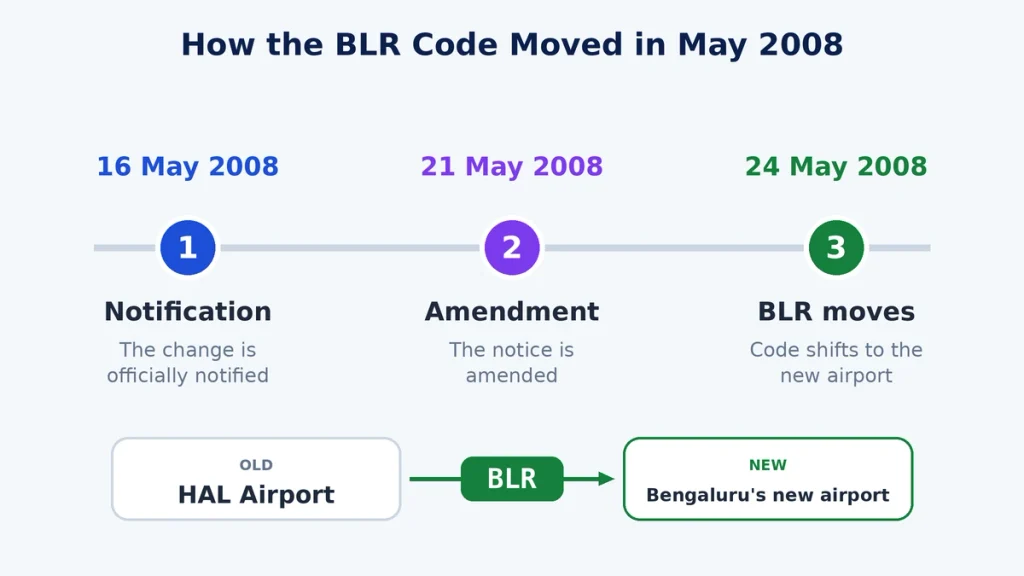
Hyderabad did the same two months earlier. Rajiv Gandhi International Airport opened at Shamshabad on 23 March 2008, and the HYD code was reassigned to it from Begumpet Airport. Begumpet, now used for general and military flying, became BPM.
The four-letter codes behaved differently. They stayed with the old fields. HAL Airport is still VOBG and Begumpet is still VOHY, while the new airports got VOBL and VOHS. In both cities, the IATA code followed the city’s main commercial airport and the ICAO code stayed with the piece of land.
One city, two airports
Goa has two airports with two codes. Dabolim in the south is GOI (ICAO VOGO, according to the Airports Authority of India), and Manohar International Airport at Mopa in the north is GOX. Delhi’s DEL and Noida’s DXN are different airports. So are Mumbai’s BOM and Navi Mumbai’s NMI, which sits in Raigad district, around 46 km from the main Mumbai airport according to Gulf News.
DXN has a story worth telling. The airport’s own explanation covers two of the three letters: D for Delhi and N for Noida, and its CEO has said the code reflects the airport’s closeness to Noida, Delhi and western Uttar Pradesh. One exam-prep site, citing a newspaper report, says the X stands for connectivity with the world. We could not find the airport saying that itself, so the X is best treated as unexplained.
The practical point is simple. A flight “to Mumbai”, “to Delhi” or “to Goa” can now land at one of two different airports. Read the three letters before you pay, not only the city name.
Reading your ticket and bag tag
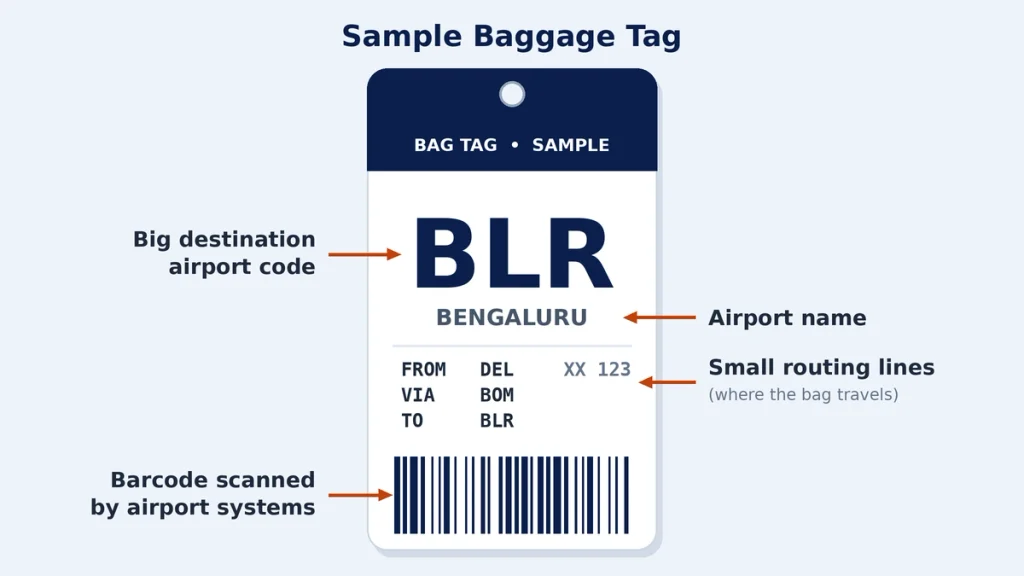
A route written DEL–IXC means you start at Delhi’s Indira Gandhi airport and land in Chandigarh. On a baggage tag, the large three-letter code is the airport your bag is routed to, and with a connection it is the final stop. Compare it with your ticket at the counter. A wrong code is easy to fix there and much harder after you land.
Common questions
How are airport codes decided in India?
India has no code system of its own. IATA assigns the three letters at an airline’s request, and Indian authorities then notify the change locally, as the Ministry of Civil Aviation did for BLR in 2008.
Why is Ranchi airport called IXR?
Ranchi belongs to the IX family, and R, the city’s first letter, was still free.
Why is Mangalore airport called IXE?
M was already taken by Madurai (IXM), so Mangaluru got a different letter. We found no source that explains why E in particular.
Do airport codes ever change?
Rarely. IATA treats them as permanent. The Indian cases that did change involved a whole airport moving, as with BLR and HYD above.
What is the difference between IATA and ICAO codes?
IATA codes have three letters and appear on tickets and bag tags. ICAO codes have four letters and are used by pilots and air traffic control.
India runs on identifier systems like this one, and each has its own logic. We have broken down two others on this site: PIN codes and train numbers.
Sources
Checked in October 2026. To confirm any code yourself, use IATA’s Airport and Airline Code Search.
- IATA, IATA Location Codes fact sheet
- Ministry of Civil Aviation notifications S.O. 1170(E) of 16 May 2008 and S.O. 1181(E) of 21 May 2008, Gazette of India
- Airports Authority of India, Dabolim airport page and airport list
- Noida International Airport, DXN announcement, 27 September 2023
- Noida International Airport, first commercial flights, 15 June 2026
- PTI via Deccan Herald, IATA allots DXN to Noida airport
- Business Today, DXN or VIND: decoding Noida airport’s two codes
- Drishti IAS, Airport Codes (for the X explanation)
- Navi Mumbai International Airport Limited, start of commercial operations, 25 December 2025
- Swarajya, NMI is the official IATA code for Navi Mumbai airport
- Gulf News, Navi Mumbai International Airport launch details
- Airport Industry-News, The History and Future of IATA Airport Codes in India
- Wikipedia, List of airports in India, List of airports by ICAO code: V, IATA airport code, HAL Airport, Begumpet Airport, Rajiv Gandhi International Airport
- Airport-code directories used to cross-check the IX list: WhereIG, Airfleets, ShipsGo

Hi, I’m Aryan, the writer behind IndiaClarity. I write plain-language explainers on how India’s systems work, from district administration to the power grid. Before I publish, I check facts against primary sources such as Parliament answers, regulator documents and Acts of law, and I list them at the end of each article. If you spot a mistake, write to me at [contact@indiaclarity.com] and I will fix it.