

Take out any train ticket and look at the number printed next to the train’s name. Say it reads 12951, the Mumbai Central to New Delhi Rajdhani.
Most of us treat that as a label, the way a roll number is a label. It isn’t random. Almost every digit in it carries a meaning, and once you know the code you can look at a number you have never seen before and guess what kind of train it is, which railway zone looks after it, and whether it is leaving its home city or heading back.
This guide starts with why the number exists at all (it involves three different trains that once shared the same number), and then takes it apart digit by digit using real trains.
The short version
- First digit: the family of the train. 1 and 2 are long-distance, 0 is special, 9 is a Mumbai local.
- Second digit (often the third as well): the railway zone, or the superfast series.
- Fourth and fifth digits: the serial number of the train.
- Odd or even at the end: usually tells you the direction.
The rest of the article is the detail, and the places where the pattern breaks.
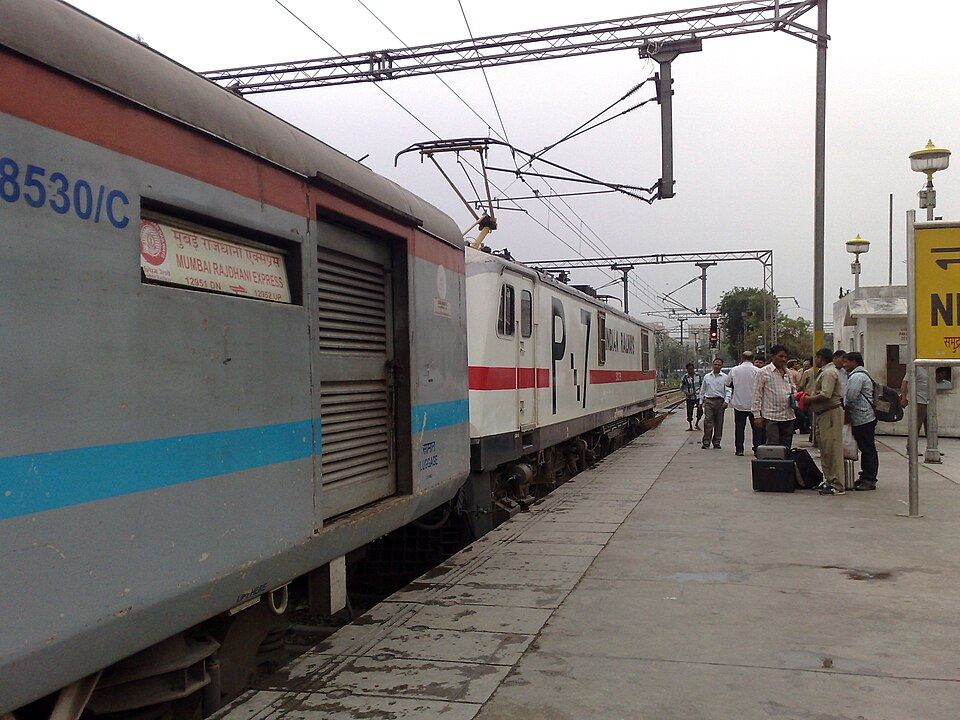
When one number meant three different trains
Before November 1989, every railway zone numbered its own trains, starting from 1 and going up. Nobody checked whether another zone had already used that number.
The Indian Railway Fan Club’s records (IRFCA) give some good examples. The number 1/2 was the Howrah to Kalka Mail on Northern Railway, the Golconda Express on South Central Railway, and the Madras to Mangalore Mail on Southern Railway. On Western Railway, 31 Down was the Kutch Express. On Central Railway, 31 Down was the Hyderabad Express. Both ended up in Mumbai.
Clerks coped by scribbling the zone next to the number, things like “31/WR”, or “31/F/WR” for the forward-journey quota. That tells you how messy it had become.
Sometimes the fix was to change the number on the way. The Punjab Mail was 5/6 between Mumbai and New Delhi, but on the New Delhi to Firozpur stretch it became 37/38, because a different 5/6 (the Howrah to Amritsar Mail) was also running on Northern Railway tracks. At Howrah, which handled trains from several zones, the Kalka Mail was numbered 1 Up and 2 Down while the Howrah to Bombay Mail was 2 Up and 1 Down, flipped on purpose to keep the two apart.
In November 1989 the railways introduced four-digit “universal numbers” for long-distance trains. Now a number meant one train, whichever zone you were standing in.
2010: why four digits stopped being enough
A four-digit system can number at most 9,999 trains. By 2010 the Ministry of Railways said Indian Railways was running more than 10,000 trains every day. The railways also wanted passenger and suburban trains in the same computer systems as the long-distance ones, with one national identity for each train.
So from 20 December 2010, all passenger-carrying trains moved to five digits. For regular express, mail and superfast trains, the transition was almost lazy: a 1 was simply added in front of the old number. The Ministry’s examples were the Rajdhanis, Shatabdis, Jan Shatabdis, Garib Raths, Durontos, Yuva trains and Sampark Kranti Expresses. The Kolkata Rajdhani became 12302 and the Mumbai Rajdhani 12952, with names unchanged. IRCTC started printing the five-digit numbers on e-tickets for journeys after that date.
This is why so many long-distance trains still carry the fingerprints of the old four-digit system. Most of the logic in the next sections was designed in 1989 and quietly carried forward.
The first digit: what kind of train is this?
| First digit | Type of train |
|---|---|
| 0 | Special trains (summer, holiday and exam specials, extra trains to clear heavy rush) |
| 1 | Long-distance trains: Rajdhani, Shatabdi, Duronto, Garib Rath, Sampark Kranti and the rest |
| 2 | Also long-distance. Used when the numbers starting with 1 run out in a series |
| 3 | Kolkata suburban trains |
| 4 | Suburban trains in Chennai, Delhi, Secunderabad and other metro areas |
| 5 | Passenger trains with conventional coaches |
| 6 | MEMU trains |
| 7 | DEMU / DMU and railcar services |
| 8 | Suvidha trains |
| 9 | Mumbai suburban trains |
That is the one part of the system with very few exceptions. If a number starts with 9, it is a Mumbai local, and nothing else in this article will help you decode it like a Rajdhani.
The second digit: a zone, or a superfast series
For numbers starting with 0, 1 or 2, the second digit follows the zone codes that were set up in 1989:
| Second digit | Zones |
|---|---|
| 0 | Konkan Railway |
| 1 | Central, West Central, North Central |
| 2 | Superfast, Shatabdi and Jan Shatabdi trains of any zone |
| 3 | Eastern, East Central |
| 4 | Northern, North Central, North Western |
| 5 | North Eastern, Northeast Frontier |
| 6 | Southern, South Western |
| 7 | South Central, South Western |
| 8 | South Eastern, East Coast |
| 9 | Western, North Western, West Central |
Several zones share a digit because the table dates from a time when there were fewer zones. So a 13xxx train, such as the Doon Express from Howrah, belongs to the Eastern and East Central family, but the digit alone cannot tell you which of the two.
Numbers starting with 5, 6 and 7 (ordinary passenger trains, MEMUs and DEMUs) use the same idea: the second digit is the zone, and the third digit is the division.
12, 20 and 22: the three prefixes people keep searching for
Here the second digit is 2, the “superfast, any zone” code (or 0 in the 20 block), and the confusion comes from timing. My reading of how the pieces fit, based on the IRFCA record and the Wikipedia article on train numbering, is this:
12xxx is mostly superfast trains that already existed before December 2010. Their old numbers began with 2 (the Delhi to Bhopal Shatabdi was 2001, the Mumbai Rajdhani 2951), and the new leading 1 turned them into 12001 and 12951.
22xxx is also superfast, but mostly for trains numbered later, once the 12 range was crowded. The 22 block is older than 2010 though. From July 2005, when the 24xx and 26xx superfast ranges were filling up, some trains such as the Lucknow to New Delhi Mail (2229/2230) were given 22xx numbers.
20xxx began as the Shatabdi and Jan Shatabdi series (a 2002 Lok Sabha reply lists Jan Shatabdis like Howrah to Malda Town as 2065/2066) and is now used for newer premium trains too. Vande Bharat trains such as 20901 and 20607 are in it.
Treat these as strong tendencies, not laws. A few trains were numbered for convenience and sit outside their “expected” block.
The third digit: where the train is looked after
For numbers starting 0, 1 or 2 with 2 as the second digit (or 0, when the first digit is 2), the third digit is the zone that maintains the train. It uses the same zone table as above, only now it points to where the coaches live, not where the train goes.
The Vande Bharat numbers show this nicely:
| Train | Route | Third digit | Zone it points to |
|---|---|---|---|
| 22435 | New Delhi to Varanasi | 4 | Northern |
| 20901 | Gandhinagar Capital to Mumbai Central | 9 | Western |
| 20607 | Chennai Central to Mysuru | 6 | Southern |
It does not work every time. The Mumbai CSMT to Solapur Vande Bharat is 22225 and the Guwahati to New Jalpaiguri one is 22227. Both have 2 as the third digit, which is not a zone code. So think of the third digit as a good clue and not a guarantee.
When the second digit is anything other than 2 (13009, for example), the second and third digits together name a railway division. A few of these division prefixes from the 1989 list: 30 Howrah, 31 Sealdah, 40 New Delhi, 42 Lucknow, 60 Chennai, 65 Bengaluru, 70 Secunderabad, 90 Mumbai, 91 Vadodara.

The last digits, and what odd and even really mean
The fourth and fifth digits are just a serial number within the series. The very last digit is the interesting one, because the two directions of a train differ by one: 12951 and 12952, 13009 and 13010.
Railway language uses “up” and “down”. A down train travels away from its headquarters (or its divisional headquarters, whichever is closer). An up train travels towards it. Usually, down trains get the odd number and up trains the even one. 12951 leaves Mumbai, away from its home, so it is odd. 12952 comes back and is even.
It is worth saying clearly because some websites flip it and call odd numbers “up”. The railway convention is that the down train is generally the odd one.
“Usually” is doing real work in that sentence. IRFCA notes the Charminar Express from Hyderabad to Madras, which carried the even number 2760 even though it was a down train. On Delhi’s Ring Railway, the clockwise direction is marked “up” in the timetable. Near zone and division boundaries there are plenty of oddities.
The words themselves are British. In the UK, trains going to London are “up”. The Great Indian Peninsula Railway copied that for Bombay, and the Madras Railway for Madras. The East Indian Railway did the opposite and called trains heading towards Calcutta “down”, so even the early companies disagreed.
Why your train’s number doesn’t match its route
This is the part that surprises people the most. You would expect a Delhi to Darbhanga train to carry a Delhi or Bihar code. It might not, because the digits follow the train’s home depot, the place where its coaches are maintained, and that is not always at either end of the route.
IRFCA lists several cases from the four-digit era, whose numbers were inherited by the five-digit system:
- The Shaheed Express between Delhi and Darbhanga was numbered 4649. The prefix 46 is the Firozpur division of Northern Railway, which is neither Delhi nor Darbhanga.
- The Tirupati to Mumbai Express was 6353/6354. The 63 stands for Thiruvananthapuram, because its rakes were shared with the Nagercoil to Tirupati Express (6351/6352).
- A train between Jammu Tawi and Amritsar, both in Firozpur division, was numbered 9113/9114, a Vadodara division prefix, again because of shared rakes.
- The Tirupati to Tiruchirappalli Express was 6799/6800, with the two directions carrying different division prefixes (67 and 68). The railways had tried to keep the last two digits of the old numbers, 199 and 200, when they created the four-digit ones.
The same train name can even have two numbers. The Poorva Express was 2303 when it ran Howrah to New Delhi through Patna and 2381 when it ran through Gaya, on different days of the week. In today’s system those would be 12303 and 12381.
Local trains have their own number blocks
Suburban trains need thousands of numbers of their own, so they sit in separate blocks. Here is what IRFCA records:
| Range | What it covers |
|---|---|
| 30xxx to 37xxx | Kolkata locals run by Eastern Railway |
| 38xxx to 39xxx | Kolkata locals run by South Eastern Railway |
| 40xxx to 44xxx | Chennai area EMUs |
| 45xxx to 46xxx | Delhi area suburban trains (on paper, see below) |
| 47xxx | Secunderabad EMUs |
| 90xxx | Western Railway locals starting from Virar |
| 91xxx | Western Railway locals from Vasai Road / Bhayander |
| 92xxx | Western Railway locals from Borivali |
| 93xxx | Western Railway locals from Malad / Goregaon |
| 94xxx | Western Railway locals from Andheri / Bandra / Mumbai Central |
| 95xxx | Central Railway fast locals |
| 96xxx | Central Railway locals going north of Kalyan |
| 97xxx | Central Railway Harbour line locals |
| 98xxx | Central Railway trans-Harbour line locals |
| 99xxx | Central Railway slow trains that don’t go beyond Kalyan |
Delhi is the exception to the plan. The original circular suggested numbers from 45xxx to 46xxx for Delhi, with the digits showing direction and type of coach. IRFCA noted in 2020 that Northern Railway was not following this and was numbering its Delhi area services in the 64xxx range, usually kept for MEMUs. What is on paper and what is on the platform are not always the same thing.
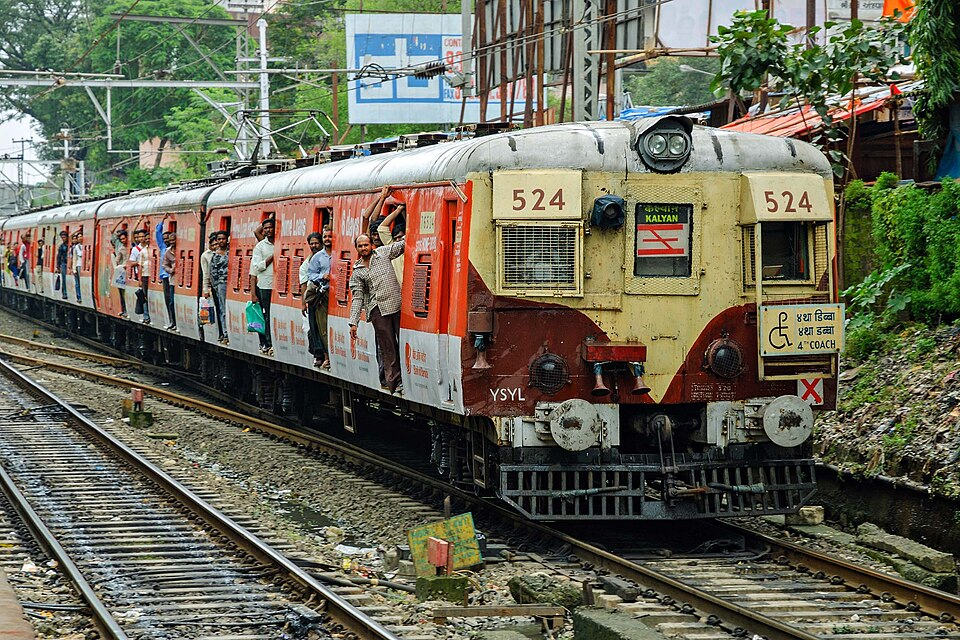
Three real numbers, decoded
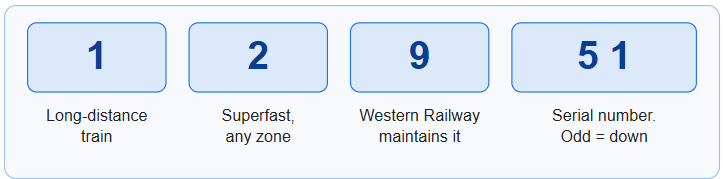
12951: Mumbai Central to New Delhi Rajdhani
The 1 puts it in the long-distance family. The 2 says superfast, under the “any zone” code. The 9 points to Western Railway, which maintains the train, and the 51 is its serial number. It leaves Mumbai, away from its home, so the last digit is odd. Its return trip is 12952.
13009: Howrah to Rishikesh, the Doon Express
The 1 is again long-distance. The 3 puts it in the Eastern family, and the 30 is the Howrah division prefix. The 09 is the serial. The train belongs to Eastern Railway and leaves Howrah, so the odd ending fits the down direction. The return is 13010.
90321: the Churchgate to Virar fast local
The 9 means a Mumbai suburban train, and 90 is the block of Western Railway locals linked to Virar. Do not read the remaining digits as you would in a Rajdhani; they are the local’s own series. The ending still follows the up and down habit: 90321 runs from Churchgate to Virar, away from Churchgate, and is odd. The Virar to Churchgate fast local 90808 is even.
Questions people ask about train numbers
Which train is number 00001?
Numbers that start with 0 are special trains, the summer, holiday and exam extras. So 00001 would fall in that block, but no official source we could find ties it to any particular train. Be careful with websites that claim otherwise.
Do freight trains have five-digit numbers like this?
No. When the system was announced in 2010, PTI reported that it would not cover freight trains. It is meant for passenger-carrying trains.
Can two trains have the same number?
Not under the five-digit system. The Ministry’s stated aim was a unique national identity for each train. That is a big change from the days when a number meant different trains in different zones.
Where can I look up a train number?
The railways’ all-India timetable, “Trains at a Glance”, has included a train number index, which lets you look up a train by its number. Online, the IRCTC and National Train Enquiry System listings work too, but remember that a new service gets a new number, so any list can be out of date.
What to take away
You do not need to memorise the tables. Look at the first digit to know the family. Look at the next one or two digits for the zone or division. Look at the last digit for direction. Then if the answer seems to disagree with the train’s route, remember it is probably telling you where the coaches sleep, not where the passengers go.
Sources used
- IRFCA, “Train Numbers” FAQ (irfca.org/faq/faq-number.html), for the digit tables, zone and division codes, suburban blocks, up and down rules, and the four-digit era examples.
- Wikipedia, “Train numbering in India”, for the 0 and 20xxx series and the third-digit rule.
- Ministry of Railways statements of September and December 2010 as reported by PTI and Deccan Herald, for the reasons behind the five-digit switch.
- Lok Sabha Unstarred Question 1587, answered 28 November 2002, for the old Jan Shatabdi numbers.
Train numbers change as new services launch, so check the current number with IRCTC before you book.
Check also: How PIN Codes Work in India: What Each of the 6 Digits Means

Hi, I’m Aryan, the writer behind IndiaClarity. I write plain-language explainers on how India’s systems, places and history work. Before I publish, I check facts against primary sources such as official records, Parliament answers, Census data and Acts of law, and I list the sources at the end of each article. If you spot a mistake, write to me at 7brewusaofficial@gmail.com and I will fix it.
1 thought on “How Train Numbers Are Decided in India: What the 5 Digits Mean”