
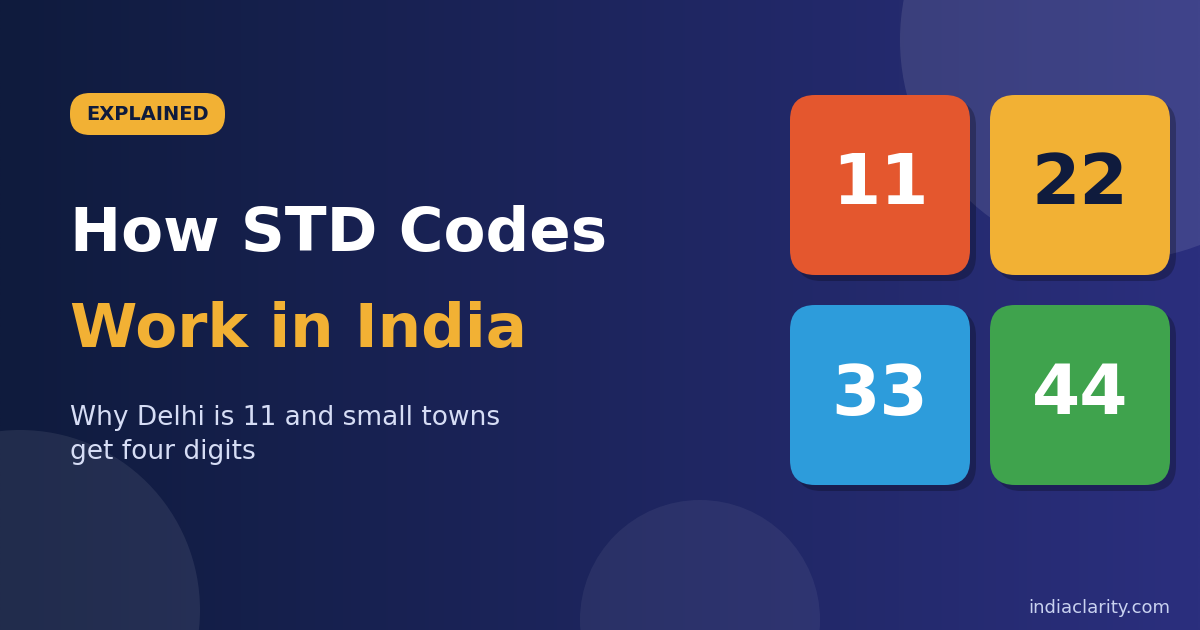
Delhi is 11. Mumbai is 22. Kolkata is 33. Chennai is 44.
Now think of a small town you know. Its STD code is probably longer, three or four digits, like 2832 for Bhuj in Gujarat. The usual explanation is that big cities get short codes. That is true, but it skips the interesting part. A code’s length is a trade: every digit that goes into the area code is a digit taken away from your phone number.
The Department of Telecommunications wrote this trade down in the National Numbering Plan of 2003. Once you know the rule, you can read almost any STD code the way you read a PIN code. This article covers the rule, what the first digit of a code tells you, why landline numbers so often begin with 2, what to dial in each situation, and what TRAI proposed in 2025.

What an STD code is, and what the zero does
STD stands for Subscriber Trunk Dialling, the system that lets you dial a number in another city yourself instead of asking an operator to connect you. A Delhi landline is written 011-2XXXXXXX.
People use two names here, and they do not always match. In BSNL’s usage, the STD code is the full 011, zero included, and the government’s telephone-number standard says so. In DoT and TRAI papers, 11 is the area code, and the 0 is a separate thing called the trunk prefix, a signal to the exchange that the call is leaving the local area. That is why one website says Bengaluru’s code is 80 and another says 080. It is the same code written two ways.
Official papers also call the area code an SDCA code. SDCA stands for Short Distance Charging Area, the local calling zone that the code belongs to. Each zone has its own unique code, and TRAI’s papers count 2,645 of them across the country.
One number that is not part of any of this is +91. That is India’s country code, and it appears only on international calls.
The 10-digit budget
Here is the rule everything else follows. The area code and the local number together must add up to 10 digits. Mobile numbers are also 10 digits long, so the whole country runs on one number length.
If the area code takes two digits, eight are left for your number. If it takes four, only six are left. The National Numbering Plan estimates what each split can hold:
| Area code length | Local number length | Landlines one area can hold |
|---|---|---|
| 2 digits | 8 digits | about 4 crore |
| 3 digits | 7 digits | about 40 lakh |
| 4 digits | 6 digits | about 4 lakh |

These are the plan’s own estimates, and they assume that most numbers (80%) are in use. Notice the pattern: each digit given to the code cuts the capacity to a tenth. That is the whole trade. A town that will never need more than a few thousand landlines can live with a four-digit code, because six digits for local numbers is plenty. A metro that needs crores of lines cannot.
Why Delhi got two digits and your town got four
The plan says the length of a code runs from two to four digits, depending on the size of the area and how many phones it needs. That is the official version. There is a second cost that people rarely notice, and it explains why short codes are so scarce.
Codes cannot overlap. If 11 belongs to Delhi, no other area can have a code that starts with 11, otherwise the exchange could not tell where the code ends and the phone number begins. The plan expresses this as a swap: give up one two-digit code and you get ten three-digit codes. Only 79 two-digit codes are possible at all (11 to 89), so each one used up wipes out a whole block of longer ones.
That is why the plan handed out just eight two-digit codes: 11 for Delhi, 20 for Pune, 22 for Mumbai, 33 for Kolkata, 40 for Hyderabad, 44 for Chennai, 79 for Ahmedabad and 80 for Bengaluru. It kept five more in reserve (39, 50, 60, 69 and 70).
The 11-22-33-44 run looks planned, but I could not find any official document that explains the repeated digits, so treat it as a pattern and not a rule. Pune (20) and Ahmedabad (79) show that repeated digits are not what earns a short code. Size does.
Mid-sized cities such as Jaipur (141), Lucknow (522), Patna (612) and Bhopal (755) have three digits. Most of the other areas have four.
Gurugram and Ghaziabad show the trade at work. Both have three-digit codes, 124 and 120, and both ran short of numbers. When TRAI studied the problem in 2024, one option in its consultation paper was to move them to one of the spare two-digit codes, 39 or 50. That would have multiplied capacity almost tenfold, but every local number would have had to grow from seven digits to eight.
One more point about what a code covers. It belongs to a local calling area, not to a town. The plan describes a typical area as covering one or more talukas, roughly 800 to 2,000 square kilometres, so one code can serve a town and the villages around it. Look up the National Numbering Plan 2003 and you will see codes listed taluka by taluka.
What the first digit tells you
The digits of an area code are not random either. The first digit points to a broad part of the country. The plan does not state this as a rule, so I built the table below from the plan’s own list of area codes (Annex II) and checked each example against it.
| First digit | Broad region | Examples |
|---|---|---|
| 1 | Delhi, Haryana, Punjab, Himachal, Jammu and Kashmir, much of Rajasthan | Gurugram 124, Chandigarh 172, Shimla 177, Srinagar 194 |
| 2 | Western Maharashtra and the coast, most of Gujarat, parts of Rajasthan | Kolhapur 231, Nashik 253, Surat 261, Rajkot 281 |
| 3 | West Bengal, Assam and the rest of the Northeast, Andaman and Nicobar | Guwahati 361, Shillong 364, Agartala 381, Andaman Islands 3192 |
| 4 | Tamil Nadu, Kerala, Puducherry (and Hyderabad) | Coimbatore 422, Madurai 452, Thiruvananthapuram 471, Kochi 484 |
| 5 | Uttar Pradesh | Kanpur 512, Prayagraj 532, Gorakhpur 551 |
| 6 | Bihar, Jharkhand, Odisha | Ranchi 651, Jamshedpur 657, Cuttack 671, Bhubaneswar 674 |
| 7 | Madhya Pradesh, Chhattisgarh, eastern Maharashtra (Vidarbha) | Nagpur 712, Indore 731, Jabalpur 761, Raipur 771 |
| 8 | Karnataka, Andhra Pradesh, Telangana outside Hyderabad, Goa | Mysuru 821, Mangaluru 824, Vijayawada 866, Visakhapatnam 891 |
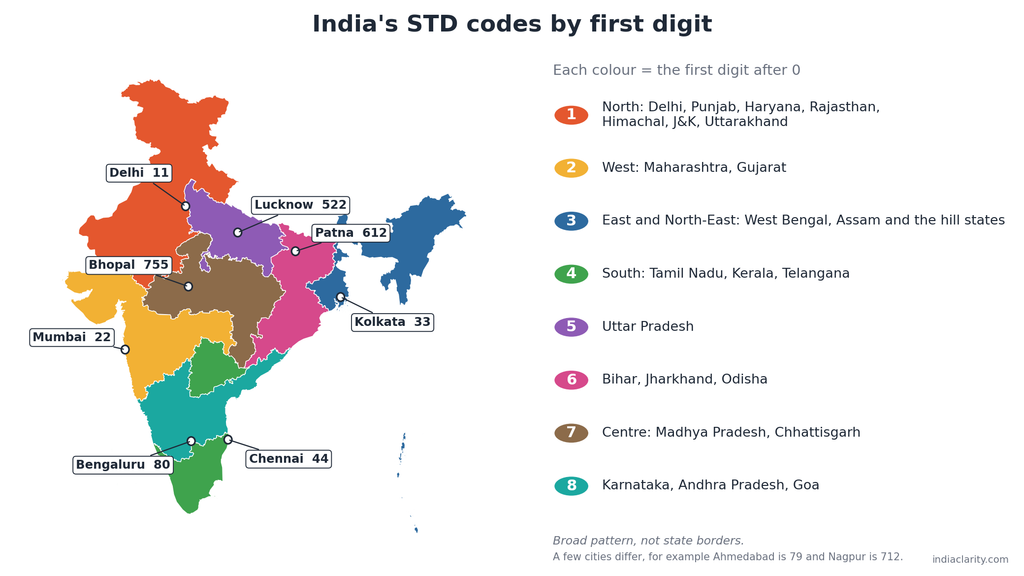
No area code starts with 0 or 9. The 0 is the trunk prefix, and 9 is kept for mobile and other services.
Treat the table as a broad pattern, not a map of state borders. Rajasthan alone uses codes starting with 1, 2, 5 and 7: Jaipur is 141, Udaipur 294, Bharatpur 5644 and Kota 744. Ahmedabad (79) and Hyderabad (40) also sit outside their neighbours’ digit. And the list dates from 2003, before Telangana and Jharkhand existed as states, which is why it files their areas under Andhra Pradesh and Bihar.
Try it on three codes.
0751. Drop the 0. The code is 751, so three digits and a seven-digit local number. It starts with 7, which puts it in central India. This is Gwalior.
02832. The code is 2832, four digits, so only six digits are left for the local number. It starts with 2, which points west. This is Bhuj, in Kutch.
080. The code is 80, only two digits, so the local number has eight. It starts with 8, the Karnataka and Andhra side. This is Bengaluru.
Why so many landline numbers start with 2
The second half of the number has a story too. Before 2003, a code plus a local number made only nine digits, and most small areas had a four-digit code with a five-digit local number. That left room for about 50,000 numbers per area. The 2003 plan fixed this by adding one digit to every local number, which is how the 10-digit rule came about.
The plan also set rules for that new digit. A local number may begin only with 2, 3, 4, 5 or 6. Zero is the trunk prefix, 1 is for services such as 100 and 112, 7 and 8 were kept in reserve, and 9 went to mobile services. BSNL and MTNL were given 2. Private operators were told to use 3 or 5. So when an old BSNL number got its extra digit, a 2 was put in front of it.
That is why so many landline numbers you have seen begin with 2, and the first digit still works as a clue. TRAI’s data from October 2023 shows 2 with BSNL and MTNL, 4 with Airtel, 60 to 69 with Tata Teleservices and 31, 35 and 36 with Jio. The blocks are handed out area by area, so the match is not the same everywhere. Mobile numbers lost this link because of number portability, since a number now stays the same when you change operator. Landlines have no such portability yet, so the opening digits there still point to the operator that was given the block.
What to dial in each situation
Here is what to dial in the five common cases.
| Situation | What to dial |
|---|---|
| Mobile to a landline anywhere in India | 0 + area code + local number |
| Landline to a landline in another area | 0 + area code + local number |
| Landline to a landline in the same area | Local number only (6 to 8 digits), for now |
| Landline to a mobile | 0 + the 10-digit mobile number |
| From abroad to an Indian landline | Your country’s exit code + 91 + area code without the 0 + local number |
The third row is the one TRAI wants to change, as the next sections explain.
Numbers that look like codes but are not
Three more numbers get mistaken for city codes. 112 is the all-India emergency number, one of the three-digit short codes reserved for essential services. Numbers starting with 1800 are toll-free, meaning the company pays for the call and not you. And 140 is the series given to telemarketers, so it belongs to no city at all.
What TRAI proposed in 2025, and what has not changed
By 2024 the system had an odd problem: enough numbers overall, but in the wrong places. TRAI’s study found that 58 of the 2,645 local areas had no fixed-line subscriber at all, and another 275 had fewer than 100. Their codes were sitting idle. Meanwhile, in 12 areas, including Gurugram, Ghaziabad, Chandigarh and Lucknow, at least one operator had used more than 70% of the numbers it was given. Blocks of numbers are tied to one local area, so unused numbers in an empty area could not help a crowded one.
On 6 February 2025, TRAI sent the government its answer in a set of recommendations: move landlines to a closed 10-digit scheme based on licence service areas, which roughly follow states and the big metros, instead of small local areas. In practice you would dial 0, then the area code, then the number for every landline call, even a local one. Dialling for calls involving mobiles would stay as it is. Existing numbers would stay too, because the 10-digit number is made by putting the area code in front of the local number you already have. New numbers could then be issued from a pool covering the whole state-level area. TRAI’s own example is adding a spare 30 to Ambala’s 171 to make a new code, 17130. Operators would get six months to switch.

Headlines called this the end of STD codes. It is nearly the opposite: the code stays, and you dial it every time. TRAI also suggested that, preferably within five years after the switch, each operator get a four-digit routing code. That would also lay the ground for keeping your landline number when you change operator, the way mobile portability works.
Where does it stand? A recommendation is not an order. The last dialling change TRAI proposed, the zero for landline-to-mobile calls, became compulsory on 15 January 2021 after the DoT issued a circular in November 2020, as this report from the time shows. For the 2025 proposal, no such order has turned up in our checks as of October 2026. Look at the TRAI and DoT websites before you assume that your local calls now need a code.
Questions people ask
Can two cities have the same STD code?
Every local area is given one unique code, so two separate areas never share one. If an online list shows the same code beside Bhavnagar and Bhuj, the list is wrong. The plan gives Bhavnagar 278 and Bhuj 2832.
How do I find the code for a small town?
Annex II of the National Numbering Plan names all the local areas with their codes. It dates from 2003, and town names have changed since (Allahabad is now Prayagraj, for instance), so search under the old name as well.
Why does a mobile number need no area code?
Mobile numbers are not tied to a place. TRAI describes the mobile system as closed and non-geographic: all ten digits are dialled for every call within India, wherever the phone happens to be.
Sources
Facts in this article were checked against the documents below on 11 October 2026.
- TRAI, Recommendations on Revision of National Numbering Plan, 6 February 2025
- TRAI, Consultation Paper on Revision of National Numbering Plan, 6 June 2024
- Department of Telecommunications, National Numbering Plan 2003
- Government of India, e-Governance standard for telephone numbers
- Deccan Herald (PTI), 14 January 2021, on the zero prefix for landline-to-mobile calls

Hi, I’m Aryan, the writer behind IndiaClarity. I write plain-language explainers on how India’s systems work, from district administration to the power grid. Before I publish, I check facts against primary sources such as Parliament answers, regulator documents and Acts of law, and I list them at the end of each article. If you spot a mistake, write to me at [contact@indiaclarity.com] and I will fix it.
1 thought on “How STD Codes Work in India: Why Delhi Is 11 and Smaller Towns Get Four Digits”