
Pick up your Aadhaar letter and try to read something into the number. Maybe the first digits hint at your state, or the last few at your age. They don’t. The 12 digits were built to say nothing about the person who holds them, and that was a deliberate choice, made before the first number was issued on 29 September 2010.
This article takes the number apart position by position. It covers what the first digit is for, why the middle digits are random, what the last digit quietly does, and where the 16-digit Virtual ID fits in. There is also a small worked example of the check-digit maths that you can follow step by step.
What the 12 digits are made of
An Aadhaar number has three kinds of digits, and only two of them have a job.
| Position | What it is | Role |
|---|---|---|
| Digit 1 | Any digit from 2 to 9 | Never 0 or 1. UIDAI’s first head wrote that this digit was reserved to denote the type of number. |
| Digits 2 to 11 | Random | Generated at random. They carry no information about the holder. |
| Digit 12 | Check digit | Worked out from the other 11 digits, so that typing mistakes can be caught. |
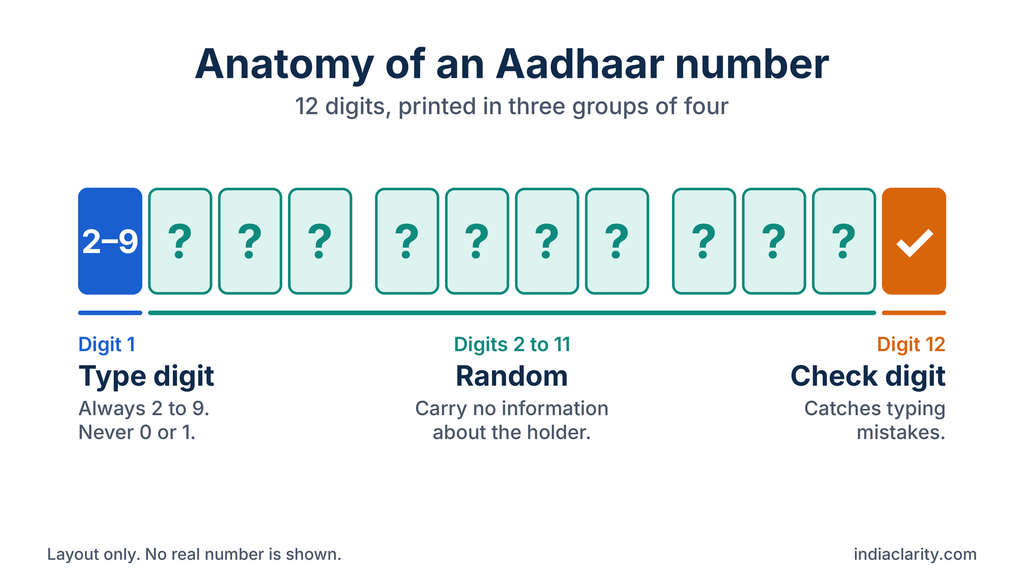
Wherever the number is printed, it appears in three groups of four digits. The gaps are only there to make it easier to read out and copy. Each of the three parts has its own story, and the random middle is the one that surprises people most.
Why UIDAI made the number meaningless on purpose
R. S. Sharma was the first director general of the Aadhaar project. In a 2016 piece for Governance Now he described a question that kept coming up in the early days: why not build the number with codes for state, district and gender, so that something like UP09/12345 would point to a person from Agra? He gave three reasons for saying no.
The first is that Aadhaar was meant to be an online identity from day one. Putting facts inside a number made sense when you had no way to look anything up. Here the details sit behind the number and can be checked in real time, so the number does not have to carry them.
The second is privacy. He points to the US Social Security Number, where patterns in the digits let people guess facts about a holder, and even guess the number if they know the person. A random number leaves nothing to guess from.
The third is plain usability. Aadhaar uses digits only because everyone understands them, they sit on every phone keypad, and they are as easy to remember as a phone number. Letters would have made the number shorter, but they were not found workable in a country with many languages and many people who struggle with reading.
The structure itself came out of an internal 2010 report by Hemant Kanakia titled “A UID Numbering Scheme”, which Sharma cites as the basis of the design.
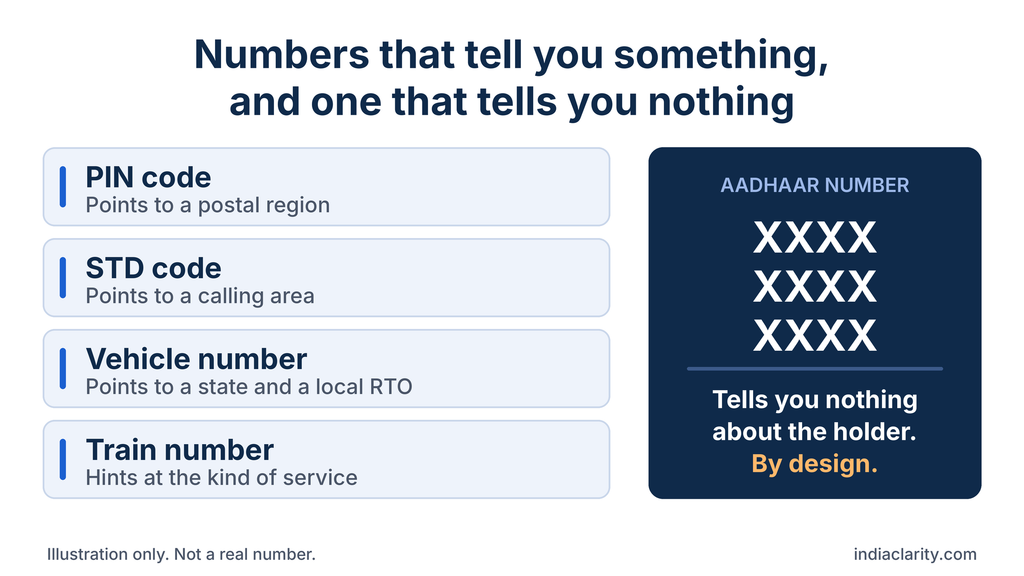
Most other numbers you meet in India work the opposite way. A PIN code points to a postal region, an STD code to a calling area, a vehicle registration number to a state and a local RTO, and a train number hints at the kind of service the train runs. Aadhaar is the odd one out, and it is odd by design.
Why 12 digits, and why the first digit is never 0 or 1
The arithmetic behind the design is simple. Twelve digits, with the last one reserved as a check digit, leave eleven digits free. Eleven digits give 100 billion combinations. Keeping the first digit between 2 and 9 cuts that to 80 billion.
That is far more than a country of well over a billion people needs, and it is meant to be. When Sharma wrote his piece, a little over one billion numbers had been issued, so only a little over one percent of the available space was in use. He compares the choice with IPv4 addresses and the Y2K problem, where a tight format ran out of room and fixing it later cost time and money.
The digit 1 was held back on purpose. Sharma says UIDAI reserved a leading 1 for entity-related UIDs, in case that need ever arises. His piece does not give a separate reason for leaving out 0. The scheme is also meant to be extendable, so more digits can be added later without breaking the numbers already issued.
Just before the first numbers were rolled out in 2010, a Business Standard report quoting UIDAI described the first digit as an implicit version number and the last digit as a check digit. That is still the way the two ends of the number are described.
The last digit: a small piece of 1960s mathematics
Typing twelve digits without a slip is harder than it sounds. One wrong digit sends a request for a number that either does not exist or belongs to a stranger. The twelfth digit is there to catch such slips before they travel anywhere.
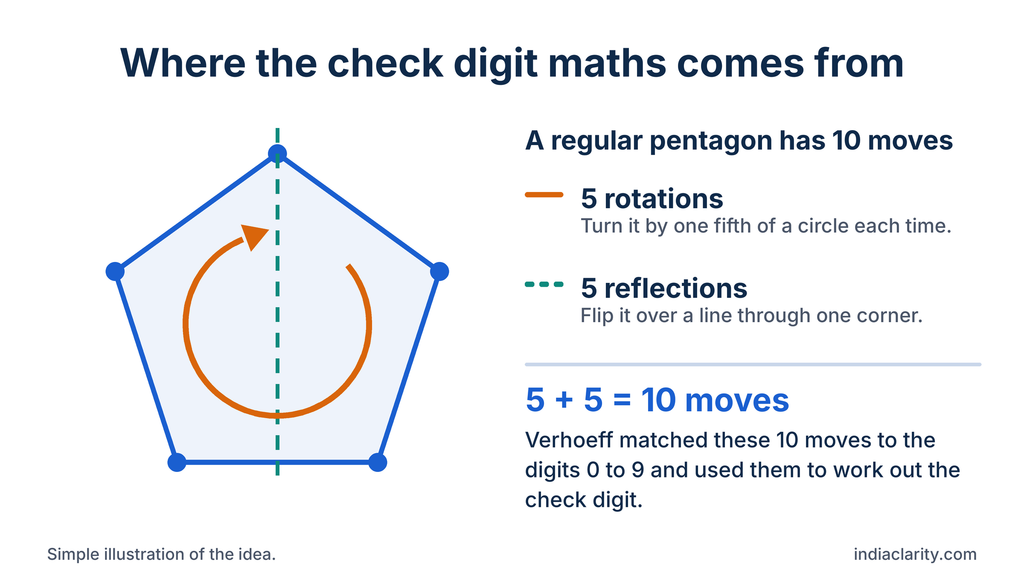
It is calculated from the first eleven digits with the Verhoeff algorithm, published in 1969 by the Dutch mathematician Jacobus Verhoeff. When it appeared, it was the first method that used a single decimal digit and still caught every single-digit mistake and every swap of two neighbouring digits, something that had been thought impossible at the time. It is built on the dihedral group of order 10, which mathematicians describe through the rotations and reflections of a regular pentagon. The same method has also been used on German Deutschemark banknotes.
You do not need group theory to use it. In practice the calculation runs on three small lookup tables, and the one real drawback, as the Wikipedia entry on the algorithm points out, is that it is too involved to do in your head.
A worked example with three digits
Real Aadhaar numbers have eleven digits to process, which makes a poor demonstration. Take the three digits 2, 3 and 6 instead. The method uses a multiplication table (called d), a permutation table (p) and an inverse table (inv). “Multiplication” here means a table lookup, not ordinary multiplication, and each position in the number uses a different row of the permutation table. That change from position to position is what makes a swapped pair show up as an error.
To generate the check digit for 236, work from the right:
| Step | Digit (right to left) | Digit after permutation | Running value |
|---|---|---|---|
| 1 | 6 | 3 | 3 |
| 2 | 3 | 3 | 1 |
| 3 | 2 | 1 | 2 |
The running value ends at 2. The inverse table turns 2 into 3, so the check digit is 3 and the full number becomes 2363. This is the same example used in Wikipedia’s Verhoeff article, which also lists all three tables if you want to repeat the steps on a longer number.
To validate 2363, the same walk is done on all four digits, and a correct number finishes on 0. Here the running values go 3, 1, 4 and then 0. Now swap the last two digits to get 2336 and run it again. The result is 4, not 0, so the number is rejected. Changing only the last digit to get 2362 is rejected as well.
What the check digit catches, and what it cannot
Every single-digit mistake is caught, and so is every swap of two neighbouring digits. Most other slips, such as two repeated digits changed together, or two digits swapped with one digit between them, are caught too, though not all of them.
The bigger limit is arithmetic. A check digit can take only ten values, so a number invented at random will pass the check about one time in ten. Passing only shows that a number is well formed. Whether it was ever issued is something only UIDAI can answer, and it offers a validity check on its My Aadhaar portal.
How a number reaches you
A number is allotted only at the end of the enrolment process. The data collected, which UIDAI lists as demographic details, ten fingerprints, two iris scans and a photograph, goes through quality and validation checks and then through de-duplication. If a duplicate turns up, no number is issued and the enrolment is rejected. UIDAI explains each stage on its Aadhaar generation page, so the whole pipeline is not repeated here.
You cannot pick your number. When the programme was starting out in 2010, UIDAI said numbers with patterns such as 1947 or 1111 would not be issued and that people would not be able to ask for a number of their choice. Once a number is assigned, it stays with the person for life. According to Sharma it is not reused even after the holder dies, which avoids confusion over who the number belongs to.
It is also worth knowing that what UIDAI issues is a number, not a card. The paper letter sent by India Post has a perforated portion that can be torn off and laminated, and Sharma points out that authentication works online with just the number. The PVC card UIDAI offers separately is a printed version of the same number.
Myths about the 12 digits, checked
A few beliefs about these digits are common. Here is how they hold up against what UIDAI and its first head have said.
| What people say | What the record says |
|---|---|
| “The digits reveal your state, district, age or gender.” | UIDAI says the number has no intelligence built into it and does not profile people by caste, religion, income, health or geography. |
| “A smaller number means an earlier enrolment.” | The digits are generated at random, so how large or small a number looks says nothing about when it was issued. |
| “If a checker says the number is valid, it is a real Aadhaar.” | The check digit only confirms that the number is well formed. A made-up number passes about once in ten tries, and only UIDAI can confirm that a number exists. |
| “Having an Aadhaar number proves you are a citizen.” | UIDAI describes it as proof of identity that does not confer any right of citizenship or domicile. |
Aadhaar number, masked Aadhaar and Virtual ID
The full 12-digit number is not needed every time, and UIDAI offers two ways of sharing less of it.
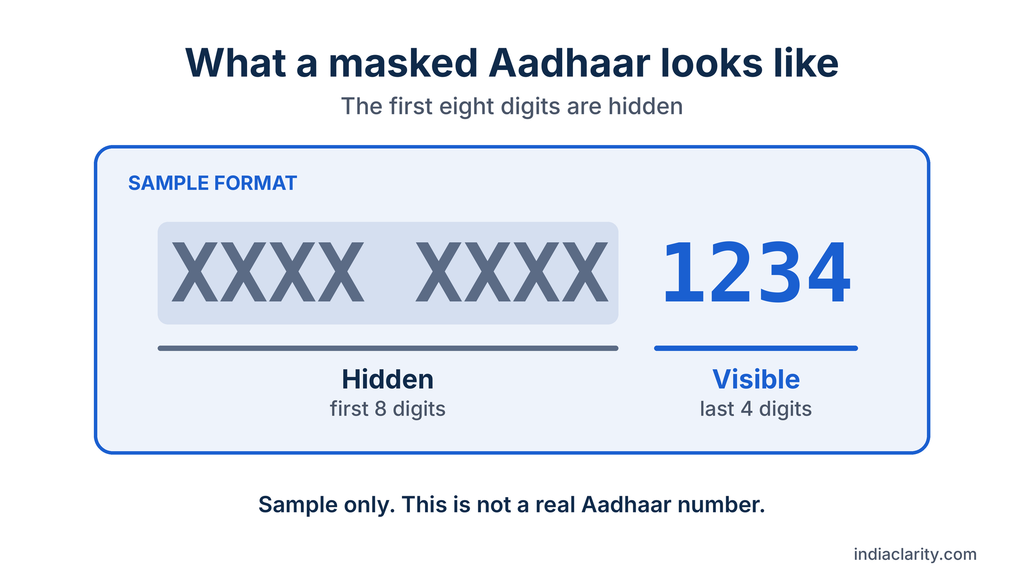
A masked Aadhaar replaces the first eight digits with X and leaves the last four visible, for example XXXX XXXX 1234. UIDAI posted that masked Aadhaar is valid and widely accepted, as Zee Business reported.
A Virtual ID, or VID, goes further. It is a 16-digit random number linked to your Aadhaar number, temporary and revocable. When UIDAI introduced it in 2018, its circular stated that the Aadhaar number cannot be worked out from a VID. Only one VID is active at a time, so generating a new one replaces the old one, as The Quint explained. UIDAI says a VID can be used in place of the Aadhaar number for authentication and e-KYC. You can generate one on UIDAI’s My Aadhaar portal, and the mobile number registered with UIDAI is needed for it.
| Aadhaar number | Masked Aadhaar | Virtual ID | |
|---|---|---|---|
| Length | 12 digits | 12 digits, first 8 hidden | 16 digits |
| Can it change? | No, it stays for life | The underlying number does not change | Yes, you can replace it |
| What it shows | The whole number | Only the last four digits | A random number linked to your Aadhaar number |
| Typical use | Authentication, KYC and linking | A copy to share where the full number is not needed | Authentication and e-KYC in place of the number |
For extra protection, the Aadhaar app lets you lock and unlock your biometrics, a service listed on UIDAI’s own pages.
Frequently asked questions
How many digits does an Aadhaar number have?
Twelve. The first is a digit from 2 to 9, the next ten are random, and the last is a check digit. It is printed in three groups of four.
Can an Aadhaar number start with 0 or 1?
No. Numbers start with a digit from 2 to 9. UIDAI’s first head wrote that the leading 1 was set aside for possible future use.
Is the Aadhaar number a secret?
It is an identity number, not a password. Sharma describes authentication as the number plus one more item, such as a fingerprint, an iris scan or an OTP, sent to UIDAI’s central records, which answers yes or no without handing back personal details. So the number alone does not open your record. Even so, UIDAI itself offers masked copies and the Virtual ID for people who would rather not share the full number, so giving it only where it is needed is sensible.
How do I get a 12-digit Aadhaar number?
Any resident of India can enrol voluntarily, and UIDAI says enrolment is free. You give basic demographic details along with biometrics, which are ten fingerprints, two iris scans and a photograph. The number is issued only after the checks described above.
Can two people have the same Aadhaar number?
UIDAI’s process is built to issue one number per person after checking for duplicates, and numbers are not reused. A number should therefore belong to one person only.
Only two digits in an Aadhaar number have a job: the first marks the type of number and the last catches typing mistakes. The ten in between are random on purpose. Anyone who says they can read your state or age from the digits is guessing.
Sources
Facts last checked on 7 November 2026.
- UIDAI, About Your Aadhaar
- UIDAI, Aadhaar Generation
- R. S. Sharma, Revisiting foundations of Aadhaar, Governance Now, 6 December 2016
- Business Standard, UIDAI to go strict on issuing numbers, 14 September 2010
- Wikipedia, Verhoeff algorithm
- Zee Business, Masked Aadhaar and VID
- The Quint, Aadhaar Virtual ID explained

Hi, I’m Aryan, the writer behind IndiaClarity. I write plain-language explainers on how India’s systems, places and history work. Before I publish, I check facts against primary sources such as official records, Parliament answers, Census data and Acts of law, and I list the sources at the end of each article. If you spot a mistake, write to me at 7brewusaofficial@gmail.com and I will fix it.