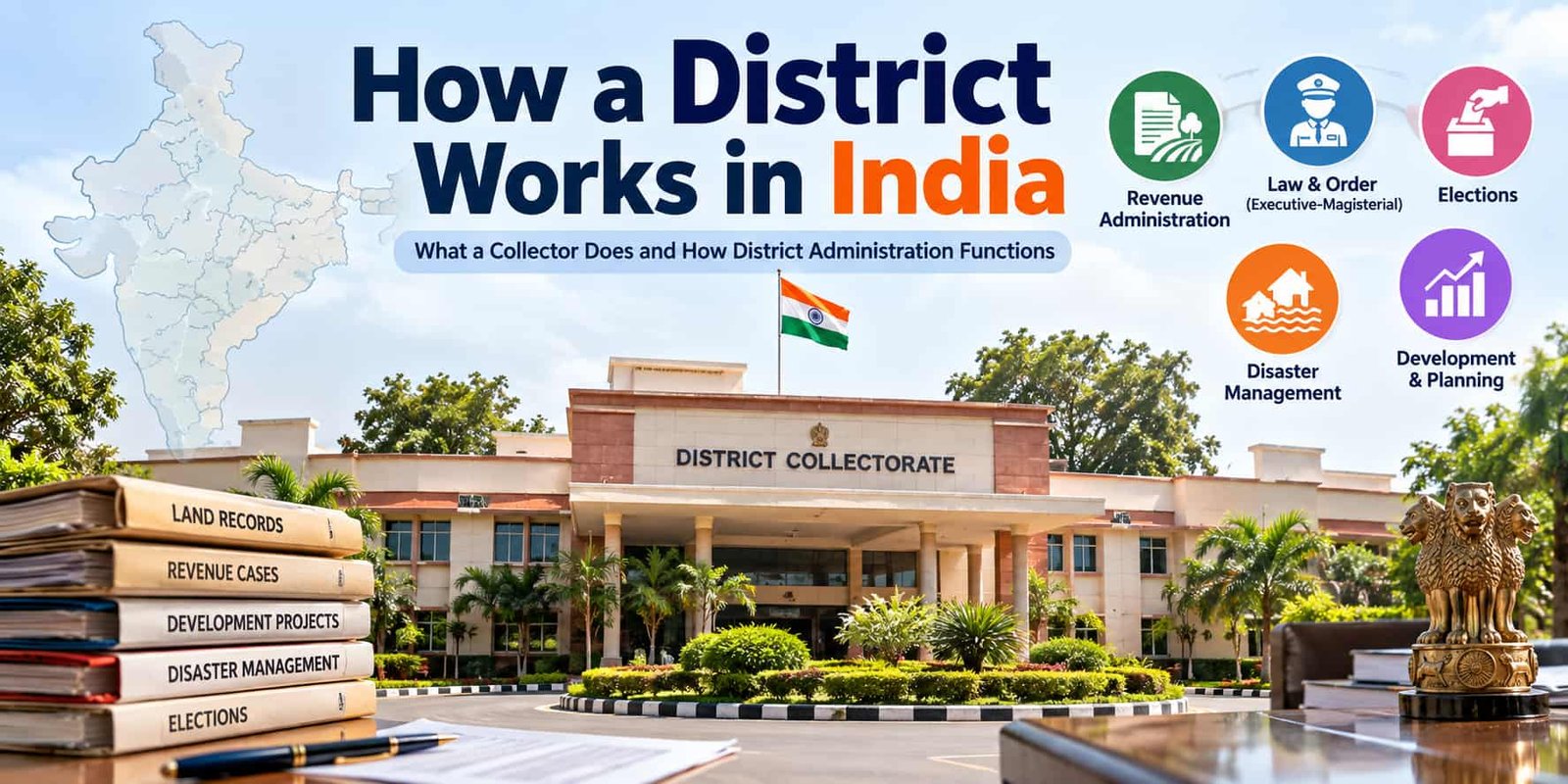
Who actually runs a district?
A district is run by many offices working side by side. The Collector, District Magistrate or Deputy Commissioner is usually the senior coordinating officer, the person who ties together revenue, executive-magisterial work, elections, disaster response and development schemes. The police, health, education and public works departments keep their own chains of command and their own district heads.
Titles and exact powers come from state law, which is why the same post is called a Collector in one state and a Deputy Commissioner in another. This article follows the post from its origin in the East India Company to the paperwork on a village land record.
What is a district?
A district is the main territorial unit of administration inside a state or Union Territory. States divide districts into sub-divisions, and those into tehsils, taluks, circles or similar units, depending on the state.
Districts differ enormously in size. Kachchh in Gujarat covers 45,674 sq km, more than the whole of Haryana (44,212 sq km) or Kerala (38,863 sq km), and has ten talukas and about 2.09 million people. At the other extreme, Mahe in Puducherry spans about 9 sq km, while Dibang Valley in Arunachal Pradesh had 8,004 residents in 2011, spread across roughly 9,100 sq km of mountains.
| What the example shows | District | Census 2011 figure |
|---|---|---|
| Largest district by area | Kachchh, Gujarat | 45,674 sq km |
| Smallest district by area | Mahe, Puducherry | 9 sq km |
| Most populous district | Thane, Maharashtra | 11,060,148 people |
| Least populous district | Dibang Valley, Arunachal Pradesh | 8,004 people |

These figures follow the district boundaries of the 2011 Census. Many districts have been split or redrawn since then, so read the table as a 2011 snapshot, not a current ranking. Leh in Ladakh, for example, comes close to Kachchh at 45,110 sq km.
India now has roughly 780 to 800 districts. The exact count depends on the date and on how special cases, such as Mahe and Yanam in Puducherry or temporary districts, are counted. The Local Government Directory publishes the current list.
The workload follows the map. A Collector in a dense urban district deals with crowds, land disputes and civic coordination, while a Collector in a district like Kachchh manages long distances, thin services and a long coastline.
Collector, District Magistrate and Deputy Commissioner
In many states these are three titles for the same officer. Each title points to a different function: “Collector” to land revenue, “District Magistrate” to executive-magisterial powers, and “Deputy Commissioner” is the administrative title used in several states. The Police Act, 1861 already defines the “Magistrate of the district” as the chief officer in charge of a district’s executive administration, whatever title that officer carries.
| State | Title commonly used for the district head |
|---|---|
| Haryana | Deputy Commissioner / District Magistrate / Collector |
| Punjab | Deputy Commissioner |
| Karnataka | Deputy Commissioner & District Magistrate |
| Assam | Deputy Commissioner |
| Madhya Pradesh | Collector & District Magistrate |
| Maharashtra | District Collector / District Magistrate |
| Rajasthan | District Collector & District Magistrate |
| Uttar Pradesh | District Magistrate |
The officer is usually from the Indian Administrative Service (IAS), although IAS officers who reached the service by promotion from a state civil service also hold these posts. Nobody is elected to the position.
Postings follow the IAS (Cadre) Rules, 1954. After a Supreme Court direction in October 2013, the Centre amended the rules on 28 January 2014: a cadre officer posted to a cadre post holds it for at least two years, unless promoted, retired, sent on deputation outside the state or sent for training longer than two months. Moving an officer earlier requires a recommendation from the state’s Civil Services Board. The Department of Personnel and Training publishes the rules.
How the Collector’s office developed
The office begins with the East India Company’s revenue management in Bengal.
- 1772: Warren Hastings appointed Collectors to districts. They collected revenue and also presided over the district civil court.
- 1780: Separate district civil judges were created, which split the two jobs.
- 1787: The Company’s directors wanted one officer for revenue, civil justice and magisterial work, so the functions returned to the Collector.
- 1793: The Cornwallis Code separated revenue administration from civil justice again. Collectors kept revenue and district judges took over the civil courts.
Land revenue was the original job. Executive and magisterial duties were attached to the district head in later reorganisations, which is why the modern post carries both “Collector” and “Magistrate” in its title.
After Independence the district stayed the basic unit of administration. The Collector now works inside a constitutional system of elected governments, courts, police, local bodies and specialised departments, and the old name survives even though collecting revenue is a small part of the work.
The five real jobs of a Collector
Revenue administration
Revenue work is the oldest of the five. It covers supervision of land records, revenue cases, government land, land acquisition and other matters assigned under state revenue laws.
Mutation means recording a change in a revenue record after a sale, inheritance or another legally recognised transfer. A mutation entry keeps the revenue record current, and it does not settle every question of ownership.
Maharashtra shows how the machinery works. Under the Maharashtra Land Revenue Code, 1966, a person who acquires rights in land reports it to the village Talathi within three months (section 149). The Talathi writes a numbered entry in the Register of Mutations, known as a ferfar. If nobody objects, the Circle Officer certifies it, and the 7/12 extract is updated. That extract records land rights in Form 7 and cultivation details in Form 12. If someone disputes the entry, it goes to the Register of Disputed Cases and the Tahsildar decides it (section 150). The Collector sits at the top of this system with supervisory and appellate powers and rarely handles a routine entry.
Executive-magisterial work
The District Magistrate is an Executive Magistrate, a separate role from a judicial magistrate or a judge trying a criminal case. Under the Bharatiya Nagarik Suraksha Sanhita, 2023 (BNSS), the State Government appoints Executive Magistrates and names one of them District Magistrate.
The best-known power is in Section 163, which replaced Section 144 of the old Code of Criminal Procedure. A District Magistrate, Sub-Divisional Magistrate or another specially empowered Executive Magistrate can issue a written order stating the material facts when immediate prevention is needed against obstruction or injury to a person lawfully employed, danger to human life, health or safety, a threat to public tranquillity, a riot or an affray. A prohibitory order of this kind can, for example, restrict assemblies in an area. It normally lasts up to two months, and the State Government can extend it in specified situations.
The magistrate issues the order, and the police enforce it under their own command.
Elections
Section 13AA of the Representation of the People Act, 1950 provides for a District Election Officer in every district. The Election Commission of India usually designates the District Collector, District Magistrate or Deputy Commissioner for the role.
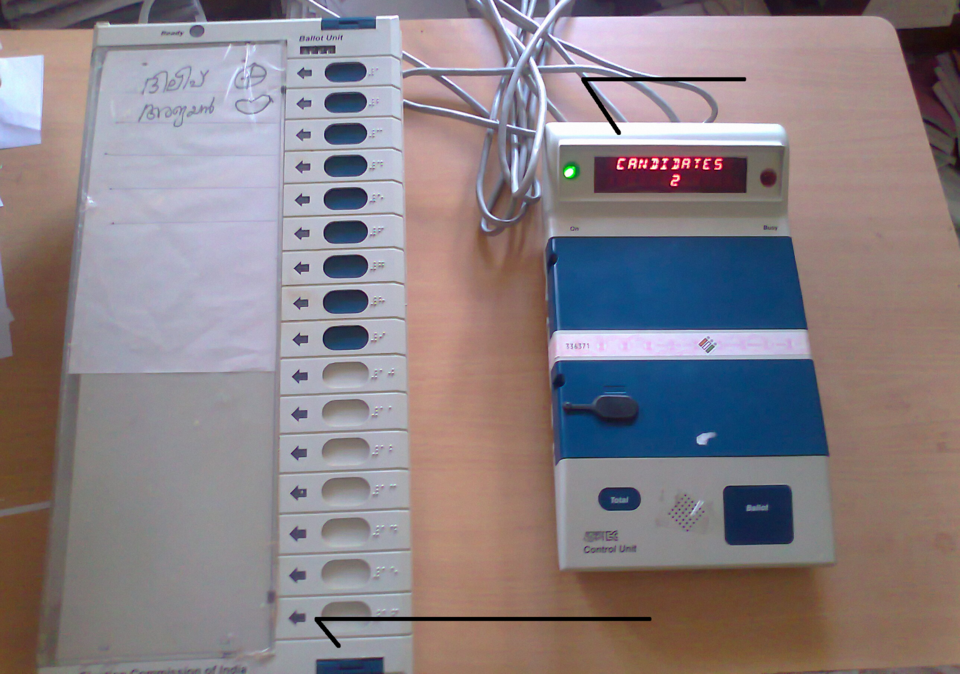
During an election the district machinery handles electoral-roll work, polling arrangements, election staff, logistics, training and security coordination. Election rules and instructions come from the Election Commission, and the Collector implements them in the district.
Disaster management
The Disaster Management Act, 2005 sets up a District Disaster Management Authority in every district (Chapter IV). Section 25 makes the Collector, District Magistrate or Deputy Commissioner its chairperson. An elected representative of the local authority serves as co-chairperson.
Assam’s 2022 notification, published by the state disaster management authority, shows the pattern. The Deputy Commissioner chairs the authority and the Zilla Parishad chairperson is co-chairperson. In Sixth Schedule areas the Chief Executive Member of the district council takes that seat. The Deputy Commissioner nominates the authority’s chief executive officer, and the Superintendent of Police, the Chief Medical Officer and the PWD Executive Engineer sit as members.
Section 26 lets the chairperson exercise powers the authority delegates. Section 30 makes the authority the district’s planning, coordinating and implementing body, and Section 31 requires a District Plan. In a major flood the Collector coordinates evacuation, shelters, relief, transport and communication, while specialist agencies do the technical work.
Development and district planning
Development work brings together departments dealing with rural development, agriculture, health, education, roads and welfare. The Collector reviews implementation, coordinates departments and resolves problems that cross office boundaries.
The District Planning Committee (DPC) has its own constitutional basis. Article 243ZD requires a DPC in every district to consolidate the plans of Panchayats and Municipalities into a draft development plan for the district. At least four-fifths of its members are elected by and from the elected members of the district Panchayat and the Municipalities, in proportion to the rural and urban population of the district. The Collector’s office coordinates the wider administration that carries the plan out.
What a Collector does not control
- Police command: The SP has a separate police command chain, even when the two offices coordinate on public order.
- Courts: Judicial courts operate independently under the Constitution and the laws governing the judiciary.
- Elected local bodies: Panchayats and Municipalities have elected representatives and statutory powers of their own.
- Technical departments: Department heads keep responsibility for their programmes and budgets under their governing rules.
Not every government employee working in a district reports to the Collector.
The chain below the Collector
The revenue and executive structure is clearest when followed from the district down to the village.
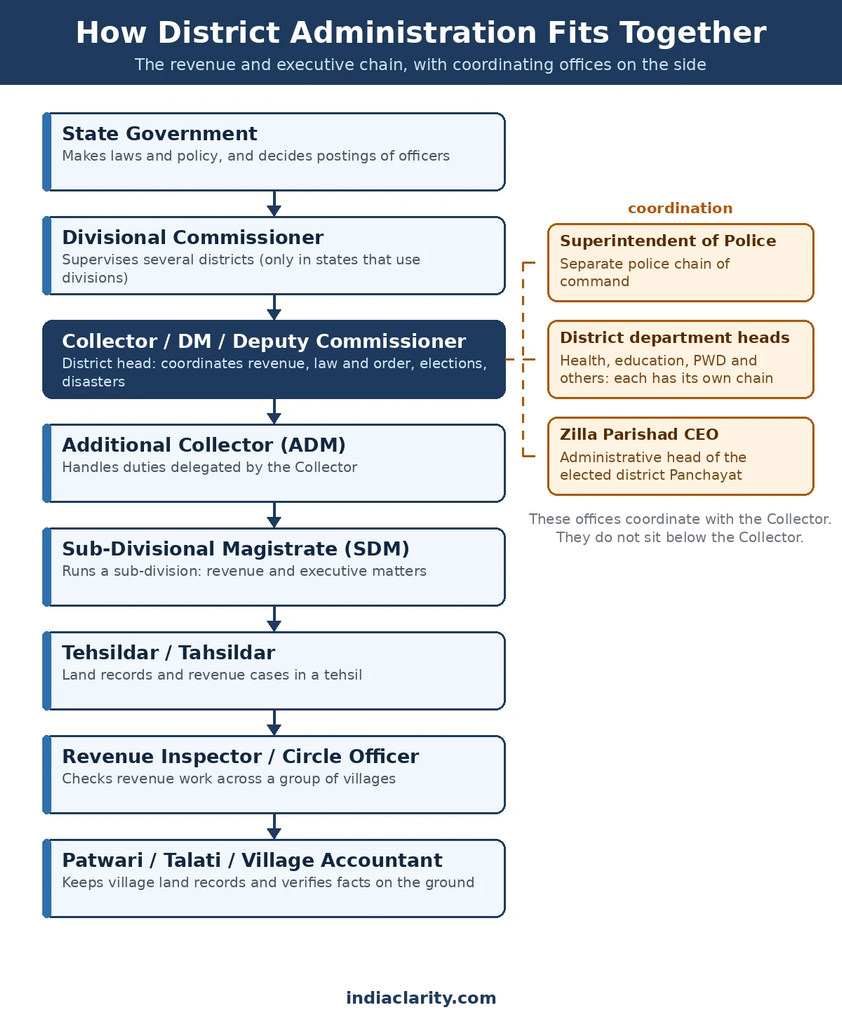
- Collector / District Magistrate / Deputy Commissioner: Coordinates district administration and exercises the statutory powers of the post.
- Additional District Magistrate / Additional Collector: Handles responsibilities delegated by the District Magistrate or the state government.
- Sub-Divisional Magistrate (SDM) / Sub-Divisional Officer: Heads a sub-division and commonly handles executive-magisterial and revenue matters at that level.
- Tehsildar / Tahsildar / Taluk-level revenue officer: A tehsil is a sub-district administrative and revenue unit. The Tehsildar handles land records, revenue cases and field administration within it.
- Revenue Inspector / Circle-level official: Checks revenue work across a group of villages or a revenue circle.
- Patwari / Talati / Village Accountant: Keeps land and revenue records at village level and does local verification.
This is the revenue and executive chain. Police, health, education and other departments have their own structures.
One task, several offices: correcting a land record
A land-record correction shows how one ordinary task passes through several levels of government. The table follows Maharashtra. Other states use different names for the same steps: Haryana records rights in the Jamabandi and Uttar Pradesh uses the Khatauni. Check your own state’s Revenue Department portal before applying.
| Step | Office involved | What happens | Paper involved |
|---|---|---|---|
| 1 | Sub-Registrar office or applicant | The sale is registered, or succession papers are prepared. | Registered sale deed, or death certificate and heirs’ details |
| 2 | Village Talathi | The Talathi opens an entry in the Register of Mutations. The new holder must report within three months. | Mutation entry (ferfar) |
| 3 | Talathi and revenue office | Interested persons are notified and can object. | Notice of mutation |
| 4 | Circle Officer, or Tahsildar if disputed | The Circle Officer certifies an undisputed entry. A disputed entry goes to the Tahsildar to decide. | Certified entry or Tahsildar’s order |
| 5 | Land-record system | The 7/12 extract is updated with the change. | Updated 7/12 extract |
| 6 | Appellate revenue authority | Anyone who challenges the order can appeal or seek revision. | Appeal and revenue order |
Landowners often say, “I need the Collector to change my record.” In practice the file starts with the village official and reaches the Collector only through an appeal or an escalated dispute.
Collector vs Superintendent of Police vs Police Commissioner
The Collector or District Magistrate handles executive-magisterial functions and coordinates district administration. The Superintendent of Police (SP) heads the district police.
The Police Act, 1861 sets the traditional balance. Section 3 vests superintendence of the police in the State Government. Section 4 vests police administration in the district in a District Superintendent, under the general control and direction of the Magistrate of the district. On paper the Magistrate has general direction, while day-to-day police work runs through the SP and up the police chain to the state’s Director General of Police. Several states now run under their own police acts, so the exact arrangement depends on local law.
Large cities may work under a Police Commissionerate, where state law gives the Police Commissioner some executive-magisterial powers. That changes the traditional Collector-SP pairing. Asking who is more powerful has no single answer, because each office performs different functions under the applicable law.
Collector vs Zilla Parishad CEO
The 73rd Constitutional Amendment Act, 1992 gave Panchayats constitutional status through Part IX of the Constitution. Article 243G lets state laws give Panchayats powers and responsibilities for economic development and social justice, including planning and implementing schemes.
A Zilla Parishad is the district-level Panchayat. Its chairperson is an elected representative, while its Chief Executive Officer (CEO) performs the administrative duties assigned by the state’s Panchayat law. The two offices are not two levels of one chain of command, and each state’s Panchayat Act sets out their working relationship.
They meet formally on the District Disaster Management Authority, where the Collector chairs and the Zilla Parishad head is co-chairperson in many states. They also meet on rural development programmes and, through the District Planning Committee described earlier, on district planning.
Myths vs facts
Myth: “The Collector is elected by the people.”
Fact: The Collector is a government-appointed officer, posted through government service arrangements.
Myth: “Collector and District Magistrate are two different officers in every district.”
Fact: In many states the titles belong to the same officer and reflect different functions of the post.
Myth: “The Collector collects every tax and fee in the district.”
Fact: Each tax and fee is handled by the authority its law names. The Collector’s revenue role covers areas such as land revenue.
Myth: “All districts have the same size and structure.”
Fact: Districts differ greatly in area, population, geography and the number of administrative units inside them.
FAQs
How can I find out who the Collector of my district is?
Open the official district website run by your state government or Union Territory administration. District portals usually publish the current district head and contact details, though the officer can change after a transfer.
What is a Divisional Commissioner and where does that post sit in the hierarchy?
In states that use divisions, a Divisional Commissioner supervises and coordinates administration across several districts. The post sits above the district level, and the state government sets its exact powers.
Can a Collector overrule a civil court?
No. Administrative or revenue powers do not let a Collector disregard a binding order of a competent civil court. Remedies against a court order go through the judicial process.
Can a Collector personally decide how a government scheme is funded?
No. Scheme funding runs through budgets, government orders, legislation and scheme guidelines. A Collector coordinates implementation and monitors spending within the powers of the office, and cannot redesign funding rules or redirect public money freely.
Sources
- India Code: Constitution of India (Articles 243G, 243ZD), Bharatiya Nagarik Suraksha Sanhita, 2023 (Section 163), Disaster Management Act, 2005 (Sections 25, 26, 30, 31), Representation of the People Act, 1950 (Section 13AA), Police Act, 1861 (Sections 1, 3, 4)
- Maharashtra Revenue Department, Mahabhulekh: Maharashtra Land Revenue Code, 1966 (Sections 149, 150), 7/12 extract
- Department of Personnel and Training: IAS (Cadre) Rules, 1954, as amended on 28 January 2014
- Assam State Disaster Management Authority: District Disaster Management Authority notification, 1 October 2022
- Census of India: Census 2011 district data
- Local Government Directory: current list of districts
- Election Commission of India: District Election Officers
- National Disaster Management Authority
