

Search for India’s first census and the answers do not agree. One page says 1872. Another says 1881. A third goes back to 1865, and some start with a head count of Dacca city in 1830. Nobody is exactly wrong, because “first” can mean three different things: the first count of any kind, the first attempt across the whole country, or the first time everyone was counted on the same night.
Here is the short version. People were counted region by region between 1865 and 1872, and that effort is what usually gets labelled the first census. The first census taken on one fixed date across British India was held on 17 February 1881. Since then India has counted its people every ten years, with one break: the count that was due in 2021 is only now being carried out as Census 2027.
The rest of this post is about what those counts looked like on the ground, who did the counting, how the questions changed, and where Census 2027 stands as of 9 November 2026.
Who started the first census of India, and which year counts?
Start with what the government itself says. The PIB backgrounder on Census 2027 describes the first modern population count in India as something done between 1865 and 1872, and not at the same time everywhere. It then names 1881 as the first synchronous census and says the exercise has been repeated every ten years since.
| Year | What happened | Why it is called “the first” | Why that is not the full story |
|---|---|---|---|
| 1865 | The North-Western Provinces were counted. | Some writers treat it as the first proper census. | It covered one region. Bengal had no region-wide count even by 1872. |
| 1867–1872 (labelled “1872”) | Provinces were counted one after another while Lord Mayo was Viceroy. | It was the first attempt at a population count for the whole of British India. | The counts were spread over several years, and the princely states were left out. |
| 17 February 1881 | British India was counted on a single night, with W. C. Plowden as Census Commissioner. | It was the first synchronous census. | Kashmir was not included. The scheme was still rough compared with later censuses. |

The ten-year idea is older than 1881. Historian S. C. Srivastava, as summarised in the Wikipedia article on the census in British India, notes that the government decided in 1856 to count the population every ten years starting from 1861. The rebellion of 1857 put that plan on hold, and the counts that followed were done region by region.
A count spread over several years has a built-in flaw. People move, children are born, others die, and a family counted in one district in 1868 could be living in another by 1871. Counting everyone on the same night removes that problem, which is the real reason 1881 is treated as the starting line of the modern series. The 1881 operation covered British India except Kashmir, and it also brought in the feudatory states, the French and Portuguese territories and Burma, according to the summary on the People’s Archive of Rural India.
The Viceroy in 1872 was Lord Mayo, and Lord Ripon held the office in 1881. The man who ran the 1881 count and wrote its main report was William Chichele Plowden. Some online lists attach the wrong names to the wrong years. J. A. Baines, who is credited with 1881 on a few pages, became Census Commissioner for 1891, and the Registrar General’s own list of census commissioners shows the same order.
Which city had the first census?
Before any of this, a few cities were counted on their own. The Odisha government’s Orissa Review mentions Allahabad in 1824 and Benares in 1827–28, both counted by James Prinsep, and Dacca in 1830 by Henry Walter. It calls Walter’s count perhaps the first complete census of an Indian city. These were one-off exercises by individual officers and not part of any national plan, which is why they are not called the first census of India.
Who is called the father of the Indian census?
Henry Walter, mostly in exam-prep notes. It is a nickname for the Dacca count, not an official title, and the PIB backgrounder does not use it.
India on the night of 17 February 1881
The 1881 report ran to three volumes, and the People’s Archive of Rural India hosts it online with a short summary of the main findings. A few of those numbers are worth reading slowly, because they describe a country that looks very different from today’s.

| What was measured | 1881 finding |
|---|---|
| People counted | About 25.39 crore (253.89 million) |
| Area covered | 18 provinces and states, with 714,707 towns and villages |
| Men and women | About 13 crore men and 12.4 crore women |
| Living in rural areas | 90.9 per cent (highest in Assam at 98.6 per cent) |
| Three largest cities | Bombay 772,196; Calcutta 766,298; Madras 405,848 |
| People per occupied house | 5.8 |
| Languages | 106 Indian languages; the largest group, over 8.2 crore people, spoke Hindustani or Urdu |
| Literacy | Out of every 1,000 men, 104 could read and write or were being taught. Among women, 6 in 1,000 could read and write and 3 in 1,000 were being taught. |
Bombay led Calcutta by fewer than 6,000 people, and Madras, the third city, had just over half of Bombay’s population. Nine in ten people lived in villages. The literacy gap between men and women was so wide that the 1881 report needed separate lines to describe it.
One warning if you want to use these figures. The 1872 total is sometimes lined up against 1881 to show how fast India grew in nine years. Do not read it that way. The 1872 effort covered less ground, so a good part of the difference is simply a matter of who got counted. By 1931 the census report had grown from three volumes to 28.
What it took to count a village
Most of the counting in the nineteenth century was done by people who already lived in the village. J. A. Baines, who ran the 1891 census, wrote in 1900 that the government declared a public holiday for the census, which freed village officials for about three days to work as enumerators close to their own homes. Outside the big cities very few outsiders were needed, and for many enumerators the reward was a certificate thanking them for the work.
The job was not always simple or safe. Census-takers had to number every house, and some communities refused. The Bhil people objected on grounds of superstition, and in Burma the objection was on artistic grounds. Enumerators were attacked by tigers. Rumours were harder to handle than animals. At different times people believed the count was a first step towards new taxes, army or labour recruitment, religious conversion or forced migration. Most of the violence happened in places where relations with the British were already tense. All of this is described in the Wikipedia article linked above, which draws on the reports of the census commissioners themselves.
Literacy made things harder. Baines estimated that only about 2 in 100 people could fill in a census form on their own, so enumerators wrote down what they heard. By 1931 only 9.5 per cent could read and write a postcard. The problem showed up most in age. Many people did not know theirs, and the answers bunched up. In 1911, about 56 per cent of reported ages ended in 0, 2 or 5, according to historian Timothy Alborn’s study of the age data. If people had known their ages, the share would be closer to 30 per cent.
Bengal in 1872 is the best story. The province had never been counted as a whole. When the figures arrived, a supervisor remarked that its population seemed to have jumped from 42 million to 67 million overnight, and the Lieutenant-Governor found he was ruling an extra population larger than that of England and Wales.
Even the calendar needed care. Census dates were chosen to stay clear of big religious festivals and melas, so that large temporary movements of people would not distort the count.
How the questions changed
The questions were rough at first. In 1872 officials asked open-ended questions about religion and occupation and wrote down whatever people said. Crispin Bates describes it as by far the least structured census ever held in the subcontinent, with a long tail of occupation columns that were a headache for the printers.
By 1881 there was a fixed scheme. Historians such as Bates and Ram Bhagat write that the 1872 and 1881 censuses tried to sort Hindus by the four varnas of the old texts. That did not match how people actually lived, and it did not help administrators either. In Punjab the 1881 count gave more weight to occupation, and the other provinces followed in 1891. The formal category of “tribe” arrived in 1901. A new commissioner led almost every census: Baines in 1891, H. H. Risley in 1901, E. A. Gait in 1911, J. T. Marten in 1921 and J. H. Hutton in 1931. The categories changed from one census to the next.
Caste is the column people ask about most, so here are the facts without commentary. The 1931 census was the last to publish detailed caste data for the whole country. After independence the census counted only Scheduled Castes and Scheduled Tribes, and that held through 2011. On 30 April 2025 the Cabinet Committee on Political Affairs decided that Census 2027 will count caste, and the population enumeration questions notified in August 2026 list “Scheduled Caste / Scheduled Tribe / Caste” as question number 10. Historians still argue about how much the colonial census shaped caste identities in the first place. This post leaves that debate alone.
1921 and 1941: the two times the count slipped
In 1921 the census found fewer people than it had ten years earlier. The Registrar General’s long-term series puts India at 252,093,390 in 1911 and 251,321,213 in 1921, a fall of 772,177 people, or 0.31 per cent. The influenza pandemic of 1918–19 and famines were behind it. Demographers call 1921 the Year of the Great Divide, because population growth has been steady ever since. It is the only decade so far in which the count went down.
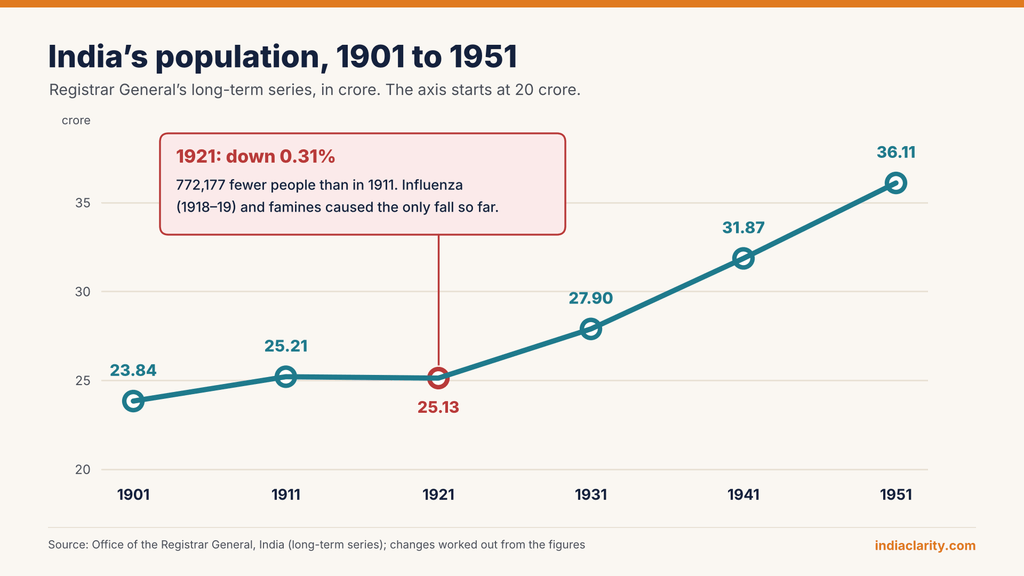
| Census year | People counted | Change from previous census |
|---|---|---|
| 1901 | 238,396,327 | – |
| 1911 | 252,093,390 | +13,697,063 (+5.75%) |
| 1921 | 251,321,213 | –772,177 (–0.31%) |
| 1931 | 278,977,238 | +27,656,025 (+11.00%) |
| 1941 | 318,660,580 | +39,683,342 (+14.22%) |
| 1951 | 361,088,090 | +42,427,510 (+13.31%) |
These figures come from the Registrar General’s long-term series, so they will not match the totals in the 1881 report, which covered a different area. The percentage changes are worked out from the figures in the table.
The other slip was 1941. The Second World War cut that census short, and very little of its data was ever published.
After independence: the Act, the office and 1951
India’s own legal framework for the census came a year after independence. The Census Act was passed on 3 September 1948. Under it the Central Government can order a census when it thinks one is needed, appoint a Census Commissioner, and direct census officers to ask the questions it notifies. The 1951 census was the first to be taken under the Act and the first after independence and Partition. Jammu and Kashmir could not be counted in 1951, and its figures were filled in by interpolation.
Then came the office. Until the 1951 census a temporary census organisation was set up for each count and then wound up. According to the Registrar General’s own account, the government decided in May 1949 to build a standing organisation for population statistics inside the Home Ministry, headed by a Registrar General who is also the Census Commissioner. You will find other dates online. Some pages say 1954 and others say 1961. The Registrar General’s account points to 1949.
R. A. Gopalaswami, as Registrar General and Census Commissioner, led the 1951 count. It found about 36.1 crore people (361,088,090), up 13.3 per cent from 1941, and only about 18 per cent of them could read. Two habits from that census have stayed. One is the post-enumeration check, where a sample of households is revisited to estimate how many people were missed or counted twice. The other is the district census handbook with village-level figures, according to demographer K. S. Natarajan’s 1998 review of post-independence censuses.
Is the census held every 10 years, and is it compulsory?
No law says ten years. Section 3 of the Census Act lets the Central Government announce a census whenever it considers one necessary or desirable, so the ten-year schedule is a habit built since 1881 and not a legal requirement. The PIB history of the census calls it decennial since 1881 and then notes the one exception, the census due in 2021 that could not go ahead on schedule because of Covid-19. By the time Census 2027 is carried out, 16 years will have passed since 2011.
The gap matters because only the census reaches every household and gives numbers down to the village and the ward. Sample surveys cannot do that. Census population figures also feed into things like the drawing of constituencies and the formula for sharing money between the Centre and the states.
Answering is compulsory. Under Section 8(2) of the Act, every person who is asked a census question is legally bound to answer to the best of their knowledge or belief. There is one carve-out: nobody has to state the name of a female member of the household, and a woman does not have to give her husband’s name. Giving a false answer or refusing to answer can bring a fine of up to ₹1,000 under Section 11. Self-enumeration online is optional, but answering the enumerator is not.
The Act also protects what people say. Under Section 15, census records cannot be inspected by the public, and entries in them are not admissible as evidence in civil proceedings or in criminal ones (other than a prosecution under the Act itself). PIB adds that personal information cannot be released under the RTI Act.
The Act gives the district a big job as well. A District Magistrate can order landowners, members of panchayats and municipal bodies, and the staff of factories and firms to help with the count. That is one reason the district office is so busy in a census year, a theme covered in our post on how a district works, and the local panchayat officials are often the first people an enumerator meets.
Census 2027: where things stand on 9 November 2026
According to PIB, Census 2027 is the 16th census in the series and the 8th since independence. The government’s intention to hold it was notified in the Gazette on 16 June 2025, and the Union Cabinet approved ₹11,718.24 crore for it. It is the first digital census. Enumerators use mobile apps on Android and iOS in 16 languages, about 31 lakh enumerators and supervisors are involved, and officers can follow progress on a portal in near real time.
The first phase, houselisting, ran from 1 April to 30 September 2026. Each state and Union Territory picked its own 30-day window, and for the first time households could fill in details online during the 15 days before the enumerator’s visit. Within about ten days of the first state windows opening, more than 5.7 lakh households had already used self-enumeration, according to All India Radio. The 33 houselisting questions were notified in January 2026. They cover the house itself, including the material of floor, wall and roof and the number of rooms, plus whether the household has a TV, internet access, a phone or a vehicle, and which cereal it mainly eats.
The second phase is the population enumeration, which counts each person. The schedule below comes from the notification of 30 October 2026, as reported by PTI.
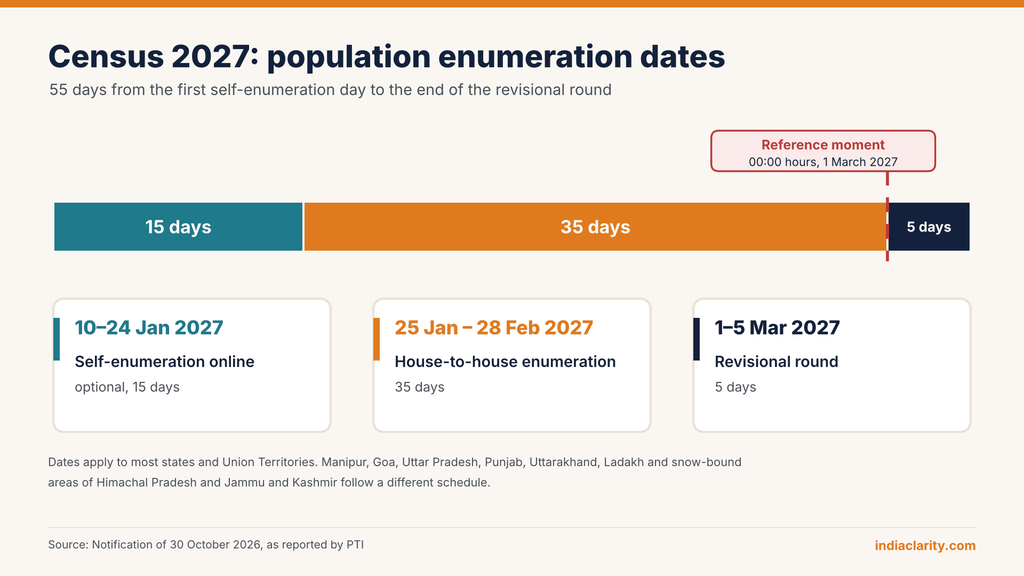
| Step | Date |
|---|---|
| Self-enumeration online (optional) | 10–24 January 2027 |
| House-to-house enumeration | 25 January – 28 February 2027 |
| Revisional round | 1–5 March 2027 |
| Reference moment (the cut-off for who is counted) | 00:00 hours on 1 March 2027 |
Some states have a different schedule. The notification excludes Manipur (until further declaration), Goa, Uttar Pradesh, Punjab, Uttarakhand, Ladakh and the snow-bound parts of Himachal Pradesh and Jammu and Kashmir. PTI notes that assembly elections are due in Uttar Pradesh, Uttarakhand, Punjab, Goa and Manipur early next year. The snow-bound areas were planned for an earlier count with a reference date of 1 October 2026. If you have seen 9–28 February 2027 mentioned somewhere, that was the earlier plan.
How long will the 2027 census last?
For most of India, the house-to-house enumeration window is 35 days. From the first day of self-enumeration to the last day of the revisional round it is 55 days, a little under eight weeks.
What will people be asked?
ANI reported on 14 August 2026 that 40 questions were notified for the population enumeration. They cover name, relationship to the head of the household, sex, date of birth and age, marital status and age at marriage, nationality, religion, caste, parents’ details, disability, mother tongue and other languages known, literacy and digital literacy, education, work, migration and, for women in specified categories, fertility. The list also includes the place of Covid-19 vaccination, the number of bank accounts, a mobile number, Aadhaar number, voter ID number, passport number for passport holders, and whether the person has a driving licence. Check the official notification for the exact wording, since ANI’s report is a summary.
The last census, in 2011, counted 1.21 billion people, made up of 62.32 crore men and 58.75 crore women living in 24.95 crore households.
Each decade fixed something the previous one had exposed. A single night in 1881 fixed the problem of people moving between counts. Fixed categories followed in the 1890s. A standing office came after independence, a check on missed households came in 1951, and now the enumerator carries a phone. The basic arrangement has not changed since the first counts: the state asks, people answer, and the numbers decide where roads, schools and seats go.
Last updated: 9 November 2026. Census 2027 dates and rules can change, so check the Registrar General’s website for the latest notices.
Sources
- PIB backgrounder: Census 2027, India’s first digital enumeration exercise
- Census 1872 memorandum, ORGI Digital Library
- Report on the Census of British India taken on 17 February 1881 (People’s Archive of Rural India)
- Census organisation and list of commissioners, Registrar General of India
- The Census Act, 1948 (full text)
- Census in British India (Wikipedia), for the commissioners’ reports and historians’ studies cited above
- Orissa Review, December 2010
- The Tribune (PTI): Population census from January 25 to February 28, 2027
- ANI: Census 2027, Centre notifies 40 questions
- All India Radio: Government notifies questions for the first phase of Census

Hi, I’m Aryan, the writer behind IndiaClarity. I write plain-language explainers on how India’s systems work, from district administration to the power grid. Before I publish, I check facts against primary sources such as Parliament answers, regulator documents and Acts of law, and I list them at the end of each article. If you spot a mistake, write to me at [contact@indiaclarity.com] and I will fix it.