
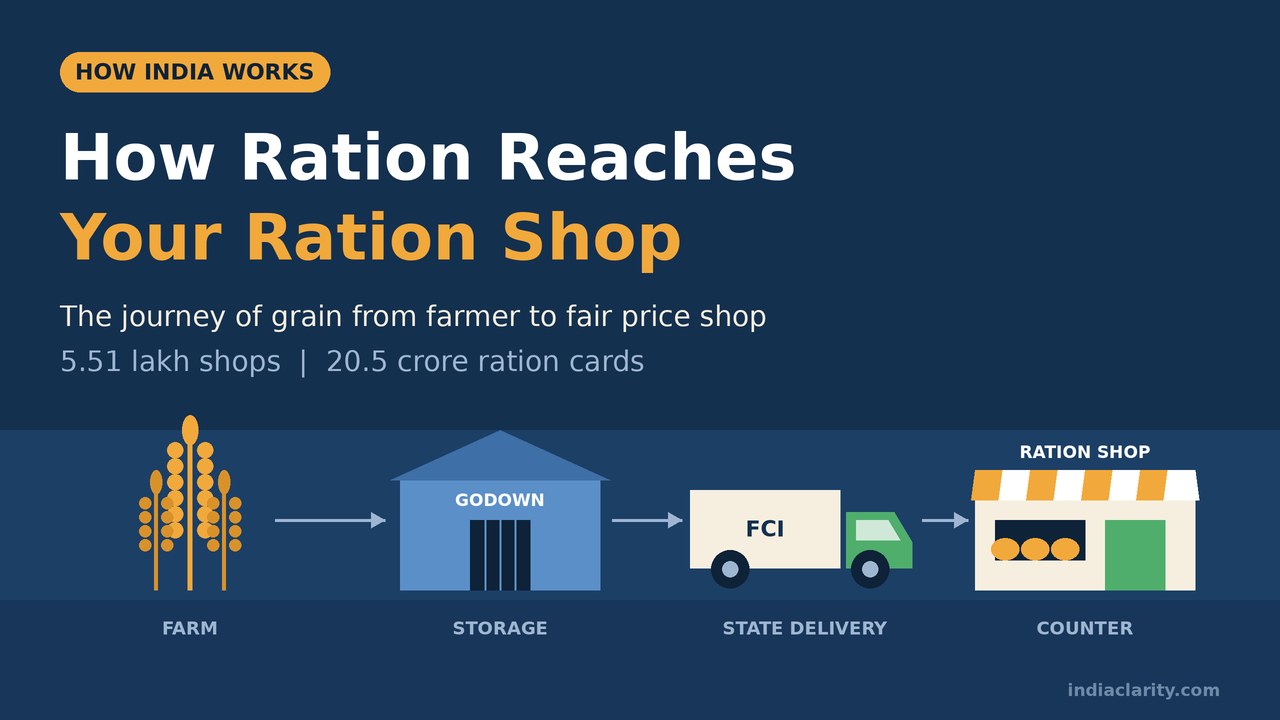
India has about 5.51 lakh fair price shops. Spread across roughly 20.5 crore ration cards, that is a little under 400 cards for each shop (my own division of the two official figures). Every month each of those shops hands out grain that was bought from a farmer, stored, moved by rail or road, and then moved again before it reached the counter.
People usually come to this topic with one of two questions. Some want to know who owns the ration shop and what the dealer earns. Others want to know where the grain actually comes from. Both questions lead to the same place, a chain with about six links, and most pages explain only one link or describe the scheme in the abstract. This article follows the grain from the farm gate to the person holding the card, using the Food Department’s own figures, Parliament replies, a gazette notification and audit reports. Where a number is my own arithmetic and not something the government published, I say so.
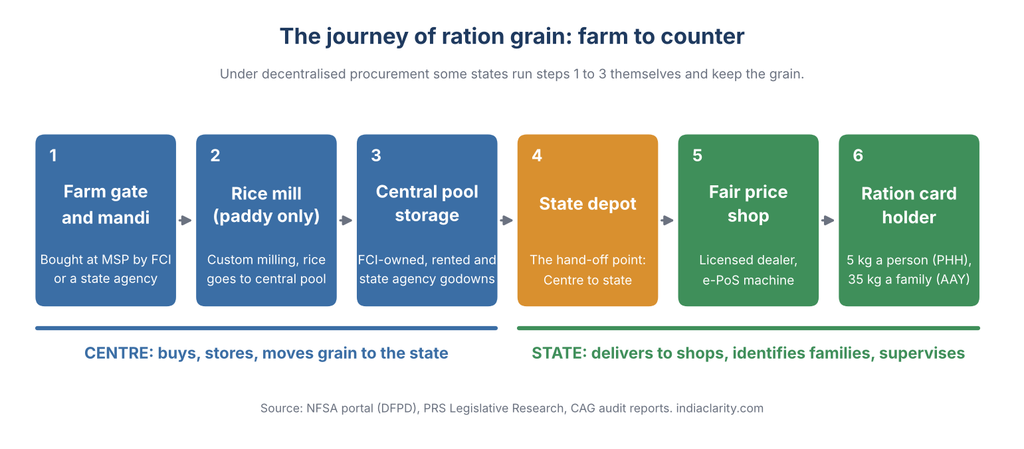
The short version. The Centre, mainly through the Food Corporation of India (FCI) and state agencies, buys wheat and rice from farmers at the minimum support price, stores it, and moves it to a depot in each state. From that depot the state government takes over. It sends the grain to every fair price shop, where a licensed dealer gives it out against ration cards on an e-PoS machine. Since January 2023 the family pays nothing for it.
Figures are the latest I could verify as of 24 November 2026, and each is dated in the text.
Who does what, and where the hand-off happens
The National Food Security Act splits the work between the Centre and the states, and the split explains a lot about how the system behaves. The Centre buys, stores, transports and allocates grain to the states in bulk. Everything after that, such as deciding which families qualify, issuing ration cards, delivering within the state and supervising the shops, is the state’s job.
| Job | Who handles it |
|---|---|
| Buying wheat and rice from farmers at MSP | FCI, and state agencies buying for the central pool |
| Storing the central pool | FCI (own and rented godowns) and state agencies |
| Moving grain between states | FCI |
| Identifying eligible families, issuing cards | State government |
| Delivering grain from the state depot to each shop | State government, with part of the cost reimbursed by the Centre |
| Licensing and supervising shops | State government |
| Deciding what the dealer is actually paid | State government (the Centre only sets a norm for the assistance it gives) |
This is also why the Act asks for grievance officers at the district level and a food commission in each state. The people who run the last stretch are the state’s, so that is where complaints are meant to be heard.
Stop 1: The farm gate
The chain starts with the minimum support price. For wheat and paddy the government is a buyer that does not close the doors. FCI and the state agencies buy what farmers bring at MSP, a policy the Food Department calls open-ended procurement. In 2024-25 the central pool took in about 266 lakh tonnes of wheat and 559 lakh tonnes of rice (counted as rice), which is roughly 825 lakh tonnes together by my sum.
Rice has an extra step that wheat does not. Farmers sell paddy, not rice. The agency that buys the paddy gives it to rice millers under the state’s custom milling policy. The miller mills it at a government-fixed rate and delivers the rice to the central pool. Audits have looked at this step closely, because the miller is holding government-owned paddy for a while. Audits by the Comptroller and Auditor General (CAG) have looked closely at delivery by millers for exactly that reason.
Not every state sends its grain into the central pool and takes it back. Under decentralised procurement, a state buys, stores and distributes grain itself for its own ration needs. It sends any surplus to the central pool, and FCI covers any shortfall. As of December 2025, 17 states ran this system for paddy and seven for wheat, and these states accounted for about 65% of procurement in 2024-25.
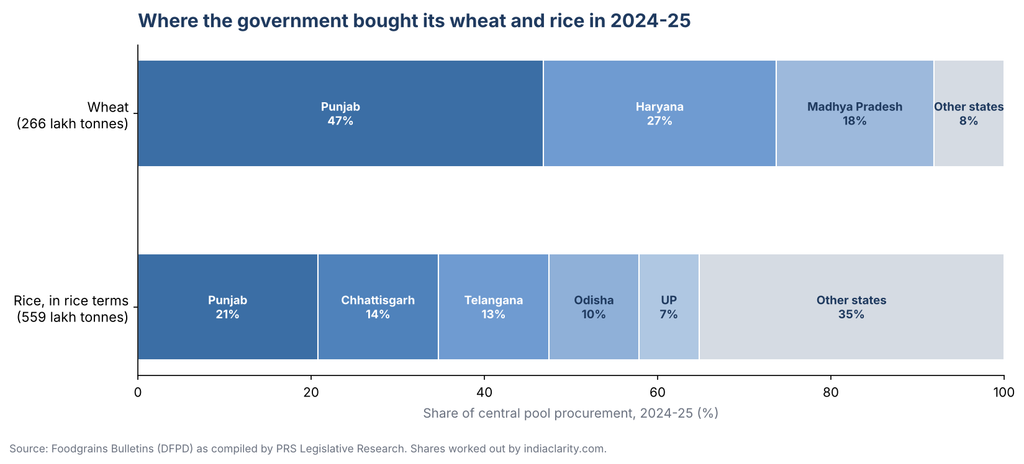
The concentration is the part most people do not expect. Punjab, Haryana and Madhya Pradesh supplied more than nine of every ten kilos of the wheat bought in 2024-25. Punjab, Chhattisgarh, Telangana, Odisha and Uttar Pradesh together supplied about 65% of the rice. Ration cards exist in every district of the country, so distance is built into the system from the first step.
Stop 2: The central pool and its godowns
Bought grain does not go straight back out. It sits in what the Food Department calls the central pool. At the end of 2025, FCI owned storage space for 154 lakh tonnes and rented another 327 lakh tonnes. Rented space is therefore about two-thirds of the capacity FCI works with. State agencies hold a further 449 lakh tonnes in their own godowns.
A buffer is deliberate, since the pool has to cover the monthly ration release, emergencies and market intervention. But on 1 January 2026 the wheat stock was about double the buffer norm and the rice stock about four times it. An earlier CAG audit found the same pattern in the years from 2017-18 to 2022-23, with average stock nearly twice what was needed. Because the government buys whatever is offered at MSP, stocks can run ahead of need, and the carrying cost lands in the food subsidy.
Building space has not kept pace. For the five years to 2021-22, CAG found that FCI built about 20 lakh tonnes of storage against a target of 110 lakh tonnes, and only about 12 lakh tonnes of steel silos against a target of 100 lakh tonnes.
Stop 3: By rail and road to the state depot
Once a state’s allocation is fixed, FCI has to get that grain to the state’s depots, usually from a surplus state to a deficit one. This is the longest leg, and the audits show where it leaks. CAG estimated that transit losses over the five years to 2021-22 came to ₹1,652 crore, from causes such as pilferage, short loading and spillage on rail and road.
The same audit pointed at something I found interesting. Grain often goes from the railhead into an FCI godown and then out again to the state, so it is handled twice. CAG calculated that if even a tenth of Jharkhand’s grain had been issued straight from the railhead, about ₹159 crore could have been saved over five years. It also noted that there were no formal guidelines for such direct issue.
The government’s answer to part of this problem is a planning tool called Anna Chakra, built by the World Food Programme and IIT Delhi and launched in December 2024. It works out the cheapest routes between warehouses and shops. It covers about 4.37 lakh shops and 6,700 warehouses, and by August 2025 it had been adopted in 30 of 31 states and UTs. The department estimates savings of about ₹250 crore a year. The Food Secretary has cited Bihar, where distances fell by 19%, and Mizoram, where distances fell by 50%. These are the department’s own estimates, not an independent evaluation.
Stop 4: From the state depot to the shop
This is where the state takes over, and where the Centre hands part of the bill back. The state works out how much grain each shop needs from the number of cards attached to it. The online allocation system produces the monthly order up to shop level. The Act expects doorstep delivery, which means the state brings the grain to the shop and the dealer does not collect it from the godown. How that delivery is organised differs from state to state.
The Centre shares the cost. Under the rules notified on 1 July 2026, with effect from 1 April 2026, the norm for central assistance towards moving and handling grain within a state is ₹70 a quintal for general category states and ₹105 for special category states. The Centre’s share is 50% for the first group and 75% for the second. Seventy rupees a quintal is 70 paise a kilo. The department’s backgrounder also lists vehicle location tracking, branded SAKSHAM, as part of the computerised supply chain.
Stop 5: The shop and the person behind the counter
Who runs it. A fair price shop is a licensed outlet. The licence holder can be a private individual or firm, a co-operative society, a self-help group federation or a government body, and the mix differs by state. I could not find a current national breakdown, so I will not quote one. The National Food Security Act asks states to give preference to panchayats, self-help groups and co-operatives when licensing shops, and to encourage management by women or their collectives.
What happens at the counter. The family’s card is checked, the member’s fingerprint is verified on an e-PoS machine, the sale is recorded, and the grain is weighed out. About 5.50 lakh of the 5.51 lakh shops now use e-PoS. In December 2025, 97.9% of transactions were authenticated with Aadhaar. Authentication needs a working connection, and PRS’s summary of the department’s modernisation work notes that connectivity problems linger, even though the machines have an offline mode. If you wonder why a ration card gets linked to a 12-digit number at all, I have written about what an Aadhaar number actually means.
What the dealer earns. This is the most searched question, and the answer is mostly in the gazette. The Centre does not pay dealers. It reimburses a part of what states pay them, using a norm per quintal. Until March 2026 that norm for general category states was ₹90 a quintal as the basic margin plus ₹21 for sales made through e-PoS, a total of ₹111. In May 2026 the Cabinet revised the norm, and the 1 July 2026 notification fixes it at ₹100 plus ₹11, from 1 April 2026. For special category states it moved from ₹180 plus ₹26 to ₹195 plus ₹11.
Look at the sums together. The basic margin went up by ₹10 a quintal, which is the 10 paise a kilo that the news reports described. The e-PoS add-on came down by ₹10 a quintal. For general category states the two components together were ₹111 before and ₹111 after, and for special category states ₹206 before and ₹206 after. On paper, then, the combined central norm did not change. States fix what dealers are actually paid, and can pay more than the norm. The dealers’ federation called the revision grossly inadequate, pointing to the running costs a shop carries.
Here is a rough picture of what that means. The Food Department’s 2025-26 allocation under the Act is about 554 lakh tonnes a year. Divided by 12 months and by 5.51 lakh shops, an average shop handles roughly 84 quintals a month. At ₹111 a quintal that is about ₹9,300 a month at the central norm, before rent, a helper, transport from the depot and electricity. This is my own estimate from averages. Real shops range from tiny to very large, and states pay different rates.
Some dealers are being asked to earn from more than grain. In August 2024 the Food Department started a pilot called Jan Poshan Kendra in 60 shops, which sell extra nutritious items alongside ration, with a plan for 50,000 over five years. I could not find a current count of converted shops.
Stop 6: The family at the counter
Two kinds of ration card carry the entitlement. A Priority Household (PHH) card gives 5 kg of grain per person per month. An Antyodaya Anna Yojana (AAY) card, for the poorest families, gives 35 kg per household per month. In January 2026 there were about 2.3 crore AAY households and 18.3 crore PHH households. The grain is free. The government decided in November 2023 to provide free grain to about 81.35 crore people for five years from 1 January 2024, at an estimated cost of ₹11.80 lakh crore.
A family of four on a PHH card is entitled to 20 kg a month. What they get is mostly rice. Of the 554 lakh tonnes allocated for 2025-26, about 65% is rice, 33% is wheat and under 2% is coarse grain. Much of the rice is now fortified, and the programme has Cabinet approval until December 2028. FSSAI has also run lab tests to answer the rumours about “plastic rice”.
Can you take it from any shop? Yes, under One Nation One Ration Card (ONORC), now live in all 36 states and UTs. The latest official figures say about 3.27 crore portability transactions happen every month, and more than 233 crore since launch. But the pattern is more local than the slogan suggests. In December 2025, only about 0.5% of e-PoS transactions were inter-state, while about 18% were people using a different shop within their own state. The Mera Ration app lets a cardholder see entitlements and past transactions and find nearby shops.
Who is counted. The ceiling is set by the 2011 Census. The Act covers 67% of the population as counted then, which gives the national figure of 81.35 crore, and states had identified about 80.6 crore people by August 2025. The Food Department has said that coverage will be reopened only after the next Census, so the list is effectively frozen. If you are curious about the counting exercise itself, I covered how the first Census of India was held in an earlier piece.
Where the money goes
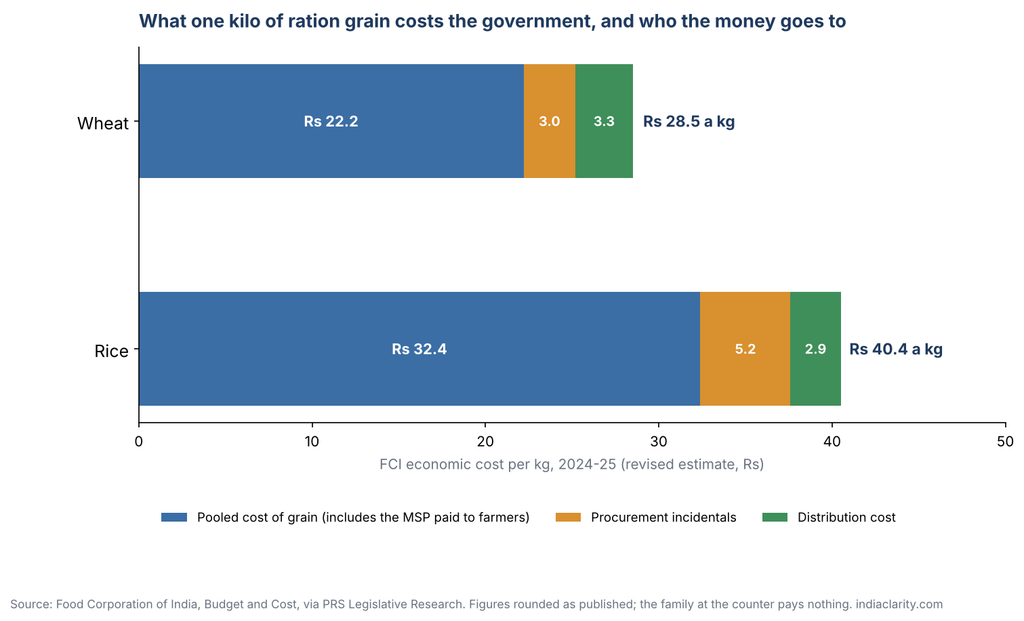
The family pays nothing, but the grain is not free to the country. FCI publishes what it costs to acquire and deliver each kilo, which it calls the economic cost. For 2024-25 the revised estimate is ₹28.5 a kilo for wheat and ₹40.4 a kilo for rice.
| Per kg, 2024-25 | Wheat | Rice |
|---|---|---|
| Pooled cost of grain (includes MSP paid to farmers) | ₹22.2 (78%) | ₹32.4 (80%) |
| Procurement incidentals | ₹3.0 | ₹5.2 |
| Distribution cost | ₹3.3 | ₹2.9 |
| Economic cost as published | ₹28.5 | ₹40.4 |
Components are rounded as published, so the rice column adds to ₹40.5. The distribution cost covers FCI’s side only, not what the state spends from depot to shop.
Take the family of four from earlier. Their 20 kg of rice cost FCI about ₹808 to acquire and deliver to the state, using the ₹40.4 figure (my arithmetic). They carried it home for free. Across the country, the 2026-27 budget sets aside ₹2,27,429 crore for PMGKAY, which is about 97% of the whole Food Department’s allocation.
How much actually reaches people
This is the question with the least agreement. Estimates of leakage, meaning grain that was issued but did not reach a beneficiary, have fallen sharply over the years. Estimates based on Commission for Agricultural Costs and Prices data put it at about 54% in 2004-05 and 40% in 2009-10. The research institute ICRIER put it at 47% in 2011-12 and about 28% in 2022-23. The Food Department has disputed the 2022-23 number in Parliament. Because each study uses a different method, treat the trend as a direction and not as a precise series.
A related idea has been tried more than once, which is to replace grain with cash. Direct cash transfers were introduced in three Union Territories from 2015. A pilot in one block of Ranchi was withdrawn after a social audit found that nearly all the beneficiaries preferred grain. It is one reason grain is still handed out at a shop counter and has not moved into a bank account.
Quick answers
Who owns a ration shop?
Whoever holds the state’s licence. It may be a private dealer, a co-operative, a self-help group federation or a government body, depending on the state, and the Act asks states to prefer panchayats, SHGs and co-operatives.
Can I get ration from any shop?
Yes, with ONORC, but most such transactions happen inside the same state, and your entitlement stays the same wherever you collect it.
How much does a ration shop owner earn?
The state decides. The central norm for general category states is ₹111 a quintal, and my estimate for an average shop works out to about ₹9,300 a month before costs.
Where do I complain if the grain is short?
All states and UTs run online grievance systems and toll-free helplines according to the Food Department, and the Act provides for district grievance officers and state food commissions.
Sources and how I checked
I used official and primary sources wherever one existed. Tonnage, stock, storage, cost and ONORC figures come from the Food Department’s bulletins and press releases as compiled by PRS Legislative Research and the Press Information Bureau. Margin norms come from the Gazette notification G.S.R. 544(E) of 1 July 2026. Audit findings come from reports of the Comptroller and Auditor General. News reports were used only for reactions, such as the dealers’ federation. My own calculations are marked as such in the text. Figures can change as the Food Department updates its data, so check the linked sources if you need today’s number.
- National Food Security Act portal, Department of Food and Public Distribution: nfsa.gov.in/portal/PDS_page
- PIB, One Nation One Ration Card backgrounder (November 2026): pib.gov.in, PRID 2335306
- PIB, Cabinet approves SARTHAK-PDS (27 May 2026): pib.gov.in, PRID 2265788
- Gazette of India, G.S.R. 544(E), 1 July 2026: egazette.gov.in
- PIB, Free foodgrains for 81.35 crore beneficiaries for five years: pib.gov.in, PRID 1980689
- PRS Legislative Research, Demand for Grants 2026-27 analysis, Food and Public Distribution: prsindia.org
- PRS Legislative Research, TPDS thematic note (2013, historical context): prsindia.org
- The National Food Security Act, 2013, section 12: indiacode.nic.in
- CAG, Performance Audit on Procurement and Milling of Paddy for the Central Pool (2015): cag.gov.in
- Business Today, dealers’ reaction to the commission revision (27 May 2026): businesstoday.in
- Business Standard, Anna Chakra launch (December 2024): business-standard.com
Last updated: 25 November 2026.

Hi, I’m Aryan, the writer behind IndiaClarity. I write plain-language explainers on how India’s systems, places and history work. Before I publish, I check facts against primary sources such as official records, Parliament answers, Census data and Acts of law, and I list the sources at the end of each article. If you spot a mistake, write to me at 7brewusaofficial@gmail.com and I will fix it.