

Take any note out of your wallet and find the string of letters and digits printed in its number panel. Most of us have never read it properly. Three stories travel around it. One says a note with a star in the number is fake. Another says that if two notes carry the same number, one of them must be forged. A third says the right serial number can turn a ₹10 note into thousands of rupees.
Each story has something real inside it, and each one goes wrong at some point. Below I go through the number panel one piece at a time. Wherever RBI has said something officially, I use that. Where only collectors have written about it, I say so, because those sources sometimes disagree with each other.
The short version. The number panel holds a three-character prefix, a six-digit serial number, usually a single inset letter, and sometimes a star. Together they tell one note apart from another. They do not prove a note is genuine. A star marks a replacement for a badly printed note, and RBI says such a note is as valid as any other. Two genuine notes can share a serial number. Whatever extra value a “fancy” number carries exists only in the collectors’ market, not in RBI’s books.
The parts of a number panel
A note carries its number twice. RBI’s December 2016 release on the ₹500 note, for instance, speaks of “both the number panels”. Start reading from the left.
The first three characters are the prefix. RBI’s FAQ says only that a prefix is made of numerals and letters. The exact layouts come from collector catalogues of Mahatma Gandhi series notes, which describe two. On ₹10 and ₹20 notes the prefix is two digits followed by a letter. On ₹50 and above it is one digit followed by two letters. Listings on a collector marketplace show both layouts in the newer notes, for example a ₹20 note numbered 46K 000089 and a ₹200 note numbered 0AA 000048.
After the prefix come six digits, the serial number. If the note carries a star, it sits in the space between the prefix and the serial number.
Then there is the inset letter, a single capital letter printed in the number panel. That is how the FAQ defines it, and it adds that some notes have no inset letter at all.
The year of printing is not in the number panel. It is on the back of the note, and only on notes issued after the Mahatma Gandhi Series-2005 was introduced. Older notes do not have it. One more detail from that FAQ: since 2015 the numerals in both panels grow in size from left to right, while the three prefix characters stay the same size.

Why six digits were never going to be enough
Six digits give about ten lakh serial numbers, counting up from 000001. India prints far more notes than that, so the system needs a way to start over, and the prefix does that job.
Using the two layouts above, a ₹10 or ₹20 prefix has 100 possible digit pairs and roughly 20 usable letters, which makes about 2,000 prefixes. At ten lakh serials each, that is around 200 crore notes. For ₹50 and above, ten digits times 20 letters times 20 letters gives 4,000 prefixes, or about 400 crore notes. Mintage World, a collector site, arrives at the same totals. RBI publishes no such figure, so read these as estimates worked out from the layout collectors document.
Once a run is used up, the number space has to be reused somehow. Collector sources say this is where the inset letter comes in: instead of beginning a brand-new series, the same series continues with a different letter, which gives the notes a separate identity. The year of printing and the Governor’s signature add two more ways to tell batches apart.
That also explains a line in the FAQ. Two notes can carry the same serial number, provided the inset letter, the year of printing or the Governor’s signature is different. So meeting a number you have seen before says nothing about a note being forged.
The inset letter, and the printing press it may point to
RBI says its notes are printed at four presses: Nashik and Dewas, which sit under the Security Printing and Minting Corporation of India, and Mysuru and Salboni, which belong to RBI’s own subsidiary, BRBNMPL.
Collector sources add that each of the four presses was given its own set of inset letters, so the letter can hint at where a note was printed. They disagree on when that began. Mintage World says 1996, while the Numismatics Club says the practice was reworked in 2005. They also disagree on the first inset ever used. Mintage World and one collector blog place it on a ₹1 note of 1945, whereas the Numismatics Club points to a note of 1940.
The bigger problem is the letter-to-press list itself. RBI has not published it. The Indian Banknote blog, a widely cited collector source, gave one list in 2010 and a different one in 2012, with the letters for Nashik and Salboni swapped. The Numismatics Club matches the 2012 version. The 2010 post itself admits there was no official notification behind its list.
So if a website tells you with full confidence which press printed your note, treat it as working knowledge among hobbyists. What is certain is only what RBI says: the inset is a letter in the number panel, and some notes have none.
The star: a printing fix, not a warning sign
RBI’s statement of 27 July 2023 puts it plainly. The star is inserted in the number panel of a note that replaces a defectively printed note in a packet of 100 serially numbered notes. Apart from the star between prefix and serial number, the note is identical to any other legal banknote.
The reason for the system goes back to 2006. Before that, a damaged note in a packet was replaced at the printing press with a good note carrying the same number, so the sequence stayed intact. RBI’s 2006 release says this took extra time and cost and needed manual handling. It adopted the star system to match international practice and to make the presses more efficient.
At the start, packets of fresh notes were numbered 1 to 100, and the star notes went at the bottom of the packet. The bands on such packets announced that they held star notes. By the time the ₹500 star note arrived, RBI described packets as holding 100 pieces “not in serial order”.
That connects to a separate change. The FAQ says non-sequential numbering was introduced in 2011, and packets numbered that way hold 100 notes that are not consecutive. Anyone hoping to get a run of consecutive serial numbers from a bank counter should know that nothing in RBI’s description promises one.
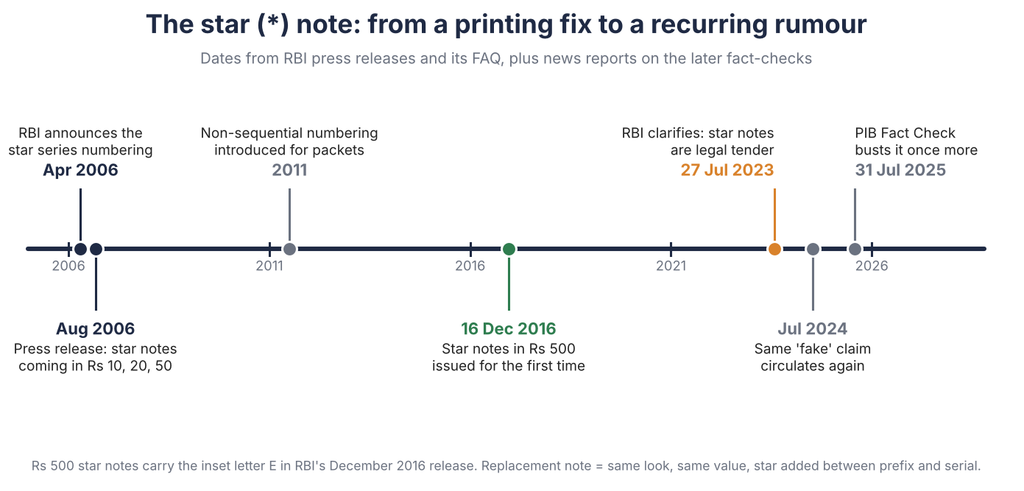
As for which notes got stars first: the 2006 release named ₹10, ₹20 and ₹50. RBI’s December 2016 release says star notes in ₹10, ₹20, ₹50 and ₹100 were already in circulation and that ₹500 star notes were being issued for the first time, with inset letter E. RBI’s FAQ and press releases give no figure for how many star notes are in circulation.
Why the “fake star note” message keeps coming back
In July 2023 a forwarded message claimed that ₹500 notes with a star were fake. RBI answered on 27 July with the clarification above, and fact-checkers such as BOOM and The Quint covered it that week. The same claim was doing the rounds again in July 2024, when PIB Fact Check called it false, and PIB Fact Check posted about it once more on 31 July 2025.
The answer was already public in December 2016, when RBI’s release said all ₹500 notes in the Mahatma Gandhi (New) Series issued from 8 November 2016 would remain legal tender. A likely reason the rumour returns is that a ₹500 star note is not seen every day, so someone meeting one for the first time has nothing to compare it with, and a forwarded photo fills the gap.
If you see the message again, two places settle it faster than any forward: the RBI press release of 27 July 2023, and question 9 in section B of RBI’s FAQ on Indian currency.
Can a serial number tell you whether a note is real?
No. RBI says a forged note is identified by the security features a genuine note carries, which can be checked by seeing, touching and tilting it. Its FAQ does not mention checking a serial number against anything. A number can be printed on any paper. Reproducing the security features is the hard part.
Three features RBI lists are the security thread, the watermark and the see-through register. On the ₹200, ₹500 and ₹2000 notes the large numeral is printed in colour-shifting ink, which looks green when the note is held flat and blue when it is tilted. RBI opened a dedicated microsite for banknotes on 10 September 2025 at indiancurrency.rbi.org.in, which replaced the older Paisa Bolta Hai site.
| Part of the panel | What it can tell you | What it cannot tell you |
|---|---|---|
| Prefix and serial number | Which note it is within a print run | Whether the note is genuine |
| Inset letter | Which series the note belongs to | The printing press, officially (RBI has not published it) |
| Star | The note replaced a defectively printed one | That it is fake, or that it is rare |
| Year on the back | When the note was printed (MG Series-2005 onwards) | Whether the note is genuine |
Fancy and “lucky” numbers
Collectors have names for the patterns they hunt. The table lists the common ones with made-up examples.
| Pattern | Example serial | What makes it fancy |
|---|---|---|
| Solid | 777777 | All six digits are the same |
| Ladder | 123456 | Digits climb or fall in order |
| Radar | 123321 | Reads the same in both directions |
| Repeater | 456456 | The same three digits twice |
| First serial | 000001 | First note of a prefix run |
| Date | 150847 | Spells a date, here 15 August 1947 |
| 786 | Any serial containing or ending in 786 | A number with a religious association, explained below |
Serial numbers restart at 000001 for every prefix, so a 000001 note is not one of a kind across India. There is one for each prefix run.
On 786: in the Abjad system, where each Arabic letter has a numeric value, the letters of “Bismillah ir-Rahman ir-Rahim” add up to 786. Many South Asian Muslims use the number as a written short form of that phrase, which is why it is treasured on documents and invitations, and among collectors on banknotes. It has no bearing on the note’s legal value.
What RBI says about value
Every banknote in circulation is legal tender for the amount printed on it, and a fancy number does not change that. RBI also says it does not deal in the buying or selling of old banknotes and coins. A press release of 4 August 2021 goes further, warning that some people are fraudulently using RBI’s name and logo to collect charges, commission or tax in such deals. RBI says it does not take part in them and never asks for such charges.
What the market shows
One dealer’s price guide, published by The Banknote Society in February 2026, lists ranges from about ₹100 for semi-fancy notes to ₹5 lakh or more for the rarest. It cites no completed sales, and the site sells notes itself. On 20 November 2026, the fancy-number category on the Sikkaji marketplace showed 1,036 listings. Of those, 966 were priced below ₹10,000, and 993 came from a single seller. An older-series ₹10 note with the serial 999999 was listed at ₹5,500, while a ₹200 note numbered 0AA 000039 was listed at ₹399.
Those are asking prices. The listing pages do not show what such notes actually sell for, so there is no reliable “market rate” to quote. If a buyer starts by asking for a registration fee, an “RBI tax” or a commission, that is not an RBI process, going by RBI’s own 2021 statement. None of this is advice to buy or sell.
Checking the note in your hand
- Find a number panel and read the prefix and serial number together.
- Look for a single letter in the panel. If there is none, that is allowed.
- Check the gap between prefix and serial for a star. If it is there, the note is valid.
- Turn the note over and look for a year of printing. Notes older than the 2005 series will not have one. RBI has decided to withdraw those older notes: banks can still take them as deposits into an account, but exchange for other notes is offered only at specified RBI offices.
- Judge whether the note is genuine from its security features, never from its number.
Smaller questions that come up
What if my note has no inset letter?
RBI’s FAQ says there can be notes without one, so its absence is not a red flag.
Can a bank refuse a star note?
It should not, because RBI treats a star note as legal tender like any other. For problems with a bank over exchange of notes, RBI’s FAQ says to complain to the bank first and, if the complaint is not answered in 30 days or you are unhappy with the reply, approach the RBI Ombudsman through cms.rbi.org.in.
Does a missing serial number reduce a damaged note’s refund?
Under RBI’s note refund rules, the presence or absence of a serial number is not a deciding factor when a damaged note is assessed for value.
Read Also: LPG Cylinder Code Explained: What A-26, B-25 or D-27 on Your Cylinder Really Means
How PIN Codes Work in India: What Each of the 6 Digits Means
Sources
- RBI, FAQs on Indian Currency (version updated 15 April 2025): rbi.org.in/commonman/english/scripts/FAQs.aspx?Id=3158
- RBI press release, “Issue of Star Series Banknotes”, 31 August 2006 (2006-2007/307): rbi.org.in/commonman/english/scripts/PressReleases.aspx?Id=249
- RBI press release, ₹500 banknotes with inset letter E and star, 16 December 2016 (2016-2017/1549): rbi.org.in/commonman/english/scripts/PressReleases.aspx?Id=2015
- RBI press release, “Reserve Bank of India clarifies on Star Series Banknotes”, 27 July 2023 (2023-2024/653): rbi.org.in/scripts/BS_PressReleaseDisplay.aspx?prid=56103
- RBI press release on fictitious offers for buying and selling old banknotes and coins, 4 August 2021 (2021-2022/634): rbi.org.in/Scripts/BS_PressReleaseDisplay.aspx?prid=51999
- RBI banknote microsite (launched 10 September 2025): indiancurrency.rbi.org.in
- Mintage World, “Inset Letters on Banknotes” (2021): mintageworld.com/media/detail/13951-inset-letters-on-banknotes
- Mintage World, “Note Numbering System”: mintageworld.com/knowledge-base/note-numbering-system
- Indian Banknote blog, “Prefix, Inset and Serial Number Syntax” (2010): indianbanknote.blogspot.com/2010/03/prefix-inset-and-serial-number-syntax.html
- Indian Banknote blog, “Inset As An Alphabet On Indian Banknotes” (2012): indianbanknote.blogspot.com/2012/02/inset-as-alphabet-on-indian-banknotes.html
- Numismatics Club, “Inset Information”: numismaticsclub.com, Independent India Paper Money, Inset Information
- The Quint (WebQoof), fact-check on ₹500 star notes, 28 July 2023: thequint.com/news/webqoof/rbi-indian-currency-500-rupee-fake-notes-star-series-fact-check
- India TV News, fact-check on ₹500 star notes, 12 July 2024: indiatvnews.com, fact-check on ₹500 note with star sign
- LatestLY, PIB Fact Check on star-marked ₹500 notes, 1 August 2025: latestly.com, star-marked ₹500 notes fact-check
- The Banknote Society, “Fancy Number Notes India: Complete Guide” (11 February 2026): thebanknotesocietyshop.com, fancy number notes guide
- Sikkaji, Fancy Number Notes category (listings and counts as seen on 20 November 2026): sikkaji.com/paper-money/fancy-number-notes
- Wikipedia, “Basmala” (Abjad value of the phrase): en.wikipedia.org/wiki/Basmala

Hi, I’m Aryan, the writer behind IndiaClarity. I write plain-language explainers on how India’s systems, places and history work. Before I publish, I check facts against primary sources such as official records, Parliament answers, Census data and Acts of law, and I list the sources at the end of each article. If you spot a mistake, write to me at 7brewusaofficial@gmail.com and I will fix it.